
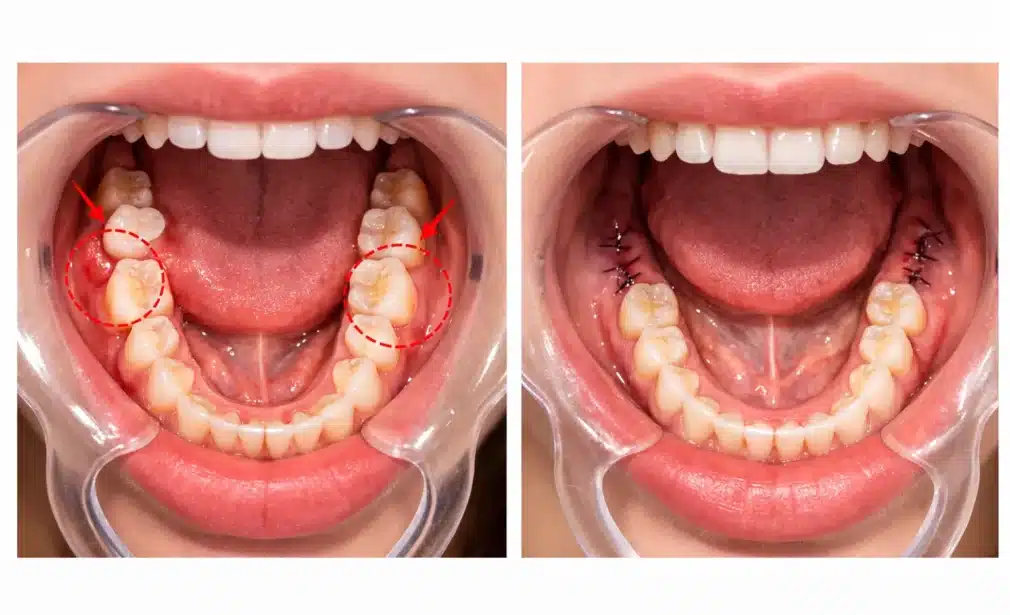
After wisdom teeth removal, you can expect minor bleeding, swelling, and soreness that typically peak around day three before improving steadily. Most patients feel close to normal within 3 to 7 days, and soft-tissue healing is largely finished by 7 to 10 days. The single most important job during that window is protecting the blood clot that forms in each socket, because that clot is what shields the bone and nerves underneath while new tissue grows in. Below we walk through the recovery timeline day by day, the habits that protect the clot and the ones that threaten it, what to eat and when, how to clean your mouth safely, when you can drive, work, and exercise again, and the signs that deserve a phone call rather than a wait.
What Should You Expect After Wisdom Teeth Removal?
After wisdom teeth removal you should expect bleeding that slows within the first hour, swelling that builds for two to three days, jaw stiffness, and soreness that responds to cold packs and the pain relief your dentist recommends. Recovery follows a predictable arc, and knowing the shape of that arc is what keeps normal healing from feeling like something has gone wrong.
Wisdom teeth are third molars, the last teeth to arrive, usually between the late teens and mid twenties. They sit at the very back of the jaw where space is tight, which is why they so often come in at an angle or stay trapped under gum or bone. Removing them is one of the most common procedures in dentistry. An analysis published in the American Journal of Public Health estimated that about 10 million third molars are removed from roughly 5 million people in the United States each year.
Dr. Yu has performed thousands of extractions over the past 20 years, and most of them happen right here in our office under local anesthesia. A tooth extraction starts with a comprehensive exam and X-ray review, moves through comfort measures and the removal itself, and ends with gauze placement and the aftercare guidelines that carry you through the next week. That final step is the one you take home, and it does more for your recovery than anything else in the appointment. Aftercare belongs to the same preventive mindset that runs through all of our general dentistry work.
What Happens in the First 24 Hours?
In the first 24 hours a blood clot forms in each empty socket, bleeding slows, and swelling begins to build. Everything you do on day one should protect that clot, because a clot lost on the first day sets recovery back further than anything that happens later in the week.
Here is the sequence for the first day:
- Bite down on the gauze with steady, gentle pressure for 30 to 60 minutes so the clot can form. Replace it if it soaks through.
- Wait for the numbness to wear off completely before eating anything, so you do not bite your cheek, lip, or tongue without feeling it.
- Apply a cold pack to the outside of your cheek, 20 minutes on and 20 minutes off, for the rest of the day.
- Rest with your head propped above your heart. Lying flat lets blood pool in the head and increases both swelling and throbbing.
- Eat cool, soft foods once the numbness is gone and chew far away from the extraction sites.
- Skip rinsing, spitting, and straws entirely on day one. Gentle warm salt water rinses start the following day.
Some oozing and a pink tinge to your saliva is normal on the first day and even into the second. Steady bleeding that does not slow with 30 minutes of firm gauze pressure is different, and that one is worth a call.
What Does the Wisdom Teeth Recovery Timeline Look Like Day by Day?
The wisdom teeth recovery timeline runs from clot formation on day one, through peak swelling around day two or three, to noticeably easier days by the end of the first week and closed gum tissue by weeks three and four. Two separate clocks are running the whole time: the gum tissue closes within a few weeks, and the bone underneath keeps rebuilding for months after you have stopped thinking about it.
The stages below reflect the pattern reported across clinical studies of third molar surgery, including research on trismus timing published in oral surgery journals and prevalence data from prospective studies of third molar extraction. Your own pace depends on your age, your general health, and whether the teeth were impacted.
| Stage | What is happening | What helps most |
|---|---|---|
| Day 1 | The blood clot forms. Light bleeding and oozing are normal. | Gauze pressure, cold packs, head elevated, no rinsing |
| Days 2 to 3 | Swelling and jaw stiffness peak. Soreness is at its highest. | Cold packs, gentle salt water rinses, soft foods, rest |
| Days 4 to 7 | Swelling comes down and pain eases noticeably each day. | Warm compresses, soft solids, light activity |
| Days 7 to 10 | Most soft-tissue healing is complete. Dissolving stitches disappear. | Normal routine, careful chewing away from the sites |
| Weeks 2 to 4 | Gum tissue closes over the sockets and the openings fill in. | Regular brushing and flossing to the back of the arch |
| Months 3 to 6 | Bone continues remodeling beneath the closed gum tissue. | Nothing. You will not feel this stage at all. |
Impaction changes the pace. A tooth that had broken through the gum comes out more simply than one still buried in bone, and the buried ones ask for a few more days of healing. That is a reflection of how much rebuilding your body has to do, not a sign that anything went wrong.
What Is the Worst Day After Wisdom Teeth Removal?
The worst day after wisdom teeth removal is usually day two or day three, when swelling and jaw stiffness reach their peak. Feeling worse on day three than you did on day one is the expected pattern, not a setback.
Inflammation explains the timing. Your body responds to surgical trauma by flooding the area with fluid and healing cells, and that response builds over roughly 48 to 72 hours before it starts to resolve. A clinical study measuring trismus after lower third molar removal found that jaw stiffness, like swelling, typically reaches its peak on the second day and clears by the end of the first week. Research predicting swelling and stiffness from pre-operative factors found that longer operating time and tooth sectioning were both associated with more of both, which is why a complicated extraction produces a bigger day-three than a simple one.
The direction of travel matters more than the intensity. Swelling and soreness that improve a little each day after day three are healing on schedule. Pain that gets worse after day three is a different signal, and we cover that further down.
How Long Does Swelling Last After Wisdom Teeth Removal?
Swelling after wisdom teeth removal lasts about a week, peaking on day two or three and then shrinking steadily through days four to seven. Cold packs do the most good during the first 48 hours, and after that switching to gentle warm compresses helps the remaining swelling clear faster.
Cold works by narrowing blood vessels and limiting how much fluid collects in the tissue, which is why the 20 minutes on and 20 minutes off pattern matters during the build-up phase. Warmth works the opposite way, opening circulation to carry away fluid that has already gathered. Using them in the wrong order is one of the most common recovery mistakes, and switching at the 48-hour mark solves it.
What Are You Not Allowed to Do After Wisdom Teeth Removal?
After wisdom teeth removal you are not allowed to use straws, smoke or vape, spit forcefully, rinse vigorously, drink alcohol, or eat hard and crunchy foods during the first several days. Every item on that list threatens the blood clot, and the clot is the only thing standing between healing bone and the outside world.
These are the restrictions that matter most in the first 72 hours:
- No straws. The suction created by drawing liquid up a straw can pull the clot straight out of the socket.
- No smoking, vaping, or nicotine pouches. Suction, heat, and the chemicals themselves all work against clot stability.
- No forceful spitting or vigorous rinsing. Both create the same negative pressure a straw does.
- No poking at the site. Tongues and fingers dislodge clots and introduce bacteria.
- No hard, crunchy, or seedy foods. Chips, nuts, popcorn kernels, and seeds lodge in open sockets.
- No alcohol or carbonated drinks. Both irritate the healing tissue while the clot is still setting.
- No heavy lifting or strenuous exercise. Raised blood pressure restarts bleeding and can dislodge the clot.
Our post on the things to avoid after any extraction covers the same ground for simpler procedures, and the principles carry over directly.
Why Can’t You Use a Straw or Smoke After Wisdom Teeth Removal?
You can’t use a straw or smoke after wisdom teeth removal because both create suction that pulls the blood clot out of the socket, and losing that clot exposes bone and nerve endings to air, food, and temperature. That exposed socket is dry socket, and it produces a deep, throbbing ache that often radiates toward the ear, temple, or jaw.
Three separate mechanisms are at work with tobacco and nicotine, which is why switching from cigarettes to a vape or a pouch does not solve the problem. Suction pulls at the clot mechanically. Heat and smoke irritate the healing tissue directly. Nicotine narrows blood vessels and reduces blood flow to the very site that needs circulation to rebuild.
The data on this is consistent. A systematic review and meta-analysis on smoking and dry socket found that tobacco smokers carried more than three times the odds of developing it, with combined incidence of about 13.2% in smokers compared to 3.8% in non-smokers. A prospective study of 238 third molar patients put the odds ratio for smokers at 6.41. A ten-year retrospective of 3,999 patients at Loma Linda University School of Dentistry found elevated risk among smokers in the 33 to 52 age range. Every one of those figures points the same direction, and a few days without nicotine is the cheapest insurance available in this entire recovery.
Can You Drink Coffee or Carbonated Drinks After Wisdom Teeth Removal?
You can drink coffee after wisdom teeth removal once it has cooled to lukewarm, though carbonated drinks are worth skipping for the first several days. Heat is the problem with coffee and carbonation is the problem with soda, and both act on the clot rather than on the tooth socket itself.
Hot liquids soften a forming clot and can increase bleeding, so temperature matters more than the drink. Carbonation introduces bubbles and pressure directly against the healing site, and most carbonated drinks are acidic on top of that. Water at room temperature is the easiest choice for the first few days, and staying hydrated genuinely helps healing. Whatever you drink, drink it from the glass rather than through a straw.
What Are the Best Foods to Eat After Wisdom Tooth Removal?
The best foods to eat after wisdom tooth removal are soft, cool or lukewarm foods that require little or no chewing, such as yogurt, smoothies eaten with a spoon, mashed potatoes, scrambled eggs, oatmeal, applesauce, and broth-based soups once they have cooled. Stick to soft foods for the first 24 to 48 hours, then add texture back gradually as chewing gets more comfortable.
Nutrition does real work during recovery, so skipping meals because chewing feels awkward works against you. Smoothies and soups carry a lot of protein and calories with almost no effort, which is why they are worth stocking before the appointment rather than after it. Eat smoothies with a spoon every single time, because the straw is the one habit most likely to undo a good recovery.
Avoid anything hard, crunchy, chewy, spicy, or acidic while the sockets are open. Chips, nuts, popcorn, crusty bread, chewy candy, citrus, and tomato-based sauces all either lodge in the sockets or sting the healing tissue. Chew on the opposite side from the extraction sites for as long as that stays comfortable.
When Can You Eat Solid Food Again?
You can start eating soft solids around days three to five and return to a mostly normal diet by days seven to ten. Crunchy foods deserve a full two weeks, because hard fragments are the most reliable way to disturb a socket that has almost finished closing.
Work back up one texture at a time. Pasta, soft rice, tender fish, and well-cooked vegetables come first, then softer breads and ripe fruit, then everything else. Let comfort set the pace rather than the calendar. If something makes a socket sore, drop back to softer food for another day and try again, because there is nothing to gain from rushing this part.
When Can You Brush Your Teeth After Wisdom Teeth Removal?
You can brush your teeth the day after wisdom teeth removal, avoiding the extraction sites themselves for the first few days. Brushing the rest of your mouth normally is not optional during recovery, because a clean mouth heals faster and a plaque-heavy mouth carries measurably more risk.
That risk is not a guess. A prospective study of 238 third molar extraction patients measured poor oral hygiene as the single strongest predictor of dry socket in the group, with an odds ratio of 9.53, higher even than smoking in the same cohort. Bacteria left to build up around a healing socket interfere with the clot and slow tissue repair.
Use a soft-bristled brush and clean every tooth except the ones immediately beside the sockets. From day two onward, rinse gently with warm salt water several times a day, especially after eating, letting the water fall out of your mouth rather than spitting it. Once your dentist says the sites are ready, an irrigation syringe used exactly as directed clears trapped food without disturbing anything. The rest of your oral hygiene routine can continue as usual throughout.
Can You Floss After Wisdom Teeth Removal?
You can floss after wisdom teeth removal, as long as you stay away from the extraction sites for the first week. Flossing the rest of your teeth keeps bacteria levels down across the whole mouth, which supports healing at the sockets even though the floss never goes near them.
Start flossing the teeth immediately next to the sockets once the tenderness has clearly settled, usually somewhere around the end of the first week, and be gentle when you do. Work from the front of the mouth backward so you are not reaching blindly into a sore area.
How Should You Sleep After Wisdom Teeth Removal?
You should sleep with your head elevated above your heart for the first two to three nights after wisdom teeth removal, propped on an extra pillow or two, and preferably on your back. Elevation reduces the amount of fluid that collects in your face overnight, which is why people who sleep flat wake up visibly more swollen.
Sleeping on the side of an extraction puts direct pressure on healing tissue and lets saliva and blood pool against the socket. Back sleeping avoids both. Placing an old towel over your pillow for the first night saves the pillowcase, since some oozing overnight is normal. Most patients can return to their usual sleeping position once swelling is clearly heading down, typically by the fourth night.
When Can You Work Out After Wisdom Teeth Removal?
You can return to light activity like walking after two to three days and to full workouts, running, and weight training after about a week. Strenuous exercise raises blood pressure, and raised blood pressure restarts bleeding and can push the clot out of a socket that was healing perfectly well.
Heavy lifting is the riskiest category because of the strain and breath-holding involved, so it is the last thing to come back. Walking is the safest early activity and actually helps circulation without raising pressure much. Ease in rather than jumping straight back to your previous load, and if a socket starts throbbing during or after a session, that is your signal to take another day or two.
Can You Drive After Wisdom Teeth Extraction?
You can usually drive yourself after a wisdom teeth extraction performed with local anesthesia only. If you choose sedation, arrange for someone else to drive you home and stay with you afterward.
Local anesthesia numbs the area without affecting alertness, judgment, or reaction time, so most patients drive themselves to and from our office. Sedation is different, because its effects linger for hours after the appointment ends. We tell you in advance which applies to your procedure so you can plan the ride rather than sorting it out in the waiting room.
Can You Fly After Wisdom Teeth Removal?
You can fly after wisdom teeth removal, though waiting at least 48 to 72 hours is the safer plan, and a week is better for longer trips. Cabin pressure changes can increase discomfort at a fresh extraction site, and being in the air puts distance between you and help if bleeding restarts.
Timing matters more than the flight itself. Flying on day one or two means traveling during the swelling peak with limited access to cold packs, soft food, and your dentist. Flying at the end of the first week, once swelling is clearly down and the sockets are settling, is far more comfortable. Let us know about travel plans before your appointment so we can schedule around them.
How Long Do You Have to Be Careful After Wisdom Teeth Removal?
You have to be careful for about a week after wisdom teeth removal, with the strictest rules applying to the first 72 hours. The first three days protect the clot, the rest of the first week protects the new tissue forming over it, and by weeks three and four the gum has closed over the sockets entirely.
Restrictions come off in stages rather than all at once. Straws, smoking, forceful rinsing, and strenuous exercise stay off the table for the first 72 hours at minimum. Soft foods run through days three to five. Crunchy foods and anything with small seeds wait a full two weeks. Careful cleaning right at the sockets continues until the tenderness is gone. Following that sequence is the whole of good extraction aftercare, and it is why most recoveries pass without incident.
How Likely Is Dry Socket on Day 4?
Dry socket is most likely to appear between days two and five, which puts day four squarely inside the highest-risk window. Dry socket occurs in roughly 3% to 4% of routine extractions overall, with meaningfully higher rates reported for impacted lower wisdom teeth.
A ten-year retrospective of 3,999 patients at Loma Linda University School of Dentistry found alveolar osteitis, the clinical name for dry socket, in 5.1% of lower third molar extractions. Reviews of dry socket etiology report figures reaching as high as 30% in some series of impacted lower third molars, which reflects how much the position of the tooth changes the picture. The same research consistently names the modifiable risk factors as smoking, poor oral hygiene, surgical difficulty, and a history of pericoronitis.
The self-check is straightforward. Normal healing gets a little better each day after day three. Dry socket announces itself as pain that was improving and then suddenly spikes, often with an ache spreading toward the ear and sometimes a bad taste that brushing will not fix. It is quick to treat and relief usually comes fast once we see you, so there is no reason to tough it out.
How Much Time Do You Need Off Work After Wisdom Teeth Removal?
Most patients need one to three days off work after wisdom teeth removal, with three to five days commonly recommended for more involved cases. Most of our patients resume light activity the next day, and if the extraction was complex or involved impacted teeth, planning for one to two days of rest makes the week much easier.
Physical demands drive the difference. Desk work is manageable for many patients by day two or three, while jobs involving heavy lifting, long shifts on your feet, or safety-sensitive tasks call for more recovery time. Scheduling the procedure for a Thursday or Friday is the simplest trick available, since it puts the day-three peak over the weekend.
Our Southwest Houston office keeps evening and Saturday hours for exactly this reason, so an extraction and its follow-up do not have to cost multiple work days. We give every patient personalized guidelines based on how their procedure actually went, and for patients weighing timing across several teeth, our page on wisdom teeth removal covers what the overall process involves.
Can You Go Back to Work 3 Days After Wisdom Teeth Removal?
Yes, most people can go back to work three days after wisdom teeth removal, particularly for desk-based roles. Day three often coincides with peak swelling, so you may look worse than you feel, and jaw stiffness can make talking for long stretches tiring.
Plan the first day back gently. Keep soft food available, avoid long meetings that require constant talking, and skip anything physically demanding. Patients doing manual labor or working in heat usually benefit from waiting until day four or five, when swelling is clearly on the way down and the risk window for dry socket has mostly passed.
What Are Red Flags After Wisdom Teeth Removal?
The red flags after wisdom teeth removal are pain that worsens after day three, bleeding that will not stop with steady gauze pressure, fever above 100.4°F, swelling that keeps growing past day three, pus or a persistent foul taste, and numbness that lasts well beyond the expected recovery. Every one of those is worth a phone call the same day, and every one of them is far easier to handle early than late.
Call our office promptly if you notice any of the following:
- Pain that intensifies after day three instead of easing, especially with an ache spreading toward the ear
- Bleeding that does not slow after 30 minutes of firm, steady gauze pressure
- A fever above 100.4°F at any point during recovery
- Swelling that keeps increasing past the third day rather than shrinking
- Pus, or a bad taste or odor that brushing and rinsing do not clear
- Lasting numbness in the lip, chin, or tongue after the anesthetic should have worn off
- Trouble breathing or swallowing, which calls for urgent attention right away
Post-surgical follow-up visits are not unusual. A study of 546 third molar patients found that 9.2% sought a post-surgical emergency appointment, most often for severe pain. Calling early is the normal, sensible move rather than an overreaction, and our urgent dental care is available for exactly these situations. An infection caught quickly stays small, while one left alone can travel, and our post on the spreading infection warning signs explains what that looks like.
What Should You Know Before Wisdom Teeth Removal?
Before wisdom teeth removal you should know what anesthesia you are having, whether you need a ride home, what soft foods are already in your kitchen, and which day of the week puts the hardest part over your time off. Preparation done the day before removes almost every source of stress from the day after.
A short list covers most of it. Shop for soft food in advance, because you will not feel like grocery shopping afterward. Fill any prescription ahead of time so you are not standing in a pharmacy while the numbness wears off. Tell us about every medication and supplement you take, especially anything affecting bleeding, and about any health changes since your last visit. Arrange the ride if sedation is part of your plan. Our post on what to expect during an extraction walks through the appointment itself in more detail.
Bring your questions to the consultation. The exam and X-ray review that open every extraction visit are also when we explain exactly how your teeth are positioned and what that means for your recovery week.
Knowing why the tooth is coming out helps too. Wisdom teeth that only partly break through the gum leave a flap of tissue that traps food and bacteria, producing a painful inflammation called pericoronitis, which our extraction page names directly as a reason patients come in. That same trapped bacteria contributes to gum disease around the second molar in front of it, and decay in a tooth nobody can reach with a toothbrush. Those are the problems removal prevents.
Why Do People Act Loopy After Wisdom Teeth Removal?
People act loopy after wisdom teeth removal because of sedation, not because of the extraction itself. Patients treated with local anesthesia alone stay fully alert throughout, which is why most of the videos circulating online involve some form of sedation.
Sedative medications affect the parts of the brain handling short-term memory, coordination, and inhibition, which produces the disorientation and unfiltered talking those videos capture. The effect wears off over the following hours, and patients often remember very little of that stretch. Most extractions at our office are done under local anesthesia, meaning you are awake, comfortable, and entirely yourself the whole time. We talk through comfort options at the consultation so nothing about the day is a surprise.
Is Wisdom Teeth Removal Always Necessary?
No, wisdom teeth removal is not always necessary. Wisdom teeth that have fully grown in, sit in a healthy position, cause no pain, and can be cleaned properly can often be monitored rather than removed.
Keeping them does come with a commitment. Third molars sit at the very back of the arch where brushing and flossing are genuinely awkward, and teeth that are hard to clean decay more often than teeth that are easy to clean. Given that the CDC reports 25.9% of adults aged 20 to 44 already have untreated dental caries, a tooth that resists cleaning deserves honest attention. Early detection of impacted or infected wisdom teeth prevents problems, which is why we track them with exams and X-rays rather than waiting for pain to make the decision.
What Dentists Want You to Know About Wisdom Teeth Recovery
What dentists want you to know about wisdom teeth recovery comes down to four things: the clot is the whole game, day three feeling worse is normal, jaw stiffness and bruising are not complications, and calling early costs nothing. Almost every recovery that goes sideways does so because someone either disturbed the clot or waited too long to pick up the phone.
The two healing clocks explain most of the questions we get weeks later. Gum tissue closes over the sockets within three to four weeks, and that is the healing you can see. Underneath, bone keeps remodeling for three to six months, filling in the space where the root used to sit. You will not feel that deeper stage, so mild tightness or an odd sensation a month out is usually the surface tissue finishing rather than a problem developing.
Jaw stiffness surprises people more than anything else on this list. Holding your mouth open for an extended procedure leaves the chewing muscles sore, and that soreness limits how wide you can open for several days. Bruising along the cheek or jawline is equally normal and fades over a week or so. A sore throat from the same muscle strain shows up more often than patients expect. None of those means something has gone wrong, and all of them resolve on the same timeline as the swelling.
One more thing worth saying plainly: the modifiable risk factors are genuinely modifiable. Smoking triples the odds of dry socket, and poor oral hygiene during recovery raises them further still. A few days of clean habits changes your odds more than anything we can do after the fact. That principle carries well past this recovery, which is why we put so much weight on routine checkups once you are healed.
Frequently Asked Questions
Is Bruising Normal After Wisdom Teeth Removal?
Bruising is normal after wisdom teeth removal and usually appears along the cheek or jawline within the first two or three days. The discoloration comes from small amounts of blood settling in the soft tissue and typically fades over about a week, sometimes passing through yellow or green shades as it clears. Bruising that spreads rapidly or comes with growing swelling after day three is worth reporting.
Why Does My Jaw Feel Stiff After Wisdom Teeth Removal?
Your jaw feels stiff after wisdom teeth removal because the chewing muscles were held open during the procedure and have become sore and tight afterward. This limited opening is called trismus, and clinical studies show it typically peaks on the second day and resolves by the end of the first week. Gentle warm compresses and easing your mouth open a little further each day help it clear.
Is a Headache Normal After Wisdom Teeth Removal?
A mild headache is normal after wisdom teeth removal and often comes from jaw muscle tension, dehydration, or a change in eating and sleeping patterns. It usually settles within the first few days as the swelling comes down. A severe headache paired with fever or worsening facial swelling is a different picture and deserves a call to our office.
Does It Hurt to Swallow After Wisdom Teeth Removal?
It can hurt to swallow after wisdom teeth removal, usually because swelling has reached the muscles and tissue near the back of the throat. This is most noticeable on days two and three and eases as the swelling goes down. Difficulty swallowing that worsens, or any trouble breathing, needs urgent attention right away rather than a wait-and-see approach.
Do Teeth Shift After Wisdom Teeth Removal?
Teeth do not shift because of wisdom teeth removal in any meaningful way. Front teeth naturally drift slightly over a lifetime regardless of whether wisdom teeth were ever present, and the evidence linking third molars to crowding is weak. If alignment is your concern, that is an orthodontic conversation rather than an extraction one.
When Can You Shower After Wisdom Teeth Removal?
You can shower the same day after wisdom teeth removal, keeping the water warm rather than hot. Very hot water raises blood pressure and can restart bleeding at a fresh extraction site, so a shorter, cooler shower is the better choice on day one. Normal showering and bathing resume from the second day onward.
Can You Have Wisdom Teeth Removed After 30?
Yes, you can have wisdom teeth removed after 30, and plenty of patients do. Recovery tends to run slightly longer than it does for patients in their late teens, since younger tissue and bone regenerate more quickly. Analysis of extraction records shows the mean patient age at third molar removal sits in the early thirties, so this is a common timeline rather than an unusual one.
The Bottom Line
Recovery after wisdom teeth removal is predictable, and that predictability is the reassuring part. Bleeding slows within the first hour, swelling and stiffness peak on day two or three, the days after that get easier one at a time, soft-tissue healing wraps up by 7 to 10 days, and the gums close over by weeks three and four. Protect the clot during the first 72 hours, keep the rest of your mouth clean, eat soft and cool, sleep with your head up, and let activity come back in stages.
The signs that deserve a call are short and specific: pain that worsens after day three, bleeding that will not stop, fever, growing swelling, or lasting numbness. Calling early about any of them is the right move every time, and we would far rather hear from you on day four than on day ten. Dr. Yu and our Houston team have guided thousands of patients through this exact week. Reach Bright Value Dental at 713-668-1600, or check current appointment times whenever you need us.