
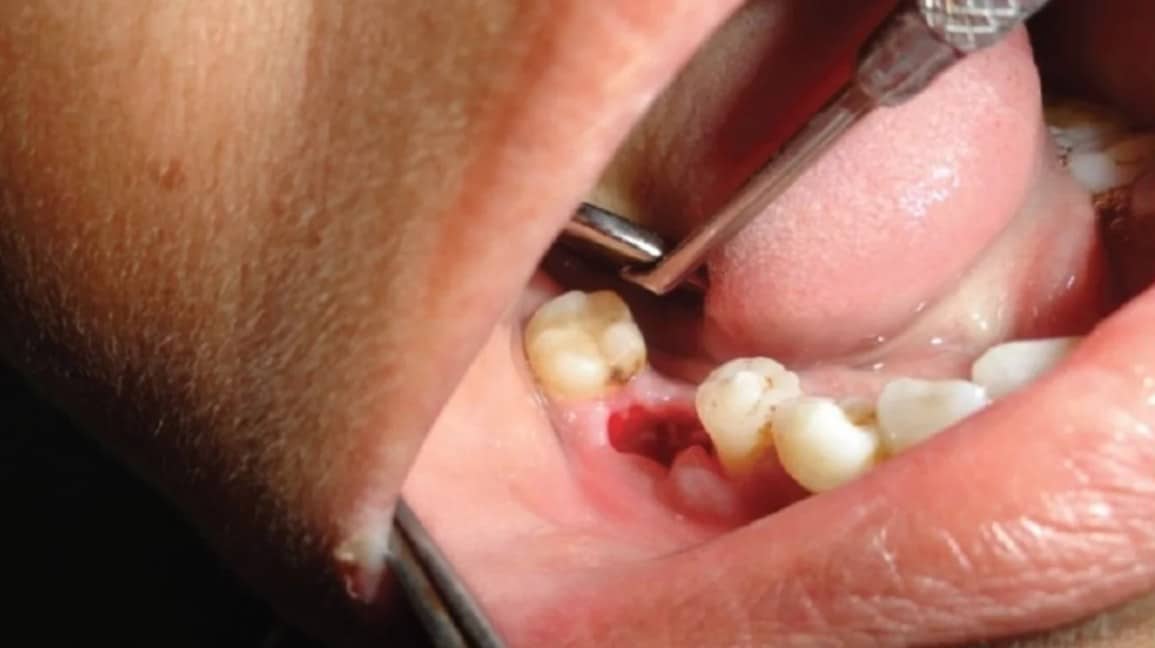
Dry socket wisdom teeth treatment involves professional cleaning of the extraction site and a medicated dressing placed by a dentist, which delivers rapid pain relief. Your dentist flushes the socket with sterile saline or an antibacterial rinse to clear trapped food debris and bacteria, then packs the socket with a medicated paste that covers the exposed bone and nerve endings, and most patients feel the pain drop sharply within 24 to 48 hours. Below we walk through every part of that treatment, what goes into the dressing, how many follow-up visits it takes, what you can do at home alongside it, how to tell a dry socket apart from normal healing, which days carry the real risk, and how the socket finishes healing afterward.
What Are the Treatment Options for Dry Socket After Wisdom Tooth Extraction?
The treatment options for dry socket after wisdom tooth extraction are socket irrigation, a medicated dressing, dressing changes, pain medication, and antibiotics only when infection is present. Socket irrigation clears the debris that collects inside an unprotected socket. The medicated dressing does the heavy lifting on pain by physically covering exposed alveolar bone and nerve endings. Dressing changes keep that coverage in place while the wound rebuilds underneath.
Dry socket, known clinically as alveolar osteitis, develops when the blood clot at the extraction site fails to form, dislodges, or dissolves before the wound has healed. That clot is the biological bandage over your jawbone. Without the clot, bone and nerve sit open to air, food, saliva, and temperature. None of the treatment options rebuild the clot, and that point matters. Treatment substitutes for the clot while your body grows new tissue underneath it.
This is why dry socket is one of the few post-surgical problems where a dental visit changes the experience immediately rather than gradually. Waiting it out is possible, and the condition does resolve on its own, but the difference between treated and untreated is measured in days of severe pain. Anyone who suspects a dry socket after a tooth extraction should be seen promptly rather than pushing through with over-the-counter pain relievers alone.
We see this often in our Houston office, and we keep room in the schedule for it. Dry socket is a same-day problem, not a next-available-appointment problem, which is why our same-day care exists in the first place.
How Do Dentists Treat Dry Socket?
Dentists treat dry socket by numbing the area, irrigating the socket clean, packing it with a medicated dressing, and scheduling follow-up dressing changes until the wound heals. The visit follows a fixed sequence:
- Diagnosis and examination. We examine the socket to confirm the clot is gone and the bone is exposed. An X-ray may be taken to rule out a bone infection or small pieces of tooth root or bone left behind at the site, a step Mayo Clinic identifies as standard practice for ruling out other conditions.
- Local anesthesia. The socket is numbed before anything touches it. Exposed nerve endings are extremely sensitive, and irrigation of an unanesthetized dry socket is not tolerable.
- Socket irrigation. The socket is flushed with sterile saline or 0.2% chlorhexidine to remove food particles, necrotic tissue, and bacterial load. Research indexed by the National Institutes of Health describes debris removal with 0.2% chlorhexidine or saline as the core of dry socket management.
- Medicated dressing placement. A gauze strip or paste carrying a numbing agent is packed gently into the socket so it contacts the exposed bone directly.
- Pain management plan. We advise on which pain relievers to combine and at what interval, and we set the follow-up schedule.
The whole appointment usually takes fifteen to thirty minutes. Patients who have already read what to expect from an extraction often recognize the setup, because the chair time and the anesthesia are similar to the original procedure, without the surgery.
What Is in the Medicated Dressing for Dry Socket?
The medicated dressing for dry socket contains eugenol, a clove oil derivative that numbs exposed nerve endings, usually combined with zinc oxide, iodoform, and a topical anesthetic such as butamben. Eugenol is the active ingredient responsible for the relief patients describe as almost immediate. Clinical literature on alveolar osteitis management, including studies catalogued in the Cochrane Database of Systematic Reviews, identifies eugenol-based sedative dressings as the most widely used intra-socket intervention.
Zinc oxide gives the paste its body so it stays packed in the socket instead of washing out with saliva. Iodoform contributes an antiseptic effect against the bacteria that colonize an open socket. Some commercial formulations add butamben or a similar topical anesthetic for a second layer of numbing on top of the eugenol.
The dressing works by contact, not by absorption into your bloodstream. It sits against the bone and interrupts the pain signal at the source, which is why relief starts so quickly and why it fades if the dressing falls out. A dressing that comes loose is a reason to call, not a reason to wait for the scheduled follow-up.
How Fast Can a Dentist Fix a Dry Socket?
A dentist can fix a dry socket fast enough that most patients feel significant pain relief within one to two hours of the dressing being placed, with severe pain resolving within 24 to 48 hours. Clinical accounts from oral surgery practice consistently report relief beginning during the appointment itself, once the eugenol dressing makes contact with the exposed bone.
Relief within 24 to 48 hours is the treated timeline. An untreated dry socket runs a very different course, typically 7 to 10 days of pain before the body covers the bone on its own. That gap between two days and ten days is the single strongest argument for being seen rather than waiting.
Fast relief does not mean fast healing. The dressing controls pain while the socket heals underneath on its own biological schedule, and that schedule does not speed up. Pain leaving early is a sign the treatment worked, not a sign the wound has closed.
How Many Dressing Changes Will You Need?
Most patients need one to three dressing changes, spaced every 24 to 72 hours, over a total treatment period of three to six days. The number depends on how severe the pain is and how quickly granulation tissue starts filling the socket from the bottom and sides. Mayo Clinic notes that the frequency of dressing changes depends directly on the severity of pain and other symptoms rather than on a fixed protocol.
Each follow-up visit follows the same short pattern. The old dressing comes out, the socket is irrigated again, and either a fresh dressing goes in or the socket is left open once healthy tissue has covered the bone. Once the bone is covered, the dressing has nothing left to do and removing it lets normal healing continue undisturbed.
Keeping those follow-up appointments matters even after the pain is gone. A dressing left in place too long can slow the tissue growth it was protecting, which is why Dr. David Yu checks the socket before deciding whether to repack or leave it open.
Do Antibiotics Treat Dry Socket?
Antibiotics do not treat dry socket itself, and they are prescribed only when a dentist detects signs of a separate bacterial infection such as fever, pus, or spreading swelling. Dry socket is a wound-healing problem, not a bacterial invasion, so an antibiotic has nothing to act against in an uncomplicated case.
Signs of a genuine infection are distinct and worth knowing. A fever above 101 degrees Fahrenheit points toward infection rather than dry socket, according to guidance published by Harvard Health Publishing with review from Dr. Tien Jiang of the Harvard School of Dental Medicine. Pus discharge, swelling that grows instead of shrinking after day three, and swelling that spreads into the cheek or under the jaw all belong to the same category. Those symptoms overlap with a spreading tooth infection, which is a different problem with a different treatment path.
Prescribing antibiotics for every dry socket would expose patients to side effects with no benefit. We reserve them for the cases that genuinely show infection, and we treat the dry socket itself the way it responds best, with irrigation and a dressing.
What Helps Dry Socket Pain at Home?
At home, dry socket pain responds best to over-the-counter ibuprofen combined with acetaminophen, cold compresses on the outside of the cheek, and gentle warm salt water rinses starting after professional treatment. These measures work alongside the dressing, not instead of it.
- Combined pain relievers. Ibuprofen and acetaminophen work through different pathways, so taking them together relieves dental pain more effectively than either alone. Harvard Health Publishing reports that studies have found this combination more effective than prescription opioid medication for this type of pain.
- Cold compresses. An ice pack held against the outside of the cheek for fifteen minutes at a time reduces swelling and dulls the radiating ache that travels toward the ear and neck.
- Gentle salt water rinses. Warm salt water keeps the area clean. Lean over the sink and let the liquid drip out of your mouth rather than spitting, because the forceful pressure of spitting is exactly what dislodges clots.
- Clear fluids and soft foods. Applesauce, yogurt, thin soups, and smoothies eaten with a spoon keep nutrition up without forcing food particles into the socket. Foods that break into small pieces, including rice and seeds, are the ones that lodge.
- No smoking, no straws, no alcohol. Each one either creates suction across the socket or interferes with the tissue growth you are waiting on.
Every one of these measures supports the dressing. None of them replaces it. The full list of habits that put a healing socket at risk lines up closely with the things to avoid in the first days after any extraction.
Does Salt Water Heal a Dry Socket?
Salt water does not heal a dry socket, but it keeps the socket clean and reduces the bacterial load while the wound heals. A warm saline rinse flushes loose food debris out of an open socket and soothes inflamed tissue around the edges. What it cannot do is cover exposed bone or replace the lost blood clot, and coverage is what stops the pain.
Research on warm saline mouth baths, including a systematic review and meta-analysis published in the Journal of Cranio-Maxillofacial Surgery, has examined saline rinsing mainly as a preventive measure rather than as a cure for an established dry socket. The distinction is practical. Rinsing after day one helps protect a healthy socket. Rinsing an existing dry socket makes it cleaner and more comfortable without shortening its course.
Technique decides whether rinsing helps or hurts. Start salt water rinses 24 hours after your procedure, never on the day of surgery, and always let the water fall out of your mouth. Aggressive swishing in the first 48 hours is one of the more common reasons a clot fails, and the same care that protects a clot also protects your daily brushing routine from doing accidental damage during recovery.
Is Dry Socket an Infection?
Dry socket is not an infection. Dry socket is an inflammatory condition caused by exposed alveolar bone after the protective blood clot is lost, and bacteria play a secondary role at most. Naming it correctly changes what you expect from treatment, which is why the distinction is worth pausing on before looking at how the pain actually works.
The clinical name, alveolar osteitis, describes inflammation of the alveolar bone, the ridge of jawbone that holds tooth roots. Inflammation of that bone follows exposure, not bacterial invasion. This is the reason antibiotics do so little for an uncomplicated case and the reason a physical dressing does so much.
Bacteria do contribute at the margins. Food debris collecting in an open socket feeds bacterial growth, and that growth produces the foul taste and bad breath that accompany dry socket. Those symptoms come from debris in an open wound rather than from an infected one, and irrigation removes the cause directly.
Why Does Dry Socket Hurt So Much?
Dry socket hurts so much because exposed alveolar bone and uncovered nerve endings sit in direct contact with air, food, saliva, and temperature changes with nothing between them. Nerve endings inside a healing socket are meant to sit under a clot. Without that layer, every sip of cold water and every breath of air through the mouth reaches raw nerve tissue directly.
Uncovered nerve endings in the lower jaw connect into the inferior alveolar nerve, the large nerve running through the mandible. The inferior alveolar nerve carries sensation from the lower teeth, the chin, and the lower lip, which explains the radiating pain pattern patients describe. Pain from a lower wisdom tooth socket travels along that pathway toward the ear, the eye, and the neck on the same side, a pattern documented consistently across Mayo Clinic and Harvard Health descriptions of the condition.
Location explains the severity too. Dry socket occurs most often in the lower jaw and molar area rather than in the front of the mouth, and lower third molar sockets are the deepest sockets in the mouth, which leaves the largest area of bone uncovered when a clot is lost.
How Painful Is a Dry Socket on a Scale of 1 to 10?
On a scale of 1 to 10, dry socket pain typically rates 7 to 9, described as constant, throbbing, and radiating rather than sharp or intermittent. Clinical descriptions in the oral surgery literature characterize it as severe pain not relieved by standard analgesics, which is one of the diagnostic criteria used to identify the condition in research studies.
Two qualities separate dry socket pain from ordinary post-extraction soreness more reliably than intensity alone. The first is direction of change. Normal extraction pain peaks around day two or three and then improves a little each day. Dry socket pain improves at first and then reverses, getting worse between days three and five when it should be fading. The second is response to medication. Ordinary soreness responds to over-the-counter pain relievers. Dry socket pain barely does.
Pain that wakes you at night, pain that no longer responds to what worked yesterday, and pain that has started traveling toward your ear are the three patterns that should prompt a phone call.
What Are the First Signs of Dry Socket?
The first signs of dry socket are pain that intensifies three to five days after extraction, a socket that looks empty or shows visible whitish bone, a foul taste, and bad breath that does not clear with brushing. The pain reversal is the earliest and most reliable signal, and it usually arrives before anything looks different.
Comparing normal healing against dry socket day by day makes the difference easier to spot at home. The healing stages below follow the socket healing sequence documented in oral surgery histology research, where granulation tissue replaces the clot from the bottom and sides of the socket during the first week.
| Timeframe | Normal healing | Dry socket | What it means |
|---|---|---|---|
| First 24 hours | Dark red blood clot fills the socket; light oozing | Socket looks shallow or empty; little or no clot visible | Clot formation either happened or it did not |
| Days 2 to 3 | Swelling and soreness peak; white fibrin film forms over the clot | Pain begins climbing instead of leveling off; dull ache starts spreading | The highest-risk window for clot loss |
| Days 3 to 5 | Pain and swelling decrease a little each day | Severe throbbing pain radiating to ear, eye, or neck; foul taste; bad breath | Peak onset period for diagnosed dry socket |
| Days 5 to 7 | Pinkish granulation tissue covers the socket; discomfort minimal | Whitish or grayish exposed bone visible; pain unrelieved by pain relievers | Normal sockets are covered by now; dry sockets are not |
| Days 7 to 14 | Gum tissue migrates inward; socket looks shallower daily | Pain resolving if treated; 7 to 10 days of pain if untreated | Both paths converge toward closure |
Reading across that table, the single clearest marker is the direction pain travels after day two. Sockets that hurt a little less every day are healing. Sockets that hurt more on day four than on day two need to be looked at, and that is exactly the kind of call a same-day dentist is set up to handle.
What Does a Dry Socket Look Like?
A dry socket looks like an empty or partially empty hole where the dark red blood clot should be, often with whitish or grayish bone visible at the bottom. The socket appears deeper than the surrounding tissue because nothing is filling it, and the edges of the gum sit unchanged rather than growing inward.
Color causes most of the confusion here. A creamy white or pale yellow film over a socket during days three to seven is granulation tissue, which is healthy new tissue, and patients regularly mistake it for pus or for exposed bone. Granulation tissue is soft, sits level with or above the socket floor, and is covering the hole. Exposed bone is hard, sits at the bottom of a hollow, and has a dull grayish-white appearance closer to bone than to tissue.
Appearance alone is not a reliable home diagnosis, and photographs found online vary enormously in lighting and stage. Pain direction remains the better test. A socket that looks unusual but hurts less each day is almost always healing normally.
Can You Get a Dry Socket If You Have Stitches?
Yes, you can get a dry socket even if you have stitches, because sutures close the gum tissue over the site without sealing the socket underneath. Stitches hold the flap of gum in position so it heals in the right place. They do not hold the blood clot, and the clot can still dissolve or wash out from beneath sutured tissue.
Sutured sites do carry a lower risk than open ones, since closed tissue offers the clot more physical protection and keeps food particles out. That advantage is partial rather than complete. Surgical extractions, which are the ones most likely to need stitches, carry roughly ten times the incidence of non-surgical extractions according to management reviews published in the British Dental Journal, so the added trauma of the surgery offsets much of the protection the sutures provide.
Stitches also change what dry socket feels like. Pain under sutured tissue can present with less visible change to the socket, which means the pain pattern becomes the main diagnostic signal rather than appearance.
What Are the Riskiest Days for Dry Socket?
The riskiest days for dry socket are days 2 through 4 after extraction, with symptoms most frequently reported between the first and third post-extraction days. That window exists because the original blood clot has stabilized but granulation tissue has not yet replaced it, leaving the socket dependent on a clot that is beginning to break down naturally.
Cochrane review literature places symptom onset between the first and third days after surgery, and prospective research on third molar patients found dry socket prevalence at 20.6% by the 48-hour mark in a monitored surgical population. Both findings point at the same narrow window, which is why post-operative instructions concentrate so heavily on the first 72 hours.
The danger zone is also when patients start feeling well enough to relax the rules. Swelling has peaked and begun receding, appetite returns, and the temptation to eat normally or resume smoking arrives right as the socket is most vulnerable. Patients who have their wisdom teeth removed in our office hear this warning specifically, because day three is when compliance drops.
Can You Stop Worrying About Dry Socket After 3 Days?
No, you cannot fully stop worrying about dry socket after 3 days, because day 3 sits at the end of the peak onset window rather than past it. Risk drops meaningfully after day 3, and it does not reach zero. Symptoms most commonly appear between days 1 and 3, which means a socket that is comfortable on day 3 has cleared the highest-probability period but has not cleared the whole window.
Cases diagnosed on days 4 and 5 are common in clinical practice, particularly after difficult lower third molar extractions where the socket is deep and the surgery was traumatic. Prospective data showing prevalence still climbing from 48 hours out to the two-week mark confirms that late-onset cases are real rather than rare exceptions.
Day 3 is the right moment to ease vigilance, not abandon it. Keep avoiding straws, smoking, and forceful spitting through the end of the first week even if everything feels fine.
What Day Are You No Longer at Risk for Dry Socket?
You are effectively no longer at risk for dry socket after day 7, once granulation tissue has covered the exposed bone at the base of the socket. Granulation tissue is the pinkish, blood-vessel-rich tissue that replaces the clot as the wound rebuilds. Once that layer covers the bone, there is no longer a clot whose loss could expose anything.
Socket healing research documents the sequence precisely. Epithelial coverage of the socket begins around day 4, connective tissue gradually replaces granulation tissue within two weeks, and initial calcification at the base of the socket occurs between days 7 and 10. By the time calcification starts, the biological conditions for dry socket no longer exist.
Day 7 is the practical all-clear for most patients. Complex surgical extractions with deep sockets can extend that margin to day 10, and patients who smoke should hold their precautions to the end of the second week because reduced blood flow slows every stage of that sequence.
How Easy Is It to Accidentally Get a Dry Socket?
Getting a dry socket accidentally is uncommon after routine extractions and considerably more likely after lower wisdom tooth surgery, and the numbers separate those two situations sharply. Dry socket occurs in roughly 1% to 5% of routine extractions, with Cochrane review figures placing the range at 0.5% to 7%. For impacted mandibular third molars, reported incidence climbs to as high as 38%.
Behavior shifts those odds substantially. A systematic review of eleven studies indexed on PubMed found dry socket in 13.2% of smokers compared with 3.8% of non-smokers, more than a threefold increase in odds. A prospective study of 238 third molar extractions calculated an odds ratio of 6.41 for smoking, 9.53 for poor oral hygiene, and 3.27 for surgical technique. Oral contraceptive users show 11% incidence against 4% in non-users, according to management reviews in the British Dental Journal, an effect attributed to estrogen’s influence on the fibrinolytic system that breaks down clots.
Age matters as well. Dry socket rarely occurs in patients under 20 and appears most frequently between ages 20 and 40, which happens to be exactly the age band when most people have wisdom teeth removal done. That overlap is part of why the condition is so closely associated with wisdom teeth in the first place.
How Long Does Dry Socket Last Without Treatment?
Without treatment, dry socket lasts 7 to 10 days, because the condition is self-limiting and resolves once granulation tissue grows over the exposed bone. The body finishes the job the clot was supposed to do, just more slowly and with a week of severe pain along the way.
Self-limiting is not the same as harmless. Untreated dry socket carries a risk of delayed healing, and an open socket collecting food debris over a full week raises the chance that a secondary infection develops in tissue that was only inflamed to begin with. Sleep loss, missed work, and difficulty eating compound over that period as well.
Set against 24 to 48 hours of relief after in-office treatment, the arithmetic is not close. The reason to treat a self-limiting condition is that the treated course is a fifth as long.
Does a Dry Socket Ever Fully Heal?
Yes, a dry socket fully heals, and it leaves no permanent damage to the jawbone or surrounding tissue once healing completes. Delayed healing is not failed healing. The socket rebuilds through the same sequence as any extraction site, starting later and finishing on a slightly extended schedule.
Soft tissue closure over an extraction socket takes roughly 3 to 4 weeks in normal healing, with epithelial coverage complete at 4 to 5 weeks according to socket healing histology. A socket that went through dry socket typically adds a week to that timeline because the process restarted after the clot was lost. Bone fill continues underneath for months afterward regardless of whether dry socket occurred.
Once healed, the site is indistinguishable from any other healed extraction site on an X-ray and to the tongue. Having had dry socket once does raise the odds of it happening again at a future extraction, which is a reason to mention it at your next appointment rather than a lasting consequence.
Will a Dry Socket Leave a Hole?
No, a dry socket will not leave a permanent hole, because the socket closes with soft tissue within 3 to 4 weeks and fills with new bone over 3 to 6 months. The hollow you can feel with your tongue during recovery is temporary and gets shallower every week.
Healing works from the bottom up rather than from the top down. Granulation tissue fills the base of the socket first, gum tissue migrates inward from the edges, and bone forms underneath last. Trabecular bone fills roughly two thirds of the socket by 6 weeks, with osteoblast activity peaking between 4 and 6 weeks and complete bone fill reached by around 16 weeks.
A small indentation in the gum ridge can remain where a molar used to sit, which is normal anatomy rather than incomplete healing. Bone that no longer supports a tooth root narrows over time, a change that matters mainly if a replacement tooth is planned. For wisdom teeth, nothing replaces them, so the contour flattens quietly and never needs attention. Routine general dentistry visits catch anything unusual at that site long before it becomes a problem.
How to Protect the Blood Clot After Wisdom Teeth Removal
Protecting the blood clot after wisdom teeth removal comes down to avoiding suction, avoiding smoking, avoiding forceful rinsing, and eating soft foods for the first 72 hours. Every rule on that list traces back to the same mechanism, which is keeping negative pressure and physical disturbance away from a socket that is holding a fragile clot.
Suction is the main threat in the first three days. Drinking through a straw, spitting forcefully, and inhaling on a cigarette all create pressure changes across the socket that lift the clot out. Drooling into a tissue instead of spitting sounds undignified and works far better than the alternative.
Smoking deserves its own line because it carries two separate risks at once. Nicotine constricts blood vessels and reduces blood flow into the healing socket, and the act of inhaling generates the exact suction that dislodges clots. Waiting 72 hours is the minimum after a simple extraction, and lower wisdom tooth sites justify waiting longer. We say the same thing to every Houston patient who leaves our chair after a lower third molar comes out.
Prevention also happens during the procedure itself. Preoperative rinsing with chlorhexidine combined with thorough saline lavage during surgery reduces dry socket incidence by up to 50% according to oral and maxillofacial surgery texts, and a meta-analysis of ten randomized controlled trials covering 862 participants published in BMC Oral Health found that 0.2% chlorhexidine gel placed in the socket prevented 57% of cases overall, rising to 71% in split-mouth trial designs. Careful technique and good preventive care shift the odds before the patient ever goes home.
Patients who have a second wisdom tooth still to come out get the most value from all of this. We go through the protection rules again at the pre-operative appointment for the remaining site, and anyone scheduling an extraction visit with a history of dry socket should say so at booking so we can plan the socket care accordingly.
Frequently Asked Questions
Can Dry Socket Heal on Its Own?
Yes, dry socket can heal on its own, because the condition is self-limiting and resolves once new tissue covers the exposed bone. Healing without treatment takes 7 to 10 days of severe pain compared with 24 to 48 hours after a medicated dressing is placed. The condition resolves either way, so the choice is really about how many days of pain you accept.
What Happens If Dry Socket Goes Untreated?
If dry socket goes untreated, the pain continues for 7 to 10 days and the risk of delayed healing and secondary infection rises. An open socket collects food debris throughout that period, which feeds bacterial growth in already inflamed tissue. Most untreated cases still resolve fully, but the recovery is longer and considerably more painful than a treated one.
Can Dry Socket Come Back After Treatment?
Dry socket can return at the same site if the dressing falls out before granulation tissue has covered the bone, and pain that returns after a dressing loosens is the usual sign. Recurrence after the socket has healed does not happen, since the condition depends on exposed bone that no longer exists. A history of dry socket does raise the risk at future extractions, so mention it before any new procedure.
How Common Is Dry Socket After Wisdom Teeth Removal?
Dry socket after wisdom teeth removal is reported in a wide range, from around 5% up to 38% for impacted lower third molars, compared with 1% to 5% for routine extractions. Lower wisdom teeth account for the high end because their sockets are deepest and their removal is the most surgically traumatic. Smoking pushes the figure higher still, to 13.2% versus 3.8% in non-smokers across pooled study data.
Can You Get Dry Socket After a Simple Tooth Extraction?
Yes, you can get dry socket after a simple tooth extraction, though the odds are far lower than after surgery. Routine extractions carry an incidence of roughly 1% to 5%, and surgical extractions carry approximately ten times that rate. Mandibular molars are the most commonly affected teeth, followed by mandibular premolars.
Does Dry Socket Cause a Fever?
Dry socket can cause a low-grade fever below 101 degrees Fahrenheit, and a temperature above that threshold suggests an infection rather than dry socket alone. Fever is not a typical feature of the condition, since the problem is exposed bone rather than bacterial invasion. A rising temperature alongside pus or spreading swelling calls for prompt evaluation.
The Bottom Line
Dry socket treatment is straightforward once you know what it involves. A dentist numbs the area, flushes the socket clean, and packs it with a eugenol-based medicated dressing that covers the exposed bone, and the severe pain usually drops within 24 to 48 hours instead of dragging on for 7 to 10 days. Combined ibuprofen and acetaminophen, cold compresses, and gentle salt water rinses support that dressing at home. Antibiotics stay on the shelf unless there are real signs of infection.
The window that matters runs from day 2 to day 4, and the clearest warning sign is pain that climbs when it should be fading. Protecting the blood clot through the first 72 hours, with no straws, no smoking, and no forceful spitting, prevents most cases outright. If you are past day 7 and the socket is covered with new tissue, the risk has passed and the site will close on its own over the following weeks.
If the pain after your extraction is getting worse instead of better, we would rather see you today than have you wait it out. At Bright Value Dental we treat dry socket the same day in most cases, and you can call our office any time to get on the schedule.