
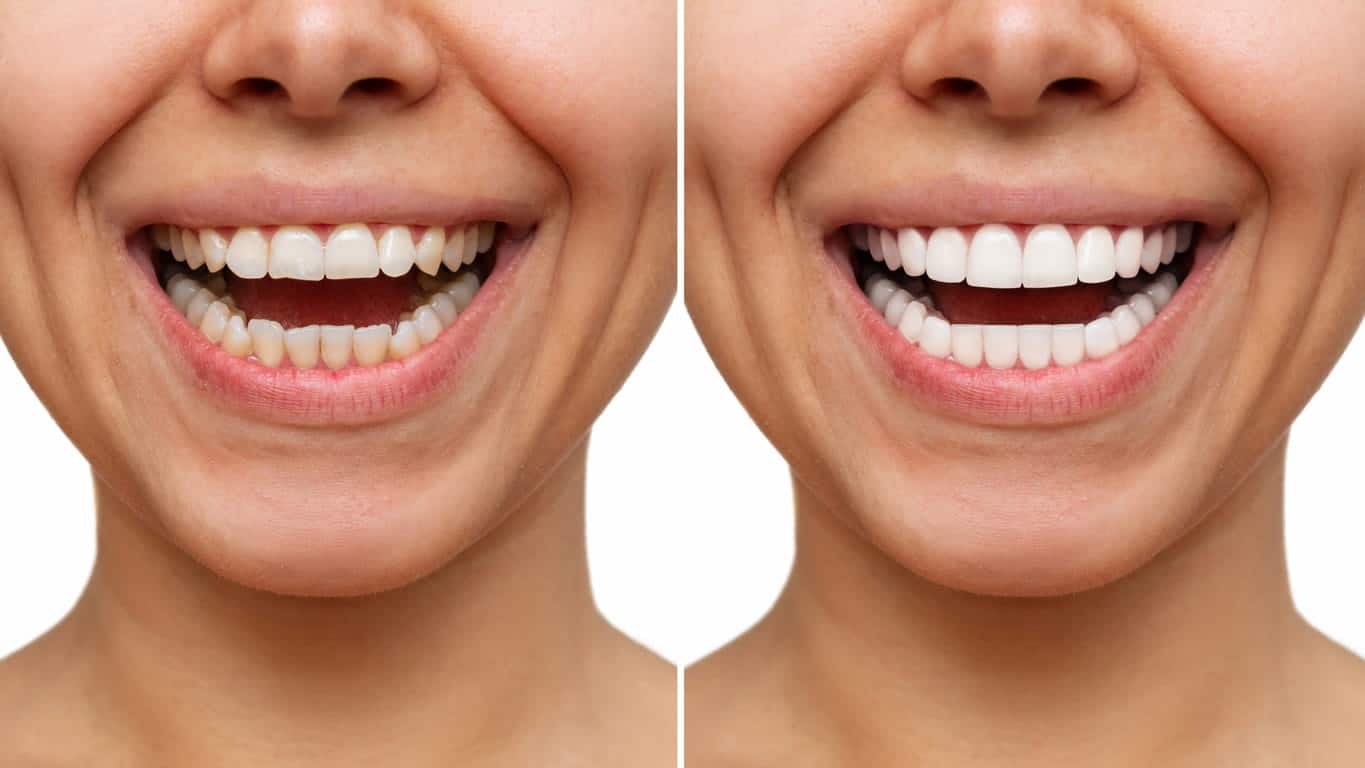
Teeth whitening before and after results range from 2 to 16 shades lighter on a dental shade guide, and where you land in that range depends on the method you use and the kind of stain you started with. Professional whitening performed with high-concentration peroxide gel produces the largest single-visit change, dentist-fitted take-home trays produce a similar result gradually over 7 to 14 days, and store-bought strips and pens typically move color 1 to 2 shades. Below we cover how shades are measured, what each whitening option actually delivers, why some teeth respond better than others, whether whitening is safe for your enamel, and how to protect the result once you have it.
What Do Teeth Whitening Before and After Results Look Like?
Teeth whitening before and after results look like a measurable drop of 2 to 16 shade-guide units, with most patients landing somewhere between 4 and 8 shades lighter. The change shows up first as a loss of yellow cast, then as a more even color across the front teeth, and finally as a smile that photographs differently under the same lighting.
Clinical measurement backs up that range. A comparative study published in Operative Dentistry reported a median change of 4 to 7 shade-guide units across every technique tested, from 10% carbamide peroxide trays to 38% hydrogen peroxide in-office gel. A separate trial in the Journal of Contemporary Dental Practice recorded 4.0 shade-guide units on the VITA Classical guide and 5.0 units on the Bleachedguide after treatment with 10% hydrogen peroxide.
Published before and after case sets from cosmetic practices show the wider tails of that distribution. Documented single-visit outcomes cluster at 4, 6, and 8 shades, with occasional cases reaching 12 and 16 shades where the starting stain was heavy. Heavy coffee and tea stain gives the most dramatic-looking change because there is simply more surface discoloration to remove, and that is the category most of our patients fall into.
How Many Shades Whiter Do Teeth Get?
Teeth get 3 to 8 shades whiter with in-office treatment, 4 to 7 shades whiter with dentist-fitted take-home trays used over 7 to 14 days, and 1 to 2 shades whiter with most store-bought products. The American Dental Association reports the in-office figure at three to eight shades after a 30 to 60 minute application of high-concentration gel.
Take-home trays reach comparable numbers on a slower schedule because contact time substitutes for concentration. A clinical study of 10% carbamide peroxide worn at home recorded a mean color change of ΔE 5.9 after one month, along with improved esthetic self-perception among the participants. ΔE is a spectrophotometer measurement of total color difference, and a value near 6 is well above the threshold where an ordinary observer notices the change.
Store-bought products sit at the bottom of the scale for one reason. Concentration. Whitening rinses, paint-on gels, and toothpastes generally shift color by one or two shades, and whitening rinses often take about three months to get there.
What Is a Tooth Shade Guide?
A tooth shade guide is a physical set of ceramic tabs, arranged from lightest to darkest, that a dentist holds against your teeth to record color before and after treatment. The VITA Classical guide is the most widely used version and carries 16 tabs. Your dentist notes which tab matches your tooth at the start, matches it again at the end, and the difference between the two positions is the number of shades you gained.
Shade-guide units are what make a before and after claim meaningful rather than impressionistic. Without a guide, “much whiter” is an opinion. With a guide, an A3 tooth that finishes at A1 has moved a documented distance on a standardized scale.
One detail matters when comparing results you see online. Different guides have different numbers of tabs and different spacing between them, so eight shades on a bleached-shade guide is not identical to eight shades on the VITA Classical guide. This is part of why published before and after numbers vary so widely between practices, and why we record your starting shade at the consultation rather than working from memory.
How Long Does It Take to See Results After Teeth Whitening?
You see results after teeth whitening immediately with in-office treatment, within 3 to 5 days with dentist-fitted take-home trays, and after 1 to 4 weeks with store-bought strips or gels. In-office gel delivers its full color change during the 30 to 60 minute appointment itself, according to the American Dental Association.
Take-home trays build the change in visible increments. Most patients notice a difference in the mirror by the third or fourth day of wear, and the full result arrives by the end of a 7 to 14 day course. Seeing the progression day by day is one reason tray patients tend to be satisfied with where they finish, since they choose their own stopping point rather than accepting a single-visit outcome.
Store-bought products stretch the timeline furthest. Strips generally require two weeks of daily use, and rinses take roughly three months for a one to two shade improvement.
What Are the Teeth Whitening Treatment Options?
The teeth whitening treatment options are in-office professional whitening, dentist-fitted custom take-home trays, and over-the-counter products. All three use the same active chemistry at different strengths, and the differences between them come down to peroxide concentration, how long the gel stays against the tooth, and who controls the process.
At our Houston practice we provide the custom take-home tray route. We take impressions, have trays molded to fit your teeth precisely, and pair them with professional-grade gel so the material reaches every surface rather than pooling in the middle of the arch. Precise fit is the whole point of a custom tray, because a gel that does not contact the tooth does nothing to the tooth. Our approach to teeth whitening fits patients with mild to moderate staining who would rather brighten gradually on their own schedule.
The table below compares all three routes on the measures that actually predict your outcome. The concentration and shade figures come from American Dental Association guidance and published randomized trials, and the sensitivity figures come from clinical trial data summarized in the Journal of Applied Oral Science.
| Measure | In-office whitening | Dentist-fitted take-home trays | Over-the-counter products |
|---|---|---|---|
| Active concentration | 15% to 43% hydrogen peroxide | 10% to 16% carbamide peroxide | Up to 3.5% hydrogen peroxide |
| Treatment timeline | One 30 to 60 minute visit | Daily wear for 7 to 14 days | Daily use for 2 weeks to 3 months |
| Typical shade change | 3 to 8 shades | 4 to 7 shade-guide units | 1 to 2 shades |
| Sensitivity risk | Roughly 63% absolute risk | Roughly 51% absolute risk | Lower risk, higher gum irritation |
| Coverage of the tooth | Full arch, gums isolated | Full arch, molded to your teeth | Front surfaces only, fit varies |
| Who controls the result | The dentist, in one session | You, guided by your dentist | You, unsupervised |
Reading across those rows, the pattern is consistent. Higher concentration buys speed, longer contact time buys the same result more slowly, and the store-bought category trades both away for convenience. Within that last category the products differ more than the packaging suggests:
- Whitening strips: flexible films coated with peroxide gel, worn 30 minutes daily for about two weeks, covering the front surfaces of the six to eight most visible teeth.
- Whitening pens and brush-on gels: peroxide painted directly onto the enamel, where saliva dilutes and washes it away within minutes. Color change of one to two shades.
- Whitening rinses: low-concentration peroxide held in the mouth for seconds at a time, requiring roughly three months for a one to two shade change.
- Whitening toothpastes: mildly abrasive formulas that lift and prevent surface stain rather than bleaching the tooth. Better than standard toothpaste at stain control, not a bleaching agent.
- Whitening gum and purple-toned correctors: these work on optics or surface film rather than on the chromogens inside the tooth, so any effect disappears as soon as use stops.
- Boil-and-bite tray kits: generic trays that seat loosely, allowing gel to escape onto the gums and leaving the back teeth undertreated.
How Does Teeth Whitening Work?
Teeth whitening works by releasing reactive oxygen molecules from peroxide, which pass through the enamel into the dentin and break apart the colored compounds trapped there. Those colored compounds are called chromogens, and they are what give a stained tooth its yellow or brown cast.
Chromogens sit deeper than most people assume. The American Dental Association describes hydrogen peroxide diffusing through the interprismatic spaces in enamel and reaching the pulp within 15 minutes of exposure, which is why whitening changes the body color of the tooth rather than simply polishing its surface. Carbamide peroxide, the agent used in take-home trays, releases about one third of its content as hydrogen peroxide, so a 15% carbamide gel delivers roughly the same active strength as a 5% hydrogen peroxide gel over a longer period.
Longer exposure at lower strength and shorter exposure at higher strength arrive at similar destinations. That equivalence is the reason a well-fitted tray worn for two weeks competes with a single high-concentration appointment, and it is why Dr. David Yu matches the gel strength and wear schedule to each patient rather than handing out one standard protocol.
What Is the Most Effective Teeth Whitening Option?
The most effective teeth whitening option is professional whitening supervised by a dentist, whether delivered in one in-office session or through custom-fitted take-home trays. Both outperform anything sold over the counter, and the gap is not marginal.
Comparative clinical review found that in-office and at-home professional techniques produce similar effectiveness for up to two years, with the in-office route producing more sensitivity in the early period. So the choice between the two professional routes is a question of speed and comfort rather than of final result. The choice between professional and store-bought is a question of how much color you want to move.
Supervision adds something the numbers do not capture. A dentist examines the teeth first, confirms there is no decay or gum problem that whitening would aggravate, records the starting shade, and protects the gum tissue from contact with the gel. Store-bought products skip every one of those steps.
How Do Dentists Feel About Whitening Strips?
Dentists view whitening strips as a legitimate but limited option that produces real color change at a fraction of the strength of professional gel. Strips are not a scam, and the evidence supports them as better than no treatment. They simply do a smaller job.
The American Dental Association considers over-the-counter hydrogen peroxide safe at concentrations no greater than 3.5%, and recommends choosing products carrying the ADA Seal of Acceptance, which requires the manufacturer to submit safety and efficacy data. A strip bearing that seal will lighten teeth. It will lighten them by one to two shades over two weeks, against three to eight shades in a single professional appointment.
The more common professional concern is what strips do not reveal. A patient whitening at home has no examination behind them, so a tooth darkening from internal damage or a stain sitting over active decay gets covered rather than treated.
Is There a Downside to Teeth Whitening Strips?
The downsides of teeth whitening strips are limited tooth coverage, inconsistent contact with curved surfaces, gel contact with the gums, and no professional oversight. Coverage is the biggest one. A strip is a flat film applied to a curved arch, so it reaches the front surfaces of the six to eight most visible teeth and leaves the premolars and molars behind.
Contact is the second problem. Strips sit flush against the flattest part of each tooth and lift away at the edges where teeth overlap or rotate, which is exactly where stain concentrates. Gel that does not touch a surface cannot bleach it.
Gum contact is the third. A 2018 Cochrane review found that tooth sensitivity and oral irritation are the most common adverse effects of home whitening products, both more prevalent at higher concentrations, and both mild and temporary. Strips have no barrier holding gel off the gum line, which is why irritation tends to be a strip complaint rather than a custom-tray complaint.
Why Are Teeth Still Yellow After Using Whitening Strips?
Teeth stay yellow after using whitening strips when the yellow comes from dentin showing through thin enamel rather than from surface stain, or when the strip never made contact with the areas that look darkest. Both causes are common, and they call for different responses.
Dentin is naturally darker than enamel and yellower in tone. Enamel is semi-translucent, so as it thins with age or wear, more dentin shows through and the tooth reads yellower without any new staining occurring. Low-concentration peroxide struggles to reach and lighten dentin in the contact time a strip allows, which is precisely the situation where a stronger professional gel or a longer tray course changes the outcome.
Contact failure explains the rest. Teeth that sit slightly rotated, overlapping front teeth, and the area right along the gum line all tend to stay dark after strip treatment because the film bridged over them. A custom tray molded from an impression of your own arch holds gel against every one of those surfaces.
Do LED Whitening Lights Work?
LED whitening lights do not improve whitening results, and studies have found that light activation increases the risk of tooth sensitivity without increasing color change. This runs against how the devices are marketed, and the research on it is consistent.
Published analysis reports that high-intensity light activation may not improve the bleaching effect at hydrogen peroxide concentrations of 25% to 35%, while raising sensitivity during treatment and increasing the temperature of the dental pulp. More recent work found that light sources neither increased efficacy nor accelerated in-office bleaching. The American Dental Association does not endorse light-activated whitening procedures on the strength of that evidence.
Peroxide concentration and contact time do the work. A blue LED sitting in front of the teeth looks like technology and functions as a timer.
Does Charcoal Whiten Teeth?
Activated charcoal does not whiten teeth, and no reliable evidence supports the claims made for charcoal toothpastes. A 2017 review article in the Journal of the American Dental Association concluded that there is insufficient data to draw conclusions about the safety or efficacy of charcoal dentifrices, and advised dentists to caution patients about products making unproven claims.
Charcoal has no bleaching action. It works, to the extent it does anything, by abrasion, scrubbing surface film off the enamel. Abrasion removes stain that sits on top of the tooth and does nothing to the chromogens inside it, and repeated abrasive scrubbing wears enamel that does not grow back. Thinner enamel shows more dentin, which makes teeth look yellower over time.
Anyone drawn to charcoal for its natural framing gets more genuine benefit from consistent oral hygiene and a professional dental cleaning, which removes hardened surface stain safely.
What Affects Your Teeth Whitening Results?
Your teeth whitening results are affected by the type of stain you started with, the thickness and translucency of your enamel, the presence of dental restorations, and your natural underlying tooth color. Method sets the ceiling on what is possible. These four factors decide where inside that ceiling you land, which is the other half of every before and after photo.
This is the part most whitening marketing leaves out, and it is the reason two people can follow the same protocol and finish four shades apart. Working through each factor in turn makes the gallery photos far easier to read against your own situation.
What Causes Teeth to Turn Yellow?
Teeth turn yellow from extrinsic stains deposited on the enamel surface and intrinsic discoloration that develops inside the tooth. The two categories behave completely differently under whitening gel, so separating them matters more than any other distinction in this topic.
Extrinsic stains come from coffee, tea, red wine, dark colas, tobacco, and deeply colored sauces. These chromogens bind to the protein film on the enamel surface and build up gradually, which is why the change creeps up on people until they compare a current photo against an old one.
Intrinsic discoloration develops within the dentin. Age thins the enamel and lets more dentin show, trauma can darken a single tooth from the inside, and certain medications taken during tooth development, notably tetracycline and minocycline, deposit gray or brown color into the dentin permanently.
Can Yellow Teeth Be Professionally Whitened?
Yes, yellow teeth can be professionally whitened, and yellow is the tone that responds best of all to whitening treatment. Yellow discoloration usually comes from surface chromogens and age-related enamel thinning, and peroxide acts efficiently on both.
A randomized clinical trial of in-office whitening with 37.5% hydrogen peroxide found perceptible color change in more than 80% of participants across all thirds of the tooth immediately after treatment, and the yellow-toned starting cases are the ones that carry that figure. The darker the yellow you start with, the larger the visible jump, because there is more color available to remove.
Very yellow teeth reliably outperform teeth that are only slightly dingy in before and after comparisons. That is why the most dramatic gallery images almost always belong to heavy coffee drinkers and long-term tea drinkers rather than to patients whose teeth were already fairly light.
Which Stains Respond Best to Whitening?
Yellow stains respond best to whitening, brown stains respond moderately, and gray stains respond poorly. That ranking holds across every whitening method and is the single most useful predictor of your result.
Yellow responds because it sits largely in the surface layers and in the outer dentin, where peroxide reaches it readily. Brown stains from tobacco and long-standing food chromogens improve but often need a longer course. Gray discoloration presents the hardest case, since the gray from tetracycline and minocycline lives deep in the dentin layer and the gel needs far longer to reach it.
Gray-toned teeth should improve with prolonged bleaching and may still hold some of their cast afterward. Patients in that situation often get a better outcome from dental bonding or porcelain veneers, which cover the underlying color rather than trying to lift it. White spots on teeth follow a different pattern again, since these are decalcifications rather than stains and tend to look more obvious after a first whitening session before blending in over subsequent treatments.
Does Whitening Work on Crowns, Veneers, and Fillings?
No, whitening does not work on crowns, veneers, fillings, bridges, or implant restorations, because bleaching agents act on natural tooth structure and not on dental materials. Porcelain, ceramic, composite resin, and gold alloy hold their color through a whitening treatment while the natural teeth around them lighten.
Sequencing solves this. Whitening before any new restorative work lets the dentist match the shade of a new crown or veneer to your brightened teeth rather than to your original color. Reversing the order leaves you with restorations noticeably darker than everything around them, and the only remedies at that point are polishing the restoration or replacing it.
Existing dental work also deserves a conversation before you whiten. Bleaching agents can cause surface changes in some restorative materials, including amalgam and glass ionomer cements, and can affect the bond strength between enamel and resin-based fillings. Patients with several restorations across the front teeth frequently do better with dental crowns or veneers as a unified approach than with bleaching alone. The same holds for dental implants, where the visible crown is a manufactured restoration with a fixed shade.
Why Do Whitening Results Look Uneven?
Whitening results look uneven because natural teeth vary in translucency from one tooth to the next, restorations do not change color at all, and root-canal-treated teeth lighten differently from vital teeth. Uneven does not mean the treatment failed. It usually means the teeth were never a single uniform color to begin with.
Translucency differences explain most of it. A more translucent tooth allows more dentin color through and holds a slightly darker appearance even after bleaching, while a more opaque neighbor reads brighter. Canines are naturally darker than incisors because they are larger and contain more dentin, so they finish a step behind the front teeth in almost every case.
Cracks, old fillings, and previous trauma create localized differences as well, and a tooth that has had root canal treatment often responds less readily than the vital teeth beside it. Recording these differences before starting, which is part of every consultation we do, is what keeps the finished result from arriving as a surprise.
Do Teeth Get Darker Again Right After Whitening?
Yes, teeth get slightly darker in the days right after whitening as they rehydrate, settling roughly one shade below the color seen immediately after treatment. This rebound is normal biology rather than a failed result, and almost nobody warns patients about it.
Whitening dehydrates the enamel temporarily. Dehydrated enamel scatters light differently and appears brighter and more opaque than hydrated enamel, so the shade recorded at the end of an appointment is the brightest your teeth will look. Over the following days the enamel reabsorbs water and the color rebounds to a shade slightly darker than that peak.
Knowing this changes how you read a before and after photo, including your own. An image shot in the chair captures the dehydration peak. The shade you will actually live with is the one you see about a week later, and that is the number worth judging the treatment by. Some patients notice a further slight brightening over the next day as the teeth settle, which is the same process running in the opposite direction on the surface layers.
What Is the Healthiest Tooth Color?
The healthiest tooth color is a natural off-white, closer to the color of bone than to pure white. Natural teeth sit a step darker than the pure white commonly presented as the goal, and that off-white tone is the sign of intact, properly mineralized enamel.
The reason is structural. Enamel is semi-translucent and the dentin beneath it is darker and yellower, so dentin color shows through and gives every healthy tooth a light gray or light yellow undertone. Larger teeth like molars and canines look darker for the same reason, since more dentin bulk shows through the enamel covering them.
Pure opaque white is not a shade natural enamel produces. Chasing it past the point where whitening can reasonably take you leads to over-treatment and sensitivity without producing the look people are picturing, which brings up a question worth answering directly.
How Is Everyone Getting Super White Teeth?
People are getting super white teeth through porcelain veneers, bonding, professional whitening, and, very often, photo lighting and editing rather than dentistry at all. The uniform opaque white seen across social media is not what bleaching produces, and expecting whitening alone to deliver it sets up disappointment.
Veneers and bonding are the dental answer. Both cover the natural tooth with a material whose shade is chosen rather than bleached, which is how a perfectly even, brighter-than-natural result is achieved. That is a restorative decision with a different cost, timeline, and permanence than whitening, and it belongs in a conversation about cosmetic dentistry rather than in a whitening appointment.
Photography accounts for a large share of the rest. Ring lighting, front-facing flash, and a single slider in any phone editing app all brighten teeth substantially in an image. Whitening gives you real, measurable shades on a shade guide. It does not give you a filter.
Is Teeth Whitening Safe?
Teeth whitening is safe when supervised by a dentist or performed with an ADA Seal product used as directed, with temporary sensitivity and gum irritation as the recognized side effects. Both effects are mild and resolve on their own.
The safety evidence has been examined repeatedly. A 2022 systematic review concluded that hydrogen peroxide whitening products do not appear to have carcinogenic effects on the oral mucosa. The reservations that do exist in the literature concern unsupervised use of concentrated agents without gum protection, which is exactly the gap professional supervision closes.
Does Teeth Whitening Damage Enamel?
Teeth whitening does not damage enamel when performed at appropriate concentrations for appropriate lengths of time. Peroxide diffuses through enamel to reach the chromogens in the dentin rather than dissolving the enamel on its way through.
Duration turns out to matter more than strength. Research has found that lower-concentration gels produced more negative effects on enamel when left on the teeth for longer periods, while higher-concentration gels required less contact time and reduced exposure overall. This is why a professionally supervised protocol with a defined wear schedule is gentler on enamel than an unsupervised habit of wearing a store-bought product for hours because it seemed to be working slowly.
Laboratory work also shows that abrasive and erosive challenges combined with excessive bleaching do reduce enamel microhardness. Whitening within a set schedule is safe. Whitening continuously while also scrubbing with abrasive products is the combination that causes trouble.
Does Teeth Whitening Hurt?
Teeth whitening does not hurt during treatment, though roughly half to two thirds of patients experience temporary sensitivity afterward. Clinical trial data summarized in the Journal of Applied Oral Science places the average absolute risk of tooth sensitivity at approximately 51% for at-home techniques and 63% for in-office techniques.
Concentration drives that difference directly. A 2026 randomized trial of 140 participants published in the Journal of Esthetic and Restorative Dentistry found sensitivity in 74% of the group treated with 35% hydrogen peroxide compared with 44% of the group treated with 6%. Across the wider literature, a British Dental Journal review reports sensitivity in 15% to 78% of patients undergoing external bleaching, with the spread explained by concentration, exposure time, and individual susceptibility.
The sensation is a sharp, brief twinge rather than steady pain, usually triggered by cold. Patients prone to sensitivity generally do better on the lower-concentration take-home route, and desensitizing agents such as potassium nitrate and sodium fluoride have been shown effective at reducing it.
How Long Does Whitening Sensitivity Last?
Whitening sensitivity lasts up to 48 hours, peaking within the first hour after treatment and resolving on its own. Clinical description of bleaching sensitivity characterizes it as sharp, short-lasting pain that intensifies within the first hour after a session and typically resolves spontaneously within 48 hours.
A 2018 Cochrane review reached the same conclusion about home whitening, finding sensitivity and oral irritation to be the most common adverse effects, more prevalent at higher concentrations, and mild and transient in character. Gum irritation follows a similar course and clears shortly after treatment ends.
Sensitivity that persists beyond a few days or arrives as constant rather than triggered discomfort is a different matter and worth a call. Ongoing pain after whitening usually points to something that was present before the gel was, such as an existing crack, exposed root surface, or untreated decay.
Is Teeth Whitening Safe for Teens or During Pregnancy?
Teeth whitening is generally delayed for children with baby teeth still present and postponed during pregnancy and breastfeeding as a standard precaution. The American Academy of Pediatric Dentistry cautions against whitening for children who still have primary teeth.
Timing is the main issue with teenagers. Whitening in a mixed dentition, where baby teeth and permanent teeth are both present, produces an uneven result as the remaining baby teeth are lost and replaced. Enamel in newly erupted permanent teeth is also more porous, which raises sensitivity. Most teens are better served by waiting until the permanent teeth are fully in and settled, and by keeping up with regular kids’ dentistry visits in the meantime.
Pregnancy and breastfeeding fall under caution rather than documented harm. No study has shown that whitening agents cause harm during pregnancy, and no study has established safety either, so the standard professional position is to postpone an elective cosmetic procedure until afterward. Anyone in either situation should raise it at the consultation rather than starting a store-bought product on their own.
What to Do After Teeth Whitening
After teeth whitening, avoid deeply colored foods and drinks for 48 hours, keep up with daily brushing and flossing, and plan periodic touch-ups. The first 48 hours carry most of the risk, and the reason is physical rather than arbitrary. Patients using our take-home kits get these instructions at the same visit as their trays.
Whitening strips away the dental pellicle, the protein film covering the enamel, and leaves the microscopic pores in the enamel surface temporarily open. Open pores absorb pigment far more readily than sealed ones, which makes a cup of coffee on day one considerably more damaging to your result than the same cup on day five. The sequence below protects the color you just paid for:
- First 24 hours: stay with clear or white foods and drinks. Water, milk, white rice, plain pasta, chicken, white fish, bananas, plain yogurt, and eggs are all safe.
- First 48 hours: avoid all tobacco products, colored lipstick, and colored mouthwashes or gels, which stain as readily as food does.
- If a staining substance does touch your teeth: rinse with water immediately and brush as soon as you reasonably can.
- From day three: return to your normal diet, using a straw for coffee, tea, and dark colas to limit contact with the front-facing surfaces.
- Ongoing: brush twice daily, floss once daily, and rinse with water after anything darkly colored.
- Every 6 to 12 months: run a short touch-up course with your trays, typically a few days of wear rather than a full cycle.
What Should You Avoid Eating After Teeth Whitening?
After teeth whitening you should avoid anything that would stain a white shirt, for a full 48 hours. That test covers the list more reliably than memorizing individual foods.
Specifically, skip coffee, tea, red wine, dark colas, colored fruit juices, berries, chocolate, red meat, tomatoes and tomato-based sauces, soy sauce, mustard, ketchup, and potato chips. Tobacco in any form belongs at the top of the list, since a single cigarette within the first 24 hours leaves visible stain on freshly whitened enamel.
What you can eat is broader than most people expect. Chicken, turkey, white fish, white rice, peeled potatoes, plain pasta with white sauce, white bread, oatmeal, bananas, apples, cauliflower, egg whites, white cheeses, plain yogurt, milk, water, and clear sodas all pass. Cheese does something useful beyond being safe, coating the enamel with a natural film that helps cover those open pores.
How Long Do Teeth Whitening Results Last?
Teeth whitening results last 6 to 12 months for most patients, and as little as 4 to 6 weeks for heavy coffee drinkers and smokers. Whitening is not permanent, because the habits that stained your teeth the first time continue to operate afterward.
Three things set the duration. Diet comes first, since daily coffee, tea, red wine, and dark colas re-deposit chromogens continuously. Tobacco use comes second and shortens the window fastest of any single factor. Daily hygiene comes third, because plaque holds stain against the enamel and a tooth surface kept clean resists pigment better than one that is not.
Gum health belongs in that picture too, since inflamed or receding tissue exposes root surfaces that do not whiten and never look as bright as enamel. Patients managing gum disease should get that under control before whitening rather than after.
Touch-ups are what make the result durable. Our custom trays stay yours after the initial course, so maintaining the shade means a few days of wear every six to twelve months rather than starting over. We usually set that schedule at your follow-up visit here in Houston based on how quickly your teeth picked up stain the first time.
Frequently Asked Questions
Is Teeth Whitening Permanent?
Teeth whitening is not permanent, because the foods, drinks, and habits that caused the original staining continue to deposit pigment after treatment. Most patients hold their result for 6 to 12 months with good maintenance, and heavy coffee drinkers and smokers may see fading within 4 to 6 weeks. Periodic touch-ups with custom trays keep the shade stable long term.
Is Teeth Whitening Worth It?
Teeth whitening is worth it for patients with extrinsic yellow or brown staining on healthy natural teeth, where a 4 to 8 shade improvement is realistic. It is worth less for patients whose front teeth are largely restored, since crowns, veneers, and fillings do not change color. A clinical study of at-home whitening recorded improved esthetic self-perception alongside the measured color change, so the reported benefit extends past the shade guide.
Can You Whiten Your Teeth Too Much?
You can whiten your teeth too much, and the signs are persistent sensitivity, gum irritation, and a flat opaque appearance that no longer reads as natural enamel. Laboratory research shows that excessive bleaching combined with abrasive and erosive challenges reduces enamel microhardness. Following a defined schedule rather than whitening continuously prevents both problems.
Does Whitening Toothpaste Actually Whiten Teeth?
Whitening toothpaste removes and helps prevent surface stain rather than bleaching the tooth, so its effect on tooth color is in the order of one or two shades. It outperforms standard toothpaste at stain control and does not reach the chromogens inside the dentin. Used occasionally, a few times a month, it helps hold a whitening result between touch-ups.
Can You Whiten Teeth With a Cavity or Gum Disease?
You should not whiten teeth with an untreated cavity or active gum disease, because peroxide reaching exposed dentin through decay causes significant pain and inflamed gum tissue reacts badly to bleaching gel. Treating the decay and stabilizing the gums first also produces a better cosmetic outcome, since healthy tissue frames the teeth more evenly. An examination before whitening catches both.
How Often Can You Safely Whiten Your Teeth?
Most patients can safely run a full whitening course once a year, with short touch-up wear of a few days every 6 to 12 months in between. Teeth can be re-whitened as often as genuinely needed, though spacing courses out reduces cumulative sensitivity. Your dentist sets the interval based on your starting shade, how fast you re-stain, and how your teeth responded the first time.
The Bottom Line
Teeth whitening before and after results come down to two things: the method you choose and the teeth you start with. Professional whitening moves color 3 to 8 shades, dentist-fitted trays reach a comparable 4 to 7 shade-guide units over 7 to 14 days, and store-bought products deliver 1 to 2 shades. Yellow extrinsic staining responds best, gray tetracycline staining responds least, and crowns, veneers, and fillings do not respond at all. Sensitivity affects roughly half to two thirds of patients, lasts up to 48 hours, and is the most common side effect by a wide margin.
Protecting the result is simpler than achieving it. Stay off deeply colored food and drink for 48 hours while the enamel pores close, keep brushing and flossing daily, and run a short touch-up with your trays every six to twelve months. Aim for a natural off-white rather than an opaque pure white, since off-white is what healthy enamel actually looks like and the alternative usually comes from veneers or a camera.
If you have been comparing whitening options and want to know what your own teeth can realistically do, we are happy to take a look and record your starting shade. Bright Value Dental fits custom whitening trays for patients with mild to moderate staining, and you can call our office to set up a consultation.