
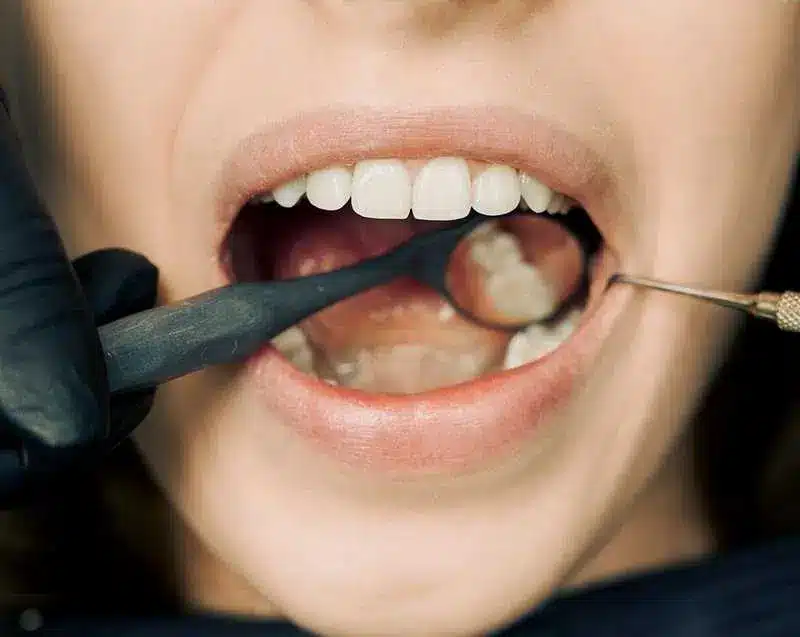
Wisdom teeth come in between the ages of 17 and 25, and treatment involves either monitoring them with regular X-rays when they erupt straight and stay healthy, or removing them when they cause pain, crowding, or infection. Those two paths cover almost every case, and which one applies to you depends on how much room your jaw has and what angle the tooth is growing at. Below we walk through the full eruption timeline from the first signs to the last, what an erupting wisdom tooth actually feels like, what impaction means, how a dentist decides between monitoring and removal, what happens during the procedure itself, and how long recovery takes.
When Do Wisdom Teeth Come In?
Wisdom teeth come in between ages 17 and 25 for most people, with eruption possible as early as 13 and as late as the early 30s. Research published in the Journal of Oral and Maxillofacial Surgery places the average age of wisdom tooth eruption at 19.4 years, with substantial variation between individuals.
That variation traces back to three factors. Genetics runs strongest, so family patterns predict a great deal. Jaw size decides whether there is physical room for the tooth to surface. Individual growth pace shifts the whole schedule forward or backward by a year or two in either direction.
The full developmental sequence starts long before anything is visible. The table below maps each stage against what is happening in the jaw and what a dentist does about it, drawing on the age staging used in pediatric dental practice and on American Dental Association guidance for third molar evaluation.
| Age range | What is happening in the jaw | What shows on an X-ray | What a dentist does |
|---|---|---|---|
| Ages 7 to 10 | Wisdom tooth crowns begin forming inside the jawbone | Early crown formation may be faintly visible | Nothing specific; routine checkups continue |
| Ages 10 to 13 | Crowns finish forming; roots have not started | All four crowns clearly visible if present | Confirms how many wisdom teeth are present |
| Ages 15 to 17 | Roots begin developing; eruption may start in some teens | Root formation and tooth angle become readable | Baseline panoramic X-ray; first position assessment |
| Ages 17 to 21 | Peak eruption window for most people | Available space and impaction risk become clear | Evaluation for monitoring or removal |
| Ages 22 to 25 | Later eruption is still normal and common | Roots close to fully formed | Continued monitoring if teeth are healthy |
| Age 25 and older | Teeth that have not emerged usually remain impacted | Position is essentially final | Long-term monitoring or removal if problems appear |
Reading down that table, the practical takeaway is that the decision point arrives years before the symptoms do. The American Dental Association recommends that wisdom teeth be evaluated by age 18 to determine whether removal is advisable, which sits squarely inside the peak eruption window rather than after it.
What Are Wisdom Teeth?
Wisdom teeth are the third molars, the last four adult teeth to develop, positioned one in each corner of the mouth behind the second molars. Most people develop four of them, though the number varies and some people develop fewer or none at all.
Third molars are ordinary molars in every structural respect. They have the same crown shape, the same chewing function, and the same enamel and dentin makeup as the first and second molars in front of them. What separates them is timing and space. First molars arrive around age six and second molars around age twelve, both while the jaw is still growing, so both usually find room. Third molars arrive after jaw growth has finished, into whatever space is left over.
Leftover space is the entire story of wisdom teeth. Everything that goes right and everything that goes wrong with them follows from how much of it there is.
Where Do Wisdom Teeth Come In?
Wisdom teeth come in at the very back of each dental arch, directly behind the second molars, two on top and two on the bottom. Reach your tongue as far back as it goes along your gum line and the area it lands on is where a wisdom tooth would surface.
Position matters more than it sounds, because the upper and lower pairs sit in different anatomical neighborhoods. Upper wisdom teeth develop in the maxilla near the maxillary sinus, in bone that is relatively soft and porous. Lower wisdom teeth develop in the mandible, in dense bone, and their root tips sit close to the inferior alveolar canal, the channel carrying the nerve that supplies sensation to the lower teeth, chin, and lip.
That proximity to the inferior alveolar canal is why lower wisdom teeth account for most of the discomfort people report during eruption, most impaction cases, and most of the surgical planning around removal. Imaging research indicates roughly 40% of mandibular third molars fail to erupt, mainly for lack of space, and impaction in the lower jaw is consistently more common than in the upper.
What Triggers Wisdom Teeth to Grow?
Wisdom teeth are triggered to grow by root development, which lengthens beneath the crown and pushes the tooth upward through the bone and gum. Nothing external starts the process. It runs on a genetic developmental schedule that begins in childhood.
Root development follows crown formation. The crown forms first inside the jawbone, finishing by the early teens, and only then do the roots begin to lengthen. Lengthening roots need somewhere to go, so they drive the crown toward the surface. The crown pressing upward stretches the bone and then the gum tissue above it, and that stretching is what produces the tenderness most people notice first.
Eruption stops when the tooth reaches its functional position or when something blocks it. Blockage explains why some wisdom teeth surface partway and then sit unchanged for months, since the root is still pushing while the crown has nowhere left to move.
How Early Can Wisdom Teeth Come In?
Wisdom teeth can come in as early as age 13, though eruption before 15 is uncommon. Early eruption usually reflects a larger jaw with genuine room at the back of the arch, which is a favorable sign rather than a concerning one.
Early arrival does shift the evaluation timeline forward. Roots are still forming at 13 and 14, which makes the final position harder to predict, so a dentist seeing an early eruption typically monitors through subsequent visits rather than making a removal decision immediately. Extractions before age 15 are uncommon and reserved for a specific problem such as a cyst or severe crowding.
Teenagers with erupting wisdom teeth benefit most from consistency at this stage, since the position changes measurably between visits. Keeping up with routine teen dental care is what makes a trend visible rather than a single snapshot.
What Is the Oldest Age for Wisdom Teeth?
Wisdom teeth can come in into the early 30s, and 25 is not too old for a wisdom tooth to erupt. Delayed eruption in the late 20s and early 30s is documented and not unusual, so a wisdom tooth appearing at 28 or 30 is a normal late arrival rather than an anomaly.
What changes after 25 is the probability rather than the possibility. A wisdom tooth that has not surfaced by the mid-20s has usually stopped trying, because root formation is complete and the driving force behind eruption is spent. Teeth in that position are typically impacted rather than merely slow.
Two practical consequences follow for adults in their late 20s and 30s. A tooth that starts erupting at that age moves through denser, fully mature bone, which tends to make the process slower and more uncomfortable than the same eruption at 18. And a tooth that has sat impacted for a decade is still capable of causing problems, so age alone does not put the question to rest.
Do All Four Wisdom Teeth Come In at the Same Time?
No, all four wisdom teeth rarely come in at the same time, and eruption is usually staggered across months or years. Each tooth runs on its own root development schedule and meets its own local space conditions, so the four rarely stay in step.
The common pattern is for one side to lead. Many people notice the lower left or lower right first, then the opposite side weeks or months later, with the uppers arriving on their own schedule. Upper wisdom teeth also tend to be less noticeable while erupting because the bone above them is more porous and the crowns are smaller.
Staggering has one useful implication. An episode of soreness that resolves is not proof the whole process is over, since the other three teeth may still be years from doing anything. It also means a patient can have one perfectly erupted wisdom tooth and one impacted one, which is why each tooth is evaluated on its own rather than as a set.
How Long Does It Take for a Wisdom Tooth to Fully Come In?
A wisdom tooth takes several weeks to several months to fully come in once eruption starts, and some never complete the process at all. Eruption is not a single continuous movement. It advances in small stages, so symptoms flare for a few days, settle, and return later.
That stop-start rhythm catches people off guard because it does not resemble how a front tooth arrived in childhood. A wisdom tooth may push visibly for a week, sit unchanged for two months, then advance again. Stretches of no apparent change are a normal part of the sequence rather than a sign something has gone wrong.
A tooth that stalls partway and stays there is a different situation. Partial eruption leaves a crown that is half-covered by gum tissue, which is difficult to clean and prone to trapping food and bacteria. A wisdom tooth that has looked the same for many months deserves an X-ray rather than more waiting.
How Rare Is It to Have No Wisdom Teeth?
Having no wisdom teeth is not rare, and roughly one person in five is missing at least one third molar. A systematic review and meta-analysis of 92 studies covering 63,314 subjects, published in the Journal of Dental Research, put the worldwide rate of third molar agenesis at 22.63%, with individual study estimates ranging from 5.32% to 56.0%.
Agenesis means the tooth never forms at all, which is different from a tooth that formed and stayed impacted. The distinction matters because only an X-ray separates the two, and a patient with no visible wisdom teeth at 30 could be in either category. Missing one or two while developing the others is more common than missing all four.
Whether you have them is largely genetic, and having none carries no disadvantage. Teeth that were never needed for modern diets are not missed, which raises the obvious question about why they are part of human development at all.
Why Do We No Longer Have Room for Wisdom Teeth?
We no longer have room for wisdom teeth because human jaws have become smaller over evolutionary time while the genetic blueprint for a third set of molars has remained. Early humans had larger jaws and ate tough, abrasive, uncooked food that wore teeth down and sometimes knocked them out, so a third set of molars arriving in early adulthood was genuinely useful.
Diet changed and jaw size followed. Cooking softened food, processing reduced the chewing load, and the jaw gradually shortened across generations. Tooth number did not shorten with it, which left a mismatch between how many molars develop and how much arch length exists to hold them.
The mismatch is the reason wisdom teeth generate so much dental attention relative to every other tooth. Rising rates of agenesis suggest the trend is still running, which is why some people are already developing without third molars while others develop four with room for none.
What Are the First Signs of Wisdom Teeth Coming In?
The first signs of wisdom teeth coming in are soreness behind the last molar, a dull ache or pressure at the back of the jaw, swollen or tender gums, and small white spots appearing at the gum line. The white spots are the tips of the crowns breaking through and are the most definitive visual sign available at home.
Symptoms tend to arrive in waves rather than steadily, matching the stop-start pattern of eruption itself. Separating what is expected from what needs attention is the most useful thing you can do while the process runs:
- Normal during eruption: mild soreness behind the last molar, pressure in the back of the jaw, brief gum swelling, tenderness when chewing on that side, a small visible edge of tooth appearing gradually, and mild jaw stiffness that eases within a few days.
- Needs a dental evaluation: swelling that keeps getting worse, a bad taste or persistent bad breath from the area, pus or drainage, pain that returns repeatedly or interrupts sleep, trouble opening the mouth fully, pain when swallowing, fever, and swelling in the face or jaw.
Facial swelling, fever, or difficulty swallowing move the situation into urgent territory, since those signs can point to an infection spreading beyond the tooth. Anyone with that combination should be seen the same day, which is what our same-day care exists for.
Does It Hurt When Wisdom Teeth Come In?
Yes, it usually does hurt when wisdom teeth come in, though the sensation is typically pressure and dull aching rather than sharp pain. Most people describe it as a persistent soreness at the back of the jaw that comes and goes over weeks.
Pain during eruption has a mechanical source. The crown pushing upward stretches the periodontal tissue and the gum above it, and stretched tissue is inflamed tissue. Inflammation around an erupting tooth produces the tenderness, the mild swelling, and the stiffness when opening wide that patients report together.
Intensity varies with space. A tooth with room to surface produces mild, short-lived discomfort. A tooth pressing against the second molar in front of it produces more, and lower wisdom teeth in dense bone produce more still. Pain that keeps intensifying instead of cycling is the pattern that separates ordinary eruption from a problem.
Can Wisdom Teeth Cause Ear Pain or Headaches?
Yes, wisdom teeth can cause ear pain and headaches, because pressure along the jaw nerve radiates away from the tooth itself. Referred pain of this kind is one of the most confusing features of wisdom tooth eruption.
The referral pattern follows the nerve. Sensation from the lower back teeth travels along the inferior alveolar nerve through the mandible, and the branches serving that region share pathways with structures near the ear and temple. Shared pathways mean the brain can misread the source, so a lower wisdom tooth registers as an earache, a tension headache, or a sore throat on the same side.
This is why wisdom tooth problems are regularly mistaken for ear infections, sinus trouble, or a temporomandibular joint disorder. Unexplained one-sided jaw or ear pain in someone between 17 and 25 is worth having checked with an X-ray before chasing other explanations.
How Do You Relieve Wisdom Tooth Pain at Home?
You relieve wisdom tooth pain at home with over-the-counter anti-inflammatory pain relievers, warm salt water rinses, cold compresses on the outside of the cheek, and careful cleaning around the erupting tooth. These measures manage an eruption in progress and do not change whether the tooth will surface properly.
Ibuprofen tends to outperform acetaminophen for this specific pain because eruption discomfort is inflammatory in origin, and an anti-inflammatory addresses both the pain and the swelling driving it. Follow the dosing on the package and take it with food.
Warm salt water rinses, roughly half a teaspoon of salt in eight ounces of warm water, soothe the inflamed gum tissue and flush debris out from under a partially covering gum flap. A cold compress held against the outside of the cheek for fifteen minutes at a time reduces swelling and dulls the radiating ache.
Cleaning is the part that changes outcomes rather than just comfort. Angle a soft-bristled brush toward the gum line at the very back of the arch and keep flossing even where access is awkward, since trapped debris around a partly erupted crown is what turns irritation into infection. Reliable daily oral hygiene in that area is the single most protective habit during the eruption window.
What Is an Impacted Wisdom Tooth?
An impacted wisdom tooth is a third molar that cannot fully erupt into a normal position because of lack of space, an unfavorable angle, or overlying bone. Impaction is where the eruption story stops being routine, and it is common enough that it deserves its own treatment here before we get to what dentists do about it.
The numbers make the case. Research published in the Journal of the American Dental Association indicates about 70% of young adults have at least one impacted wisdom tooth, and data from the National Library of Medicine puts the figure at 72% among people aged 20 to 30. Across all third molars, reported impaction prevalence sits around 24.4%.
An impacted tooth is not automatically an emergency. Many stay quiet for years. What impaction does is remove the possibility of a normal outcome, which changes the question from whether the tooth will erupt properly to what it is likely to do while it sits where it is.
What Are the Types of Wisdom Tooth Impaction?
The types of wisdom tooth impaction are soft tissue impaction, partial bony impaction, and complete bony impaction, each described further by the angle the tooth is growing at. Depth and angle together decide how the tooth behaves and how complex removal would be.
Soft tissue impaction means the tooth has broken through bone but remains partly covered by gum tissue, which carries the highest infection risk of the three because the covered pocket traps food and bacteria. Partial bony impaction leaves part of the crown embedded in jawbone, creating a cleaning problem and a decay risk for both the wisdom tooth and the second molar beside it. Complete bony impaction means the tooth is fully encased in bone and cannot erupt, which often stays symptom-free for years while still capable of causing problems later.
Angle adds the second dimension. A vertical impaction sits upright but lacks space. A mesial impaction tilts forward toward the front of the mouth and is the most common pattern. A distal impaction angles backward toward the throat. A horizontal impaction lies on its side pressing directly into the second molar, which is the most problematic position because it can damage the root of a healthy tooth that had nothing wrong with it.
What Is Pericoronitis?
Pericoronitis is inflammation or infection of the gum tissue surrounding a partially erupted tooth. It develops under the flap of gum, called an operculum, that covers part of an emerging wisdom tooth crown.
The mechanism is straightforward. An operculum creates a pocket that a toothbrush cannot reach, food debris and bacteria collect inside it, and the trapped material inflames the tissue around the crown. Inflamed tissue swells, which deepens the pocket, which traps more debris, so the problem tends to recur rather than resolve cleanly.
Symptoms include localized swelling and redness at the back of the jaw, a bad taste, bad breath, pain when biting on that side, and in more advanced cases difficulty opening the mouth. Repeated episodes at the same site are a strong indicator that the tooth is not going to finish erupting, and untreated pericoronitis can progress into a spreading tooth infection that needs prompt attention.
Can Wisdom Teeth Cause Problems Later in Life?
Yes, wisdom teeth can cause problems later in life, and a tooth that has been quiet for years can still develop decay, infection, cysts, or damage to the tooth beside it. Age does not settle the matter.
Decay leads the list. A partially erupted or awkwardly angled wisdom tooth is hard to clean at any age, and cavities that form there frequently cannot be restored with a filling because of access, which makes removal the only remaining option. Decay also spreads to the second molar, putting a healthy tooth at risk.
Gum problems follow the same path. Bacteria collecting around a hard-to-clean third molar drive localized inflammation that can progress into gum disease affecting the back of the arch. Fully impacted teeth carry a separate, less common risk, since the sac surrounding an unerupted crown can develop into a fluid-filled cyst that erodes bone and damages neighboring tooth roots.
What Does Wisdom Teeth Treatment Involve?
Wisdom teeth treatment involves either monitoring the teeth with regular examinations and X-rays, or removing them surgically when they are impacted, infected, decaying, or damaging nearby teeth. Those are the two paths, and an X-ray is what determines which one applies.
Monitoring is active rather than passive. It means checkups every six months, periodic X-rays to track position and root development, careful cleaning at the back of the arch, and prompt attention if symptoms start. A wisdom tooth under observation is being watched for specific changes, not simply ignored.
Removal is recommended when the tooth cannot reach a functional position or has already started causing harm. We handle wisdom tooth extraction in our Houston office for most cases, with complex positions referred when that serves the patient better, and we go through the X-ray findings with you before any decision is made.
How Do Dentists Check on Wisdom Teeth?
Dentists check on wisdom teeth with a clinical examination of the back of the mouth combined with panoramic X-rays that show the whole jaw at once. The examination finds what is visible. The X-ray finds everything that decides the outcome.
A panoramic image shows the position and angle of each third molar, how much space exists between the second molar and the ascending part of the jaw, how far root development has progressed, whether the crown is contacting the tooth in front of it, and how close the lower roots sit to the inferior alveolar canal. None of that is visible by looking in the mouth, and symptoms alone do not reveal it either, since some teeth with no realistic chance of erupting cause almost no discomfort.
Timing the first image matters. A baseline X-ray around age 16, repeated periodically through the peak eruption years, turns a single snapshot into a trend, and a trend is what makes the removal decision straightforward instead of a judgment call. This is one of the clearest arguments for keeping up with routine preventive care through the late teens.
Do All Wisdom Teeth Need to Be Removed?
No, not all wisdom teeth need to be removed, and a third molar can stay when it is healthy, fully erupted, correctly positioned and biting properly, and able to be cleaned daily. Those four conditions come from Mayo Clinic guidance and function as a practical checklist.
All four have to be met, which is where most teeth fall short. The American Association of Oral and Maxillofacial Surgeons reports that approximately 85% of wisdom teeth will eventually need removal, and clinical guidance suggests only about 12% to 15% meet every criterion for being safely left in place. Removal is common because qualifying is uncommon, not because removal is the default.
The American Dental Association identifies pain in or near the wisdom teeth, repeated infection of the soft tissue behind the last lower tooth, cysts, tumors, damage to nearby teeth, gum disease, and widespread tooth decay as reasons removal may be needed. A tooth showing none of those and meeting all four keep-criteria is a genuine candidate for monitoring.
Can You Just Let Your Wisdom Teeth Grow In?
Yes, you can let your wisdom teeth grow in when they erupt straight, have enough room, stay healthy, and you can brush and floss them properly. A well-positioned third molar is a functional chewing tooth with no reason to come out.
Keeping them carries an ongoing obligation rather than a one-time approval. Wisdom teeth that stay in place need checkups every six months, periodic X-rays to catch changes, and excellent cleaning at the very back of the arch where brushing is awkward. Problems can develop years after a tooth was judged healthy, so monitoring continues indefinitely.
The decision also cannot be made from symptoms. A wisdom tooth that feels fine may still be mesially angled against the second molar with decay forming between them, which is visible on an X-ray and invisible to the patient. Letting them grow in is a reasonable choice made with an image in hand, not a choice made by waiting to see what happens.
What Is the Best Age to Have Wisdom Teeth Removed?
The best age to have wisdom teeth removed is generally between 15 and 22, because the roots are not fully formed, the jawbone is less dense, and recovery is faster. Mayo Clinic identifies that window specifically, noting that removal as a young adult is safer, easier, and requires less recovery than removal later in life.
Each of those three factors does real work. Incompletely formed roots are shorter and sit further from the inferior alveolar canal, which lowers the risk of nerve involvement. Less dense bone releases the tooth more readily, which shortens the procedure and reduces trauma to the surrounding tissue. Younger patients also heal faster and report less post-operative discomfort.
Waiting has measurable costs. Nerve injury risk rises with age as roots lengthen toward the canal, and complications generally increase for patients past their mid-twenties. Patients who have their wisdom teeth removed in their late teens typically have an easier time of it than those who wait until a problem forces the decision, which is the practical argument for evaluating early even when nothing hurts.
What Happens During Wisdom Tooth Removal?
During wisdom tooth removal, the area is numbed, the gum is opened if needed, the tooth is loosened and lifted out, the socket is cleaned, and stitches and gauze are placed. A simple extraction of an erupted tooth takes roughly 20 to 40 minutes, and surgical removal of impacted teeth often runs 45 to 60 minutes for all four.
The appointment follows a set sequence:
- Review and planning. The X-ray is reviewed with you, the position of each tooth is explained, and the approach and anesthesia are agreed before anything begins.
- Anesthesia. Local anesthetic numbs the area completely. Most extractions are done this way, and sedation is available for patients who would rather be more relaxed. Complex cases are sometimes handled under deeper sedation or referred.
- Access. For an erupted tooth, no incision is needed. For an impacted tooth, a small incision in the gum tissue exposes the crown, and a thin layer of overlying bone may be removed.
- Sectioning if needed. An angled or horizontally positioned tooth is often divided into pieces, because removing it in sections takes far less force than lifting it whole and protects the tooth and bone around it.
- Removal. The tooth is loosened in the socket and lifted out.
- Cleaning. The socket is irrigated to clear debris and any remaining fragments.
- Closure. Dissolvable stitches are placed where an incision was made, and gauze is positioned so a blood clot can form in the socket.
Patients who have read through what to expect from an extraction generally find the appointment less stressful than they anticipated.
Knowing the sequence in advance removes most of the anxiety patients bring with them. Dr. David Yu walks through each step before starting, so nothing in the chair arrives as a surprise.
How Painful Is Wisdom Teeth Removal?
Wisdom teeth removal is not painful during the procedure, because local anesthesia numbs the area completely, and most post-operative discomfort is manageable with pain relievers. What patients feel during the extraction is pressure and movement rather than pain.
Discomfort after the anesthesia wears off follows a predictable curve. Soreness and swelling build over the first two days, peak around day two or three, and improve daily from there. Impacted lower teeth produce more of both than erupted upper teeth, since the procedure involves more tissue.
Complications are the exception rather than the rule. A nationwide cohort study of impacted lower third molar extractions published in PLOS ONE found dry socket in 3.6% of cases, temporomandibular disorder in 0.41%, and surgical site infection in 0.17%. Permanent nerve damage occurs in up to 1% of third molar surgeries according to Cochrane review data, with temporary nerve involvement reported at roughly 1% to 5% and usually resolving on its own.
How Long Does It Take an Adult to Recover From Wisdom Teeth Removal?
An adult takes one to two weeks to recover from wisdom teeth removal, with most people feeling close to normal by the end of the second week. Full healing of the sockets underneath continues for three to six months, long after you stop noticing it.
The visible timeline runs in stages. The first 24 hours are for rest, ice on the outside of the cheek, and soft, cool foods. Days two and three bring peak swelling, which is expected rather than a setback, and gentle salt water rinses can begin. Days four through seven show steady daily improvement and a gradual return to a normal diet. By the second week most patients are back to regular activity.
Adults past their mid-twenties should plan on the longer end of that range. Denser bone and fully formed roots make the extraction more involved, and healing capacity declines gradually with age, so an adult of 32 reasonably expects a slower course than a patient of 18 having the same tooth removed. Protecting the blood clot matters at every age, and the things to avoid in the first few days are what keep recovery on schedule.
How Long Is Bed Rest After Wisdom Teeth Removal?
Bed rest after wisdom teeth removal lasts about 24 hours, with limited activity for a further day or two rather than full rest. The first day calls for genuine rest, with the head elevated on extra pillows to reduce swelling and no physical exertion at all.
Activity returns in steps after that. Most patients handle light activity by day two and are comfortable resuming school or desk work by day three, though a complex removal of impacted lower teeth reasonably justifies taking two full days. Strenuous exercise, heavy lifting, and anything that raises blood pressure sharply should wait until about a week out, since elevated pressure can restart bleeding or dislodge the clot.
Scheduling around the recovery is worth a moment of planning when you book an extraction visit. A Friday appointment gives the weekend for the peak swelling days, which is why we book many of our Houston patients that way, and a brief follow-up afterward confirms the sockets are healing as expected.
Frequently Asked Questions
Can Wisdom Teeth Cause Crowding or Undo Braces?
Wisdom teeth do exert forward pressure on the teeth in front of them as they try to erupt, though they are not the sole cause of crowding after braces. Research indicates that not wearing a retainer is a larger factor, and removing wisdom teeth does not by itself prevent teeth from shifting. Removal does eliminate one contributing force, which matters most for patients who had crowding before treatment.
How Many Wisdom Teeth Do Most People Have?
Most people have four wisdom teeth, one in each corner of the mouth behind the second molars. Having fewer is common, since the worldwide rate of third molar agenesis is around 22.63% according to a meta-analysis of 92 studies. A panoramic X-ray confirms how many you have, including any still sitting beneath the gum line.
Can a Wisdom Tooth Come In and Then Stop?
Yes, a wisdom tooth can come in partway and then stop, which happens when there is not enough space or the angle is unfavorable. Partial eruption is a common pattern with impacted and partially impacted teeth. A tooth that has looked unchanged for months should be evaluated, since the half-covered crown is difficult to clean and prone to repeated inflammation.
Do Upper and Lower Wisdom Teeth Behave Differently?
Yes, upper and lower wisdom teeth behave differently, and lower ones cause the majority of problems. Impaction is more common in the lower jaw, roughly 40% of mandibular third molars fail to erupt, and lower roots sit close to the inferior alveolar canal, which makes their removal more technically involved. Upper wisdom teeth sit in softer bone and are usually simpler to extract.
Should All Four Wisdom Teeth Be Removed at Once?
All four wisdom teeth are often removed in one appointment, which consolidates recovery into a single window rather than repeating it. Whether that suits you depends on the position of each tooth, the anesthesia used, and your own preference. Some patients do the lower two first because those are usually the more involved extractions.
What Should You Do If a Wisdom Tooth Comes In During Pregnancy?
If a wisdom tooth comes in during pregnancy, elective removal is usually postponed while symptoms are managed conservatively with careful cleaning and rinses. An active infection is treated rather than delayed, since untreated infection carries its own risk. Tell your dentist you are pregnant at the first visit so imaging and treatment can be planned around it.
The Bottom Line
Wisdom teeth come in between 17 and 25 for most people, averaging around 19.4 years, and they arrive one at a time over weeks or months rather than all together. Soreness behind the last molar, pressure in the jaw, and white spots at the gum line are the normal signs. Swelling that keeps worsening, a bad taste, pus, fever, or trouble opening your mouth are the ones that need a dentist. Roughly 70% of young adults have at least one impacted wisdom tooth, and lower wisdom teeth account for most of the trouble.
Treatment comes down to two paths. A wisdom tooth that is healthy, fully erupted, correctly positioned, and cleanable can stay under regular monitoring with periodic X-rays. Everything else points toward removal, which is easiest between 15 and 22 while the roots are still forming and the bone is less dense. The procedure itself is done under anesthesia with no pain during it, and most adults feel normal again within two weeks.
The most useful thing you can do is get a baseline X-ray around age 16 to 18, before anything hurts. Knowing the position of all four teeth turns this into a planned decision rather than an urgent one. If you are noticing pressure at the back of your jaw or want to know where your wisdom teeth stand, Bright Value Dental can take a look and walk you through the image with you.
A first evaluation takes one visit and usually ends with a clear answer. You can call our office any time to set one up.