

Yes, wisdom teeth can cause headaches, mainly when they come in or become impacted. The American Dental Association (ADA) says wisdom teeth appear between ages 17 and 21 and can bring pain, swelling and jaw stiffness. That pain can spread toward the head. MedlinePlus adds that a fully impacted tooth may cause no symptoms. A dentist finds the source with an exam and an X-ray.
Key Takeaways
- Cleveland Clinic describes wisdom tooth headaches as referred pain from the back of the jaw.
- The ADA lists pain, infection and damage to nearby teeth as impacted wisdom tooth problems.
- NIDCR says jaw joint disorders can occur together with headaches.
- Warm saltwater and over-the-counter pain relievers ease mild pain while you wait for a dental visit.
- The NHS advises a dental call for severe pain, swelling, bad taste or a high temperature.
Can Wisdom Teeth Cause Headaches?
Wisdom teeth can cause headaches when they emerge or become impacted, according to Cleveland Clinic. A Cleveland Clinic oral surgeon calls these headaches likely a type of referred pain. Referred pain starts in the back of the jaw and is felt in the head.
The ADA names pain, infection and damage to neighboring teeth as the main wisdom tooth problems. Our wisdom tooth evaluation starts with an exam and an X-ray to find which of these problems is present.
Published evidence here comes mostly from clinical guidance and case reports, not large trials. The next section explains how the pain reaches the head.
How Do Wisdom Teeth Cause Headaches?
Wisdom teeth cause headaches through four routes: gum inflammation, infection, cysts and jaw muscle strain. A dental pain review in PubMed Central notes the trigeminal nerve region spans the teeth, jaws, jaw joint, ears and sinuses. Pain from one site can therefore register at another.
The table below sets each route beside its source.
The graphic below shows the same four routes as a simple chain from tooth to head.
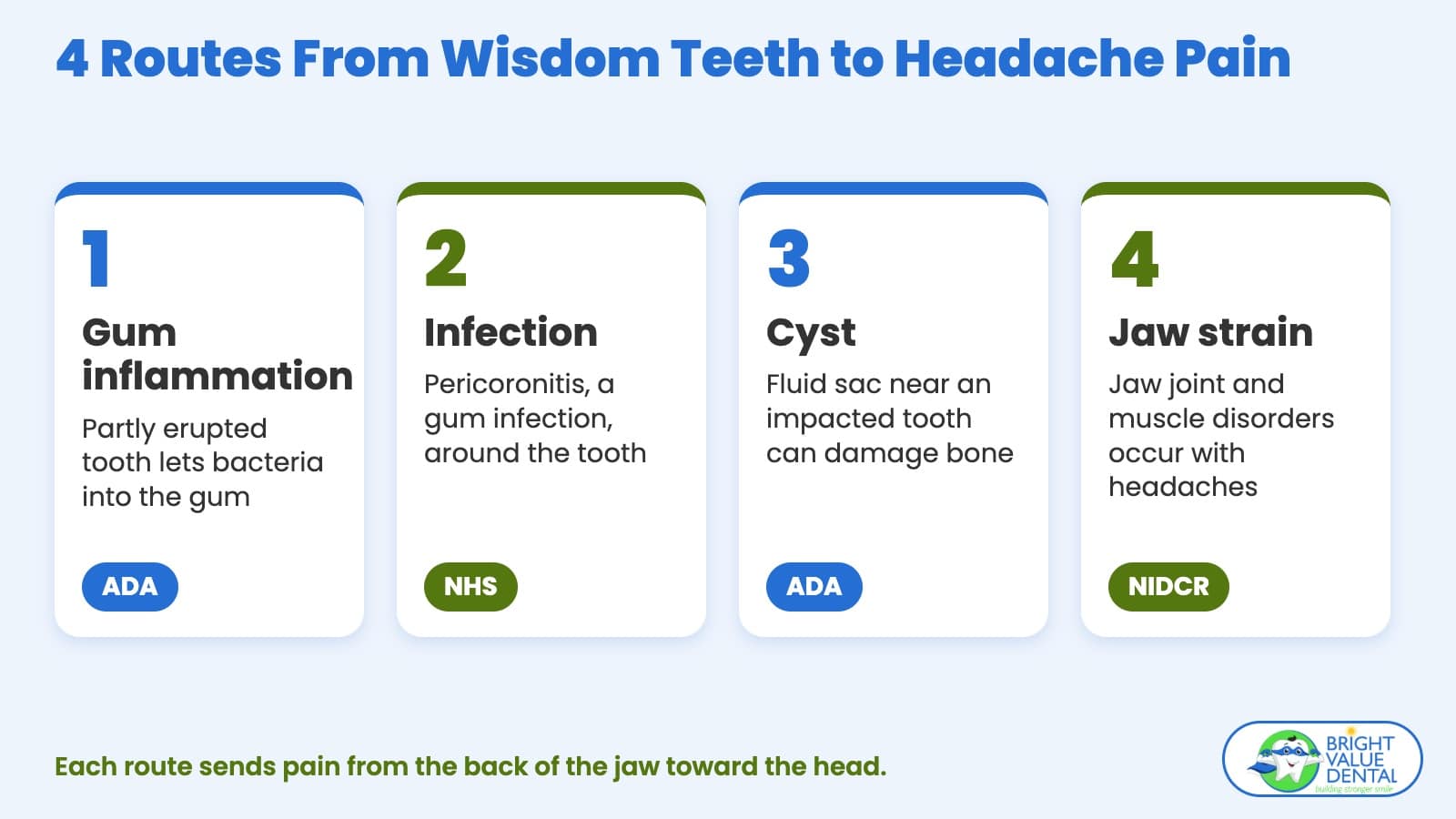
Each route also produces jaw symptoms, which leads to the next question.
Can Wisdom Teeth Cause Headaches and Jaw Pain Together?
Wisdom teeth can cause headaches and jaw pain together, because the ADA links partly erupted teeth to pain, swelling and jaw stiffness. The National Institute of Dental and Craniofacial Research (NIDCR) adds that jaw joint disorders may occur together with headaches. Both symptoms can share one dental source.
Jaw pain and headache together also fit other conditions. A dentist rules those out during the exam.
Can Impacted Wisdom Teeth Cause Headaches?
Impacted wisdom teeth can cause headaches when the trapped tooth leads to infection, a cyst or pressure on nearby teeth. The ADA defines an impacted tooth as trapped in the jaw or under the gums. MedlinePlus adds that a fully impacted tooth may cause no symptoms at all.
Impaction is common. A Clinical Evidence review reports that 72% of Swedes aged 20 to 30 had at least one impacted wisdom tooth. The same review found that 30% to 60% of people with symptom-free wisdom teeth later developed disease or needed extraction.
Those figures appear in the chart below, next to the ADA age range.