
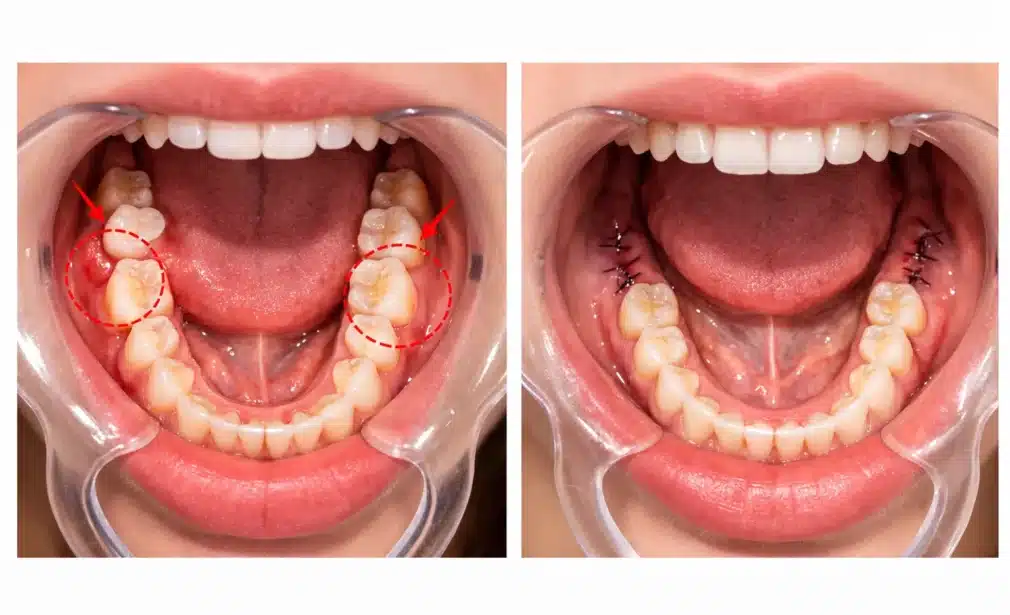
After wisdom teeth removal, you can expect minor bleeding, swelling, and soreness that typically peak around day three before improving steadily. Most patients feel close to normal within 3 to 7 days, and soft-tissue healing is largely finished by 7 to 10 days. The single most important job during that window is protecting the blood clot that forms in each socket, because that clot is what shields the bone and nerves underneath while new tissue grows in. Below we walk through the recovery timeline day by day, the habits that protect the clot and the ones that threaten it, what to eat and when, how to clean your mouth safely, when you can drive, work, and exercise again, and the signs that deserve a phone call rather than a wait.
What Should You Expect After Wisdom Teeth Removal?
After wisdom teeth removal you should expect bleeding that slows within the first hour, swelling that builds for two to three days, jaw stiffness, and soreness that responds to cold packs and the pain relief your dentist recommends. Recovery follows a predictable arc, and knowing the shape of that arc is what keeps normal healing from feeling like something has gone wrong.
Wisdom teeth are third molars, the last teeth to arrive, usually between the late teens and mid twenties. They sit at the very back of the jaw where space is tight, which is why they so often come in at an angle or stay trapped under gum or bone. Removing them is one of the most common procedures in dentistry. An analysis published in the American Journal of Public Health estimated that about 10 million third molars are removed from roughly 5 million people in the United States each year.
Dr. Yu has performed thousands of extractions over the past 20 years, and most of them happen right here in our office under local anesthesia. A tooth extraction starts with a comprehensive exam and X-ray review, moves through comfort measures and the removal itself, and ends with gauze placement and the aftercare guidelines that carry you through the next week. That final step is the one you take home, and it does more for your recovery than anything else in the appointment. Aftercare belongs to the same preventive mindset that runs through all of our general dentistry work.
What Happens in the First 24 Hours?
In the first 24 hours a blood clot forms in each empty socket, bleeding slows, and swelling begins to build. Everything you do on day one should protect that clot, because a clot lost on the first day sets recovery back further than anything that happens later in the week.
Here is the sequence for the first day:
- Bite down on the gauze with steady, gentle pressure for 30 to 60 minutes so the clot can form. Replace it if it soaks through.
- Wait for the numbness to wear off completely before eating anything, so you do not bite your cheek, lip, or tongue without feeling it.
- Apply a cold pack to the outside of your cheek, 20 minutes on and 20 minutes off, for the rest of the day.
- Rest with your head propped above your heart. Lying flat lets blood pool in the head and increases both swelling and throbbing.
- Eat cool, soft foods once the numbness is gone and chew far away from the extraction sites.
- Skip rinsing, spitting, and straws entirely on day one. Gentle warm salt water rinses start the following day.
Some oozing and a pink tinge to your saliva is normal on the first day and even into the second. Steady bleeding that does not slow with 30 minutes of firm gauze pressure is different, and that one is worth a call.
What Does the Wisdom Teeth Recovery Timeline Look Like Day by Day?
The wisdom teeth recovery timeline runs from clot formation on day one, through peak swelling around day two or three, to noticeably easier days by the end of the first week and closed gum tissue by weeks three and four. Two separate clocks are running the whole time: the gum tissue closes within a few weeks, and the bone underneath keeps rebuilding for months after you have stopped thinking about it.
The stages below reflect the pattern reported across clinical studies of third molar surgery, including research on trismus timing published in oral surgery journals and prevalence data from prospective studies of third molar extraction. Your own pace depends on your age, your general health, and whether the teeth were impacted.
| Stage | What is happening | What helps most |
|---|---|---|
| Day 1 | The blood clot forms. Light bleeding and oozing are normal. | Gauze pressure, cold packs, head elevated, no rinsing |
| Days 2 to 3 | Swelling and jaw stiffness peak. Soreness is at its highest. | Cold packs, gentle salt water rinses, soft foods, rest |
| Days 4 to 7 | Swelling comes down and pain eases noticeably each day. | Warm compresses, soft solids, light activity |
| Days 7 to 10 | Most soft-tissue healing is complete. Dissolving stitches disappear. | Normal routine, careful chewing away from the sites |
| Weeks 2 to 4 | Gum tissue closes over the sockets and the openings fill in. | Regular brushing and flossing to the back of the arch |
| Months 3 to 6 | Bone continues remodeling beneath the closed gum tissue. | Nothing. You will not feel this stage at all. |
Impaction changes the pace. A tooth that had broken through the gum comes out more simply than one still buried in bone, and the buried ones ask for a few more days of healing. That is a reflection of how much rebuilding your body has to do, not a sign that anything went wrong.
What Is the Worst Day After Wisdom Teeth Removal?
The worst day after wisdom teeth removal is usually day two or day three, when swelling and jaw stiffness reach their peak. Feeling worse on day three than you did on day one is the expected pattern, not a setback.
Inflammation explains the timing. Your body responds to surgical trauma by flooding the area with fluid and healing cells, and that response builds over roughly 48 to 72 hours before it starts to resolve. A clinical study measuring trismus after lower third molar removal found that jaw stiffness, like swelling, typically reaches its peak on the second day and clears by the end of the first week. Research predicting swelling and stiffness from pre-operative factors found that longer operating time and tooth sectioning were both associated with more of both, which is why a complicated extraction produces a bigger day-three than a simple one.
The direction of travel matters more than the intensity. Swelling and soreness that improve a little each day after day three are healing on schedule. Pain that gets worse after day three is a different signal, and we cover that further down.
How Long Does Swelling Last After Wisdom Teeth Removal?
Swelling after wisdom teeth removal lasts about a week, peaking on day two or three and then shrinking steadily through days four to seven. Cold packs do the most good during the first 48 hours, and after that switching to gentle wa