
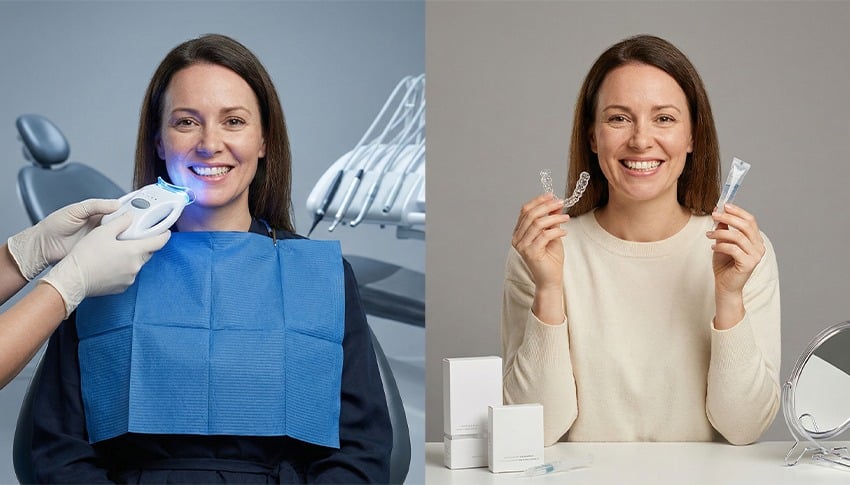
At-home teeth whitening works through peroxide-based bleaching agents that pass through enamel and lift the stain compounds sitting inside the tooth. The strongest at-home options are prefilled whitening trays, whitening strips, LED whitening kits, and custom-fitted trays made by a dentist, and the right pick depends on your stain type, your sensitivity level, and how evenly you want the color to change. Dentists also want you to know a few things before you start: get your mouth checked first, look for real bleaching agents on the label, remember that crowns and fillings keep their color, skip abrasive scrubbing pastes, and wait before you brush after a session. The rest of this article walks through how whitening actually changes a tooth, which at-home method fits which situation, what to check before your first application, and how to make the result last.
What Do Dentists Recommend for At-Home Teeth Whitening?
Dentists recommend peroxide-based whitening for at-home use, delivered through a tray, a strip, or a dentist-made custom tray. Hydrogen peroxide and carbamide peroxide are the only two ingredients in the at-home category that chemically change the color of a natural tooth. Everything else on the shelf either polishes the outside of the tooth or does nothing measurable at all.
Peroxide concentration is where the recommendation gets specific. According to dentist Dr. James Heaton, over-the-counter products run between 3 and 10 percent hydrogen peroxide and between 10 and 35 percent carbamide peroxide, while dental offices work with concentrations reaching 43 percent. The ADA reports that in-office agents sit in the 15 to 43 percent hydrogen peroxide band and brighten teeth three to eight shades in a single 30 to 60 minute visit. Those numbers explain the trade-off at the center of this whole topic: a dental office gets there faster because it uses a stronger gel under supervision, and an at-home product gets there gradually because its gel is calibrated to be safe without a dentist in the room.
Gradual is not the same as weak. Our take-home whitening kits use custom-molded trays that hold professional gel against every surface of every tooth, and patients who use them correctly and consistently see their shade lighten over the course of the cycle. We see the same pattern over and over in our chairs: the people who get the best at-home results are not the people who bought the strongest product, they are the people who finished the cycle.
How Does At-Home Teeth Whitening Work on a Tooth?
At-home teeth whitening works by sending peroxide through the enamel and into the dentin, where it oxidizes the stain molecules that make a tooth look yellow. The bleaching agent breaks apart the pigmented compounds trapped inside the tooth structure rather than scrubbing color off the outside. Those pigmented compounds, called chromogens, come from coffee, tea, red wine, tobacco, and dark sauces, and they build up inside the tooth over years.
Enamel is porous enough to let peroxide travel through it. The peroxide that travels through enamel reaches the dentin layer underneath, and the dentin layer is where most of a tooth’s visible color actually lives. That is why surface polishing never produc