
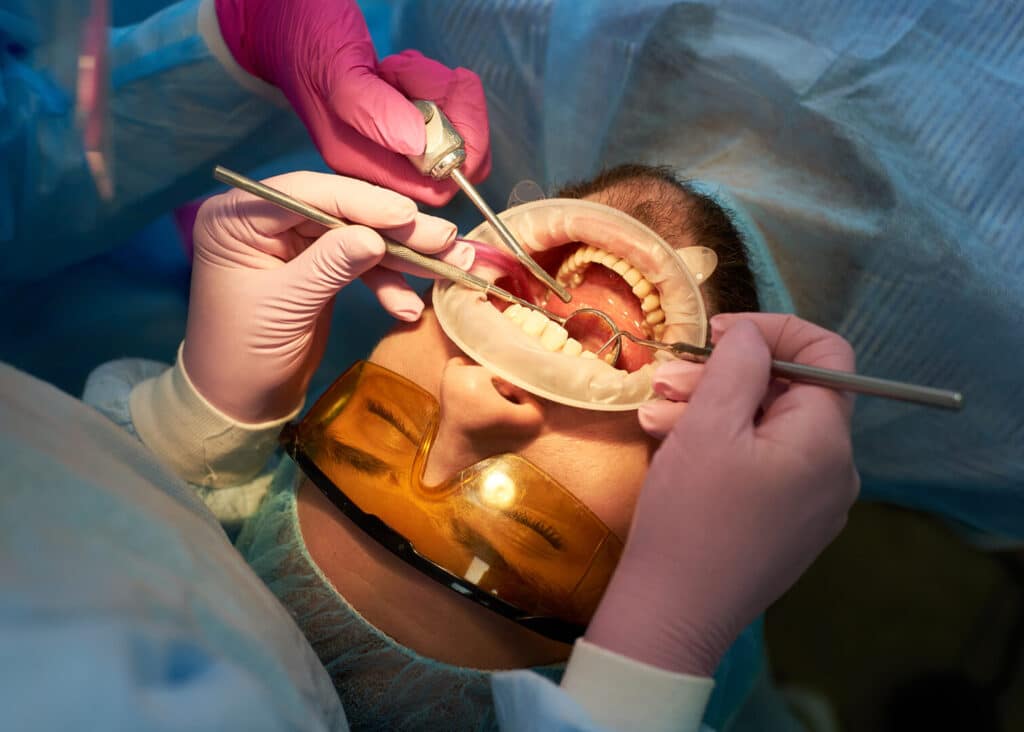
Wisdom teeth surgery takes 30 to 60 minutes for all four teeth, with deeply impacted or complex cases running up to 90 minutes, and a single erupted tooth coming out in 15 to 25 minutes. The number most people actually need is the other one: plan on roughly 1.5 to 2 hours at the office once paperwork, numbing, the procedure itself, and a few minutes of recovery are all counted. Here is what patients should know beyond the clock: the anesthesia choice shapes both the appointment length and whether you can drive home, the first night matters more than any other part of recovery, swelling peaks on day two or three rather than day one, and protecting the blood clot in each socket is the single thing that keeps the week on track. The rest of this article walks through the timing, the appointment, the first night, and the days that follow.
How Long Is Wisdom Teeth Surgery?
Wisdom teeth surgery is 30 to 60 minutes of actual chair time for a full four-tooth case. Each individual tooth takes about 5 to 10 minutes to remove once the area is numb, and the rest of the time goes to access, positioning, and closing. Access is where the variation lives, because reaching a tooth sitting under bone takes longer than lifting one that is already above the gumline.
The distinction that drives every figure here is simple versus surgical. A simple extraction removes a tooth that has fully erupted and sits in a reasonably normal position, so it can be loosened and lifted with standard instruments. A surgical extraction removes a tooth that is partly or completely covered by gum tissue and bone, which means a small incision, sometimes removal of a little bone, and sometimes sectioning the tooth into pieces so it comes out safely. Published procedure guidance from major dental groups puts simple extractions at 15 to 25 minutes and surgical extractions at 45 to 60 minutes or more, with oral surgery practices reporting 40 to 90 minutes for a full four-tooth case. The breakdown below reflects those ranges.
| Case Type | Chair Time | What Is Involved | Total Office Time |
|---|---|---|---|
| One erupted wisdom tooth | 15 to 25 minutes | Numbing, loosening, lifting the tooth, gauze | About 45 minutes to 1 hour |
| One impacted wisdom tooth | 20 to 40 minutes | Small incision, possible bone removal, sometimes sectioning, stitches | About 1 to 1.5 hours |
| All four, simple | 30 to 45 minutes | One side at a time, 5 to 10 minutes per tooth | About 1.5 hours |
| All four, impacted or surgical | 45 to 90 minutes | Incisions, bone removal, sectioning, stitches at each site | About 1.5 to 2 hours |
Total office time is the column worth planning around, because it is the one that decides how much of your day disappears. We will give you a realistic figure for your own case at the consultation, once we have looked at your X-ray and talked through a wisdom tooth extraction plan.
How Long Does It Take to Remove All Four Wisdom Teeth?
Removing all four wisdom teeth takes 30 to 60 minutes in most cases, and up to 90 minutes when the teeth are deeply impacted. Four teeth do not take four times as long as one, because the numbing, setup, and closing happen once rather than four times over. Setup time is fixed, so the marginal cost of each additional tooth is only the 5 to 10 minutes of removal itself.
Doing all four in one appointment is what most patients choose, and the reason is the recovery rather than the surgery. One appointment means one set of aftercare instructions, one swelling curve, and one week of soft foods instead of two. The teeth are usually handled one side at a time, upper and lower together, which keeps swelling and bleeding easier to manage and leaves the other side available for the first careful bites.
How Long Does a Single Wisdom Tooth Extraction Take?
A single wisdom tooth extraction takes 15 to 25 minutes when the tooth has erupted and 20 to 40 minutes when it is impacted. An erupted tooth is the fastest case in the entire category, because the whole crown is already accessible and nothing has to be cut or uncovered. Accessibility is the whole variable.
Impacted single teeth run longer for a reason that shows on the X-ray before anyone sits down. The lower jaw carries the majority of impacted third molars, with published prevalence for the lower wisdom tooth reaching 77 percent in some series, and a lower tooth lying sideways against its neighbor takes more careful work than an upper tooth sitting upright under a thin layer of tissue.
What Makes Wisdom Teeth Surgery Take Longer?
Wisdom teeth surgery takes longer when the tooth is angled, buried in bone, or shaped in a way that resists a clean lift. Four factors account for nearly all of the variation: the angle of the tooth, how deeply it is impacted, the shape of its roots, and the anesthesia being used. The first three are visible on film weeks before the appointment.
Angle comes first. A tooth growing straight up comes out along the path it was already traveling, wh