
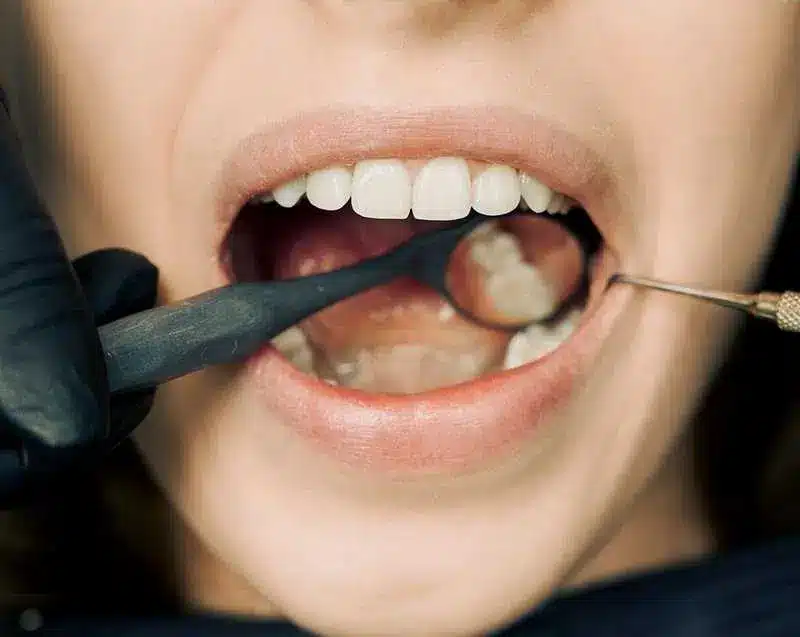
Wisdom teeth come in between the ages of 17 and 25, and treatment involves either monitoring them with regular X-rays when they erupt straight and stay healthy, or removing them when they cause pain, crowding, or infection. Those two paths cover almost every case, and which one applies to you depends on how much room your jaw has and what angle the tooth is growing at. Below we walk through the full eruption timeline from the first signs to the last, what an erupting wisdom tooth actually feels like, what impaction means, how a dentist decides between monitoring and removal, what happens during the procedure itself, and how long recovery takes.
When Do Wisdom Teeth Come In?
Wisdom teeth come in between ages 17 and 25 for most people, with eruption possible as early as 13 and as late as the early 30s. Research published in the Journal of Oral and Maxillofacial Surgery places the average age of wisdom tooth eruption at 19.4 years, with substantial variation between individuals.
That variation traces back to three factors. Genetics runs strongest, so family patterns predict a great deal. Jaw size decides whether there is physical room for the tooth to surface. Individual growth pace shifts the whole schedule forward or backward by a year or two in either direction.
The full developmental sequence starts long before anything is visible. The table below maps each stage against what is happening in the jaw and what a dentist does about it, drawing on the age staging used in pediatric dental practice and on American Dental Association guidance for third molar evaluation.
| Age range | What is happening in the jaw | What shows on an X-ray | What a dentist does |
|---|---|---|---|
| Ages 7 to 10 | Wisdom tooth crowns begin forming inside the jawbone | Early crown formation may be faintly visible | Nothing specific; routine checkups continue |
| Ages 10 to 13 | Crowns finish forming; roots have not started | All four crowns clearly visible if present | Confirms how many wisdom teeth are present |
| Ages 15 to 17 | Roots begin developing; eruption may start in some teens | Root formation and tooth angle become readable | Baseline panoramic X-ray; first position assessment |
| Ages 17 to 21 | Peak eruption window for most people | Available space and impaction risk become clear | Evaluation for monitoring or removal |
| Ages 22 to 25 | Later eruption is still normal and common | Roots close to fully formed | Continued monitoring if teeth are healthy |
| Age 25 and older | Teeth that have not emerged usually remain impacted | Position is essentially final | Long-term monitoring or removal if problems appear |
Reading down that table, the practical takeaway is that the decision point arrives years before the symptoms do. The American Dental Association recommends that wisdom teeth be evaluated by age 18 to determine whether removal is advisable, which sits squarely inside the peak eruption window rather than after it.
What Are Wisdom Teeth?
Wisdom teeth are the third molars, the last four adult teeth to develop, positioned one in each corner of the mouth behind the second molars. Most people develop four of them, though the number varies and some people develop fewer or none at all.
Third molars are ordinary molars in every structural respect. They have the same crown shape, the same chewing function, and the same enamel and dentin makeup as the first and second molars in front of them. What separates them is timing and space. First molars arrive around age six and second molars around age twelve, both while the jaw is still growing, so both usually find room. Third molars arrive after jaw growth has finished, into whatever space is left over.
Leftover space is the entire story of wisdom teeth. Everything that goes right and everything that goes wrong with them follows from how much of it there is.
Where Do Wisdom Teeth Come In?
Wisdom teeth come in at the very back of each dental arch, directly behind the second molars, two on top and two on the bottom. Reach your tongue as far back as it goes along your gum line and the area it lands on is where a wisdom tooth would surface.
Position matters more than it sounds, because the upper and lower pairs sit in different anatomical neighborhoods. Upper wisdom teeth develop in the maxilla near the maxillary sinus, in bone that is relatively soft and porous. Lower wisdom teeth develop in the mandible, in dense bone, and their root tips sit close to the inferior alveolar canal, the channel carrying the nerve that supplies sensation to the lower teeth, chin, and lip.
That proximity to the inferior alveolar canal is why lower wisdom teeth account for most of the discomfort people report during eruption, most impaction cases, and most of the surgical planning around removal. Imaging research indicates roughly 40% of mandibular third molars fail to erupt, mainly for lack of space, and impaction in the lower jaw is consistently more common than in the upper.
What Triggers Wisdom Teeth to Grow?
Wisdom teeth are triggered to grow by root development, which lengthens beneath the crown and pushes the tooth upward through the bone and gum. Nothing external starts the process. It runs on a genetic developmental schedule that begins in childhood.
Root development follows crown formation. The crown forms first inside the jawbone, finishing by the early teens, and only then do the roots begin to lengthen. Lengthening roots need somewhere to go, so they drive the crown toward the surface. The crown pressing upward stretches the bone and then the gum tissue above it, and that stretching is what produces the tenderness most people notice first.
Eruption stops when the tooth reaches its functional position or when something blocks it. Blockage explains why some wisdom teeth surface partway and then sit unchanged for months, since the root is still pushing while the crown has nowhere left to move.
How Early Can Wisdom Teeth Come In?
Wisdom teeth can come in as early as age 13, though eruption before 15 is uncommon. Early eruption usually reflects a larger jaw with genuine room at the back of the arch, which is a favorable sign rather than a concerning one.
Early arrival does shift the evaluation timeline forward. Roots are still forming at 13 and 14, which makes the final position harder to predict, so a dentist seeing an early eruption typically monitors through subsequent visits rather than making a removal decision immediately. Extractions before age 15 are uncommon and reserved for a specific problem such as a cyst or severe crowding.
Teenagers with erupting wisdom teeth benefit most from consistency at this stage, since the position changes measurably between visits. Keeping up with routine teen dental care is what makes a trend visible rather than a single snapshot.
What Is the Oldest Age for Wisdom Teeth?
Wisdom teeth can come in into the early 30s, and 25 is not too old for a wisdom tooth to erupt