

Wisdom teeth are removed when they cause pain, infection, cysts, tumors, gum disease or decay, says the American Dental Association (ADA). Removal also applies to damage to neighboring teeth. The teeth appear between ages 17 and 21. A dentist examines the mouth and takes an X-ray first before advising removal, and the NHS says problem-free teeth are usually monitored.
Key Takeaways
- The ADA lists pain, infection, cysts, tumors, gum disease, decay and neighbor tooth damage as reasons for removal.
- Impacted wisdom teeth are trapped in the jaw or under the gums, and a fully impacted tooth may cause no symptoms.
- NICE advises removal only when there is evidence of disease, and symptom-free teeth are monitored.
- MedlinePlus reports that removal before age 20 often has better results because the roots are not fully developed.
- The ADA says dental X-rays and local anesthesia are safe at any point in pregnancy.
Why Are Wisdom Teeth Removed?
Wisdom teeth are removed because they cause or threaten a problem such as pain, infection, a cyst or neighbor tooth damage. The ADA lists seven reasons: pain, infection, cysts, tumors, damage to neighboring teeth, gum disease and decay that cannot be restored.
The ADA says a dentist may also recommend removal as part of braces or other dental care. A dentist examines the mouth and takes an X-ray first. Our wisdom tooth extraction page explains how we approach this visit.
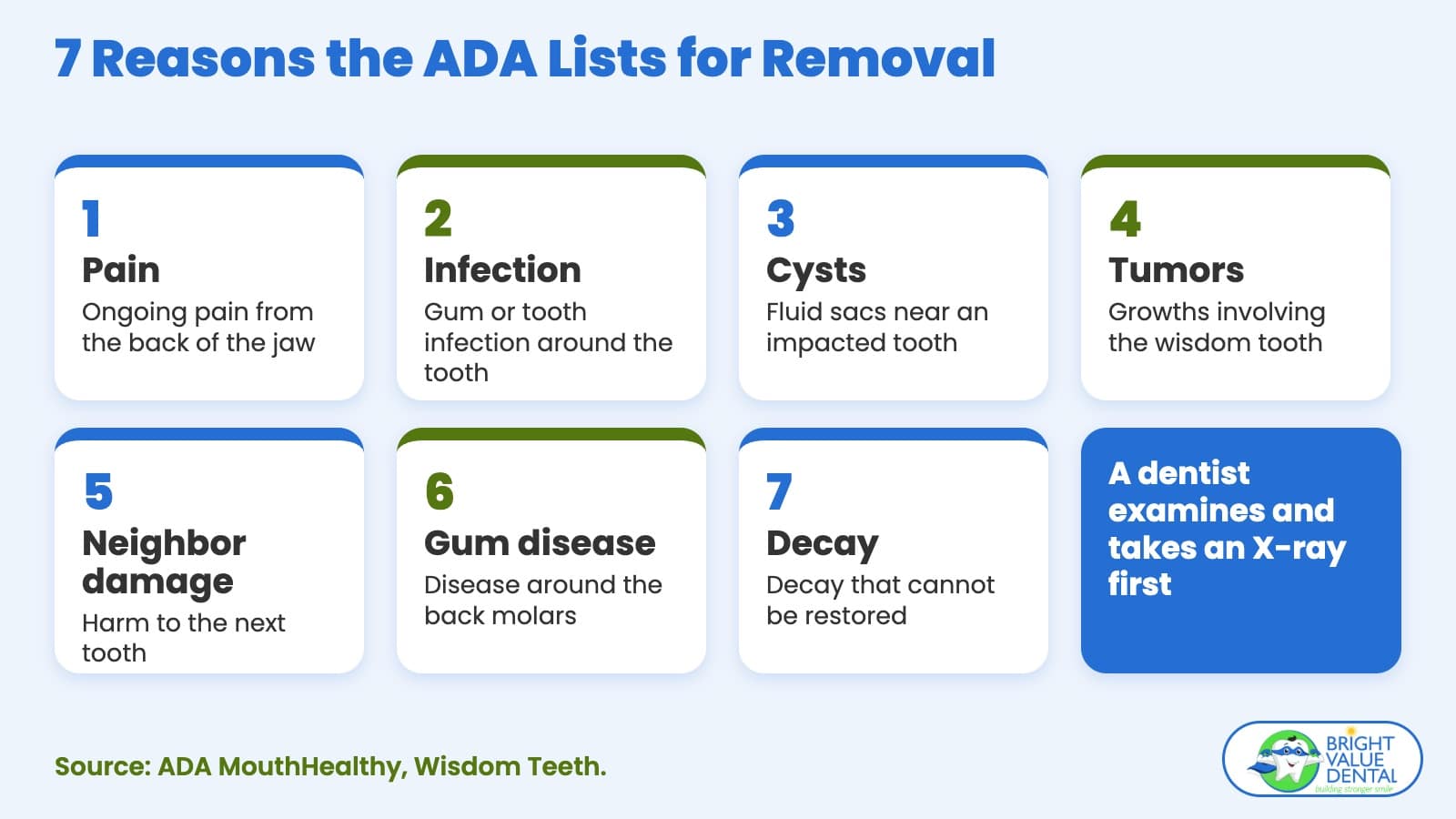
The graphic above shows the seven reasons from the ADA. The next two sections explain the main causes behind them.
What Is an Impacted Wisdom Tooth?
An impacted wisdom tooth is a tooth trapped in the jaw or under the gums. The ADA says this happens when there is not enough space or the tooth comes through in the wrong position. Crowding, a small jaw or a tilted tooth are the causes MedlinePlus names.
MedlinePlus calls impacted wisdom teeth very common and often painless. A fully impacted tooth may have no symptoms at all. The trouble starts when the tooth only partly breaks through.
What Is Pericoronitis?
Pericoronitis is an infection of the gum flap over a partly erupted wisdom tooth. The ADA explains that a partly erupted tooth lets bacteria into the gum. A dental pain review in PMC calls it the most common cause for removal of wisdom teeth.
Symptoms include pain, swelling and jaw stiffness, as stated by the ADA. MedlinePlus adds bad breath and an unpleasant taste near the tooth. Food trapped around the tooth gives cavity-causing bacteria a place to grow.
Do Wisdom Teeth Need to Be Removed?
Wisdom teeth need to be removed only when they show or threaten disease, based on guidance from NICE and the ADA. NICE says surgery should be limited to patients with evidence of pathology. Healthy, symptom-free teeth are monitored at routine visits instead.
Do All Wisdom Teeth Need to Be Removed?
No, not all wisdom teeth need to be removed. The NHS says a tooth that causes no problems is usually left in place and monitored at check-ups. Monitoring replaces removal when the tooth is healthy and can be cleaned.
The ADA adds that kept wisdom teeth need flossing and regular visits. The potential for problems later still exists as people age.
Should Wisdom Teeth Be Removed Before They Cause Problems?
Whether wisdom teeth should be removed before they cause problems is not settled by the evidence. A 2020 Cochrane review found only low- to very low-certainty evidence on removal versus retention of symptom-free impacted teeth.
NICE advised in 2000 that removal of disease-free impacted teeth should be discontinued in the NHS. Cohort studies cited by a BMJ Clinical Evidence review found that 30% to 60% of symptom-free impacted teeth were later extracted.
How Do I Know If I Need My Wisdom Teeth Removed?
Only a dentist can tell whether a patient needs wisdom teeth removed, using an exam and an X-ray. MedlinePlus lists signs of a partly impacted tooth that call for a dental visit.
- Pain or tenderness in the gums or jawbone
- Redness and swelling of the gums around the tooth
- Bad breath or an unpleasant taste
- Difficulty opening the mouth
- Prolonged headache or jaw ache
The ADA advises seeing a dentist right away for wisdom tooth pain. The NHS adds that severe or worsening pain, swelling or fever needs prompt care. Our dental emergencies page covers urgent pain.
When Do You Get Your Wisdom Teeth Removed?
Removal happens once a dentist finds a reason, and MedlinePlus favors before age 20 because results are often better. The ADA says wisdom teeth appear between ages 17 and 21.