
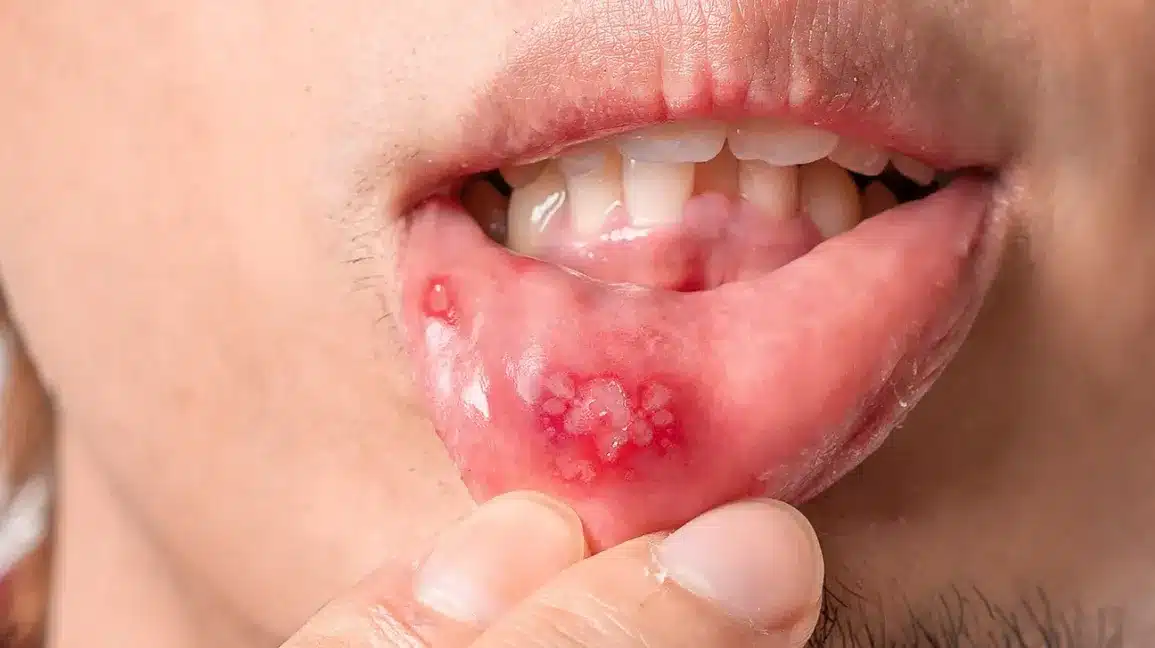
A canker sore on your gum is a small, shallow, non-contagious ulcer that typically heals on its own within one to two weeks. It shows up as a round or oval sore with a white, yellow, or gray center and a bright red border, and it usually hurts far more than its size suggests. You did not catch it from anyone and you cannot pass it to anyone. Below we cover what it looks like, why a sore on the gum specifically is worth a closer look, what triggers these ulcers, how long each type takes to heal, how to stay comfortable while it does, how to brush around it, and the point at which a sore stops being something to wait out.
What Is a Canker Sore on the Gum?
A canker sore on the gum is a shallow ulcer in the soft tissue of your mouth, known clinically as an aphthous ulcer. It is not an infection you caught, it is not related to the virus that causes cold sores, and it is not a sign that you have done anything wrong with your oral hygiene.
Aphthous ulcers are among the most common oral conditions there are. Oral medicine literature puts the average prevalence of recurrent aphthous stomatitis at around 20% of the general population, with reported figures varying widely between populations and study methods. People who get them repeatedly typically experience episodes two to three times a year.
The exact cause remains genuinely unsettled. Research describes aphthous ulcers as an immune-mediated condition influenced by genetics, nutrition, hormones, stress, and minor injury, rather than one thing that can be pointed at and removed. That uncertainty is worth stating plainly, because a lot of content on this topic implies a precision the science does not support. What is well established is how they behave and what helps. We see these regularly alongside the rest of our general dentistry work, and most patients need reassurance and comfort measures rather than treatment.
What Does a Canker Sore on the Gum Look Like?
A canker sore on the gum looks like a round or oval sore with a white, yellow, or gray center surrounded by a bright red, inflamed border. Many people feel a burning or tingling sensation in the spot a day or two before the sore itself appears, which is often the first warning you get.
Size is the useful detail. Minor aphthous ulcers, which account for roughly 70% to 80% of cases, measure around 5 millimeters, about the width of a pencil eraser. The sore sits flat or slightly sunken rather than raised, and the surrounding tissue looks angry and red. Pain peaks in the first few days, particularly when something touches it, and then eases well before the sore has visibly disappeared.
What Is the White Stuff in a Canker Sore?
The white or yellow material in the center of a canker sore is a fibrin membrane, a natural protein layer your body forms over the exposed tissue. It is not pus, it is not infection, and it is not food debris, which is why it does not come away when you rinse or brush.
Fibrin is the same protein involved in forming a scab on your skin. Inside the mouth it cannot dry into a crust, so it stays soft and pale. The membrane is doing a job, covering raw nerve endings and giving new tissue a surface to grow underneath. Leaving it alone is the correct approach, which we come back to in the questions at the end of this article.
Can You Get a Canker Sore on the Gum Line Above or Below a Tooth?
You can get an ulcer anywhere in the mouth, including on the gum line above or below a tooth, on the upper gum, and on the lower gum. Classic aphthous ulcers, though, tend to arise on the movable tissue inside the lips and cheeks, under the tongue, and on the floor of the mouth rather than on the firm gum tissue attached to the bone.
That distinction is the single most useful thing on this page, and almost nobody mentions it. The attached gum, the firm pink tissue hugging your teeth, is tougher and more keratinized than the loose tissue that lines your cheeks. Aphthous ulcers favor the loose tissue. A sore sitting right on the attached gum can still be a canker sore, and often is, particularly near the gum line where the tissue becomes more mobile. But it is also the location where other things get mistaken for one, which is what the next section is about.
What Can Be Mistaken for a Canker Sore on the Gums?
Things commonly mistaken for a canker sore on the gums include a draining abscess, a traumatic ulcer from an appliance or a toothbrush, a cold sore near the lip margin, and localized gum inflammation. Location matters because the same white-and-red appearance can belong to a sore that resolves itself or to an infection that needs treating.
Localized inflammation is the most common lookalike. A patch of gum that is red, swollen, and tender is often the early tissue response that leads toward gum disease rather than an ulcer at all. Inflammation of that kind does not form a defined white center and does not heal in two weeks the way an aphthous ulcer does. It responds to cleaning rather than to waiting.
Is It a Canker Sore or a Gum Abscess?
A gum abscess forms a raised bump rather than a flat shallow ulcer, and it often comes with throbbing tooth pain, swelling, a bad taste, or drainage. An abscess draining through the gum creates a small opening that can look strikingly like a canker sore, which is why a sore paired with tooth pain should never be waited out.
The distinguishing features are straightforward once you know them. A canker sore is flat or sunken, it hurts on contact but not spontaneously, the tooth beside it feels fine, and there is no swelling in the surrounding face or jaw. An abscess sits raised like a pimple, the nearby tooth is usually sensitive to pressure or temperature, and pain can be constant rather than triggered by touch.
The reason this matters is that an untreated dental infection does not stay local. Our post on the signs of a spreading tooth infection covers what to watch for. If a sore on your gum comes with tooth pain, swelling, or fever, treat it as an infection until a dentist tells you otherwise.
Canker Sore vs Cold Sore: What’s the Difference?
Canker sores appear inside the mouth and are not contagious, while cold sores appear outside the mouth on the lips and surrounding skin and are highly contagious. Cold sores are caused by the herpes simplex virus; canker sores involve no virus and no bacteria at all.
The two also look different once you know what to compare. Cold sores begin as a cluster of small fluid-filled blisters that break and crust over, and they recur in the same spot because the virus lives in the nerve. Canker sores are single shallow ulcers with a white center from the start, they appear in different places each time, and they never form blisters or crusts. A sore on your gum is on the inside, which already rules out a classic cold sore.
Could It Be Denture or Appliance Irritation?
A sore that keeps appearing in the same spot on the gum is very often mechanical irritation rather than a true canker sore. A denture edge, a partial clasp, a retainer, or an orthodontic bracket rubbing the same patch of tissue produces a traumatic ulcer that will keep coming back until the appliance is adjusted.
Traumatic ulcers look almost identical to aphthous ulcers, which is why they get self-diagnosed as canker sores for months. The tell is the pattern: same location, every time, and a sore that heals whenever the appliance is out and returns when it goes back in. Our post on the problems that come with ill-fitting dentures covers how that cycle develops.
This one is worth fixing rather than managing, because it is fixable in a single visit. A denture adjustment takes minutes and removes the cause entirely, and orthodontic wax over a rough bracket does the same job temporarily until you can be seen.
Why Am I Suddenly Getting Canker Sores on My Gums?
Canker sores appear suddenly because several unrelated triggers can set off the same immune response in the mouth lining. The most common are minor injury to the tissue, acidic or spicy foods, toothpaste and mouthwash ingredients, stress, hormonal shifts, and nutritional deficiencies.
Minor injury is the one most people overlook. Catching the gum with a toothbrush, scraping it on a crusty piece of bread or a tortilla chip, biting the tissue, or irritation from braces and dentures all break the surface just enough to start one. A sudden run of sores usually means one of these triggers changed recently rather than that something has gone wrong with your health.
Are Canker Sores From Poor Hygiene?
No, canker sores are not caused by poor hygiene. People with excellent brushing and flossing habits get them just as often, and aggressive brushing actually makes them more likely by injuring the tissue.
This misconception causes real guilt in patients who are already doing everything right. Aphthous ulcers are an immune response in the mouth lining, not a hygiene failure or a bacterial infection. Good hygiene does help indirectly by keeping the surrounding tissue healthy and reducing irritation, but no amount of brushing prevents them entirely, and brushing harder makes things worse rather than better.
Does Sodium Lauryl Sulfate Cause Canker Sores?
Sodium lauryl sulfate, the foaming agent in most toothpastes, is associated with more frequent canker sores in people who are sensitive to it. Switching to an SLS-free toothpaste is one of the simplest changes available, and patients who are sensitive often notice a difference within a month or two.
SLS is a detergent that creates the lather people associate with a clean mouth. In susceptible people it appears to strip the protective layer on the mouth lining, leaving the tissue more vulnerable. Not everyone reacts to it, so this is worth testing rather than assuming. Check the active and inactive ingredient list on the back of the tube; SLS-free options are widely available and clean just as effectively, since the foam was never doing the cleaning.
Can Stress Cause Canker Sores?
Stress is one of the most consistently reported triggers for canker sores, though it works as a contributor rather than a direct cause. Sustained stress affects immune regulation, and aphthous ulcers are an immune-mediated condition, which is the proposed link.
Patients frequently notice outbreaks clustering around exams, deadlines, illness, or poor sleep. Stress also drives behaviors that injure the tissue directly, including cheek biting, jaw clenching, and rushed aggressive brushing. If your sores track with stressful periods, that pattern is real and worth noting rather than dismissing.
Are Canker Sores Linked to Vitamin Deficiency?
Recurrent canker sores are linked to deficiencies in iron, vitamin B12, and folate at rates well above the general population. One study of 32 adults with recurrent aphthous ulcers found blood nutrient deficiencies in 56.2% of them compared with 7% of controls living in the same area, and anemia in 34.4% versus 6.9%.
Larger studies find the same pattern at varying strength. A study of 143 patients reported nutrient deficiencies in 37.8%, with low vitamin B12 in 26.6% and low ferritin in 16.8%. A separate review of 273 patients found anemia in 20.9% and low serum iron in 20.1%. A meta-analysis pooling 13 studies calculated that people with vitamin B12 deficiency were roughly 2.9 times more likely to develop recurrent aphthous ulcers.
Those numbers apply to people getting sores repeatedly, not to someone with an occasional one. If you are getting them often, a conversation with your physician about blood work is a reasonable next step, because correcting an underlying deficiency addresses the cause rather than the symptom. That is a medical conversation rather than a dental one, and it is worth having.
Are Canker Sores Hereditary?
Yes, canker sores have a strong hereditary component. Clinical literature reports that a person’s likelihood of developing recurrent aphthous ulcers is around 90% when both parents are affected and around 20% when one parent is.
Family history explains a great deal of why two people with identical habits have completely different experiences with mouth ulcers. It also means that if these run in your family, prevention is about reducing frequency and severity rather than eliminating them. That is an achievable goal and a realistic one.
How Long Do Gum Canker Sores Take to Heal?
Most canker sores on the gum heal within one to two weeks without treatment and without scarring. Healing time depends on which of the three types you have, and the large majority of people only ever get the smallest and fastest-healing kind.
The classification below follows the standard clinical framework used in oral medicine, based on ulcer size, location, and healing behavior.
| Type | Share of cases | Typical size | Healing time | Scarring |
|---|---|---|---|---|
| Minor | Roughly 70% to 80% | About 5 mm, under 1 cm | 7 to 10 days | None |
| Major | Roughly 10% to 15% | 10 to 30 mm, over 1 cm | Two to six weeks | Possible |
| Herpetiform | Roughly 5% to 10% | Clusters of many tiny ulcers | One to two weeks | Uncommon |
Despite the name, herpetiform ulcers have nothing to do with the herpes virus. The label refers only to the clustered appearance, which resembles a viral outbreak without being one.
Do Canker Sores Leave Scars?
Minor canker sores do not leave scars, while major ulcers sometimes do because they extend deeper into the tissue. Since minor ulcers account for the large majority of cases, most people never see any lasting mark once a sore has healed.
A patch of tissue that looks slightly different for a week or two after healing is normal and usually resolves. Anything that remains visibly changed in the same spot for longer than that deserves an examination, since persistent tissue change is a different signal from a healing ulcer.
How Do You Heal a Canker Sore on the Gum?
You heal a canker sore on the gum by protecting it from further irritation and managing the pain while your body does the healing. No treatment makes the tissue repair itself faster, but reducing irritation prevents the sore from being reinjured and lets it heal on its normal schedule rather than a longer one.
These measures give the most relief:
- Rinse gently with warm salt water several times a day, especially after meals, to keep the area clean and reduce soreness.
- Use an over-the-counter numbing gel applied directly to the sore before meals, following the package directions exactly.
- Switch to an SLS-free toothpaste while the sore heals, and consider staying on it if sores are frequent.
- Avoid acidic, spicy, salty, and crunchy foods until the tissue has closed over.
- Keep the area cool. Cold water, ice chips, and cool foods numb the sore temporarily without any product at all.
- Leave it alone. No poking with the tongue, no touching with a fingernail, and no attempting to clean off the white center.
Most people find the pain drops off noticeably after the first three or four days even though the sore is still clearly visible. That is the expected pattern rather than a sign something has stalled.
What Is the Fastest Way to Heal a Canker Sore?
The fastest way to heal a canker sore is to remove every source of irritation while it heals, because reinjury is what turns a ten-day sore into a three-week one. Nothing available over the counter accelerates tissue repair itself, and any product promising to is overstating what it does.
Practical speed comes from consistency. Keeping acidic food away from it, brushing around rather than over it, and avoiding the reflex to prod it with your tongue all protect the fragile new tissue forming under the fibrin layer. Every time that layer is disturbed, the clock restarts on that portion of healing.
Does Mouthwash Help Canker Sores?
Mouthwash can help a canker sore if you choose the right kind, and it can make things noticeably worse if you do not. Alcohol-based mouthwashes sting badly and irritate already-inflamed tissue, so an alcohol-free formula is the better choice while a sore is present.
Antimicrobial rinses reduce the bacterial load around the sore, which supports healing without directly speeding it. Prescription-strength rinses are sometimes used for patients with frequent or severe outbreaks, and those are prescribed based on an examination rather than picked off a shelf. If a rinse stings sharply on contact, that is a signal to stop using it rather than to push through.
What Foods Should You Avoid With a Canker Sore on the Gum?
Avoid acidic, spicy, salty, and crunchy foods while a canker sore is healing. Citrus, tomatoes and tomato sauces, vinegar, hot peppers, chips, crusty bread, and very hot drinks are the items patients most often identify as the worst offenders.
Acid is the primary problem, because it contacts exposed nerve endings directly. Crunchy and sharp-edged foods are the mechanical problem, scraping the sore and the fibrin layer covering it. Very hot food and drink irritate inflamed tissue on contact and make the throb worse for an hour afterward.
Cool, soft, mild foods carry you through comfortably. Yogurt, eggs, smooth soups at room temperature, oatmeal, and soft fruit all work. Chewing on the opposite side helps when the sore sits near a specific tooth, and drinking plenty of water keeps the mouth from getting dry, which makes every mouth sore feel worse.
How Do You Brush and Floss With a Canker Sore on the Gum?
Brush and floss as normal everywhere else, and clean gently around the sore rather than skipping it entirely. A sore sitting on the gum line is directly in the path of your toothbrush, which is exactly why technique matters more here than for a sore inside the cheek.
Use a soft-bristled brush and light pressure, angling the bristles along the gum line and easing off as you reach the sore. Approach it from the side rather than dragging the brush straight across it. Floss the teeth on either side carefully, sliding the floss out sideways instead of snapping it upward against the tissue.
Abandoning the area altogether is the mistake to avoid. Plaque building up next to an ulcer irritates the tissue further and slows everything down. A few gentle seconds beats skipping the spot for a week, and it keeps the rest of your oral hygiene routine intact while the sore resolves.
How Do You Prevent Canker Sores on Your Gums?
You prevent canker sores on your gums by removing the triggers you can control and reducing the mechanical injury that starts most of them. Prevention reduces frequency and severity rather than eliminating them entirely, particularly for people with a family history.
Work through these in order of impact:
- Switch to an SLS-free toothpaste and give it six to eight weeks before judging the result.
- Use a soft-bristled brush with light pressure, since aggressive brushing is one of the most common causes of the initial injury.
- Have any rough appliance or restoration adjusted rather than living with it, including denture edges, partial clasps, and orthodontic brackets.
- Identify your food triggers by keeping a short note of what you ate in the two days before a sore appeared.
- Switch to an alcohol-free mouthwash if you use one at all.
- Address sustained stress and poor sleep, which show up repeatedly in patients who get outbreaks in clusters.
- Ask your physician about blood work if sores recur several times a year, since correcting an iron, B12, or folate deficiency addresses the cause directly.
Consistent regular cleanings support all of this by keeping the surrounding tissue healthy and by catching rough edges on restorations before they start causing trouble.
My Canker Sore Won’t Go Away. What Should I Do?
If a canker sore has not healed within two weeks, have it examined rather than continuing to wait. The two-week mark is the standard clinical threshold because most ordinary ulcers resolve well inside it, and anything that persists past it needs to be looked at rather than assumed.
Major aphthous ulcers genuinely do take longer, sometimes several weeks, so a persistent sore is not automatically a problem. What it does need is a professional set of eyes rather than more waiting. A dental exam takes a few minutes, identifies what type of sore it is, and rules out the causes that need a different approach, including mechanical irritation that will keep the sore coming back indefinitely.
When Should You See a Dentist About a Mouth Sore?
See a dentist about a mouth sore if it lasts more than two weeks, is larger than about a centimeter, keeps returning in the same spot, comes with fever or facial swelling, or makes eating and drinking difficult. A first-ever mouth sore appearing after age 30 is also worth having checked, since most people who get these have had them since their teens or twenties.
Sores that arrive alongside tooth pain, swelling, or a bad taste deserve attention the same day rather than in two weeks, because those features point toward infection rather than an ulcer. We welcome walk-ins and keep same-day care available for exactly that situation.
Should I Be Worried if I Have Canker Sores?
No, occasional canker sores are not a cause for worry. They are one of the most common oral conditions there is, affecting roughly a fifth of the population, and the vast majority heal completely on their own with no lasting effect.
The circumstances that do warrant attention are specific and few: a sore that outlasts two weeks, one that keeps recurring several times a year, or one paired with symptoms elsewhere in the body. The first is a reason for an examination. The second is a reason to look into nutritional or mechanical causes. The third is a reason to speak with a physician as well as a dentist. None of those is a reason for alarm, and all three are reasons to get information rather than to worry in silence.
Can Children Get Canker Sores?
Yes, children get canker sores, and they are common from roughly school age onward. Kids often struggle to describe the pain precisely and may simply refuse food or complain that eating hurts, which is frequently the first sign a parent notices.
The same triggers apply, with a few that show up more in children: braces and orthodontic appliances rubbing the tissue, injury from falls and sports, and the habit of chewing on pens and pencils. Treatment is the same, with softer foods, gentle brushing, and cool drinks doing most of the work. Numbing gels intended for adults are not always appropriate for young children, so check the label carefully and ask before using one.
A sore in a child that lasts beyond two weeks, or recurring sores paired with poor growth or fatigue, is worth raising with both a dentist and a pediatrician. Our children’s dentistry team is comfortable examining mouth sores in kids without making the visit frightening.
What a Dentist Can Do for a Canker Sore
A dentist can confirm what the sore actually is, provide in-office treatment that relieves the pain quickly, fix the mechanical cause when there is one, and advise on next steps when sores keep returning. Most canker sores need none of that, and the ones that do tend to be the ones people have been quietly enduring for weeks.
Identification is the most valuable part. A few minutes of examination separates an aphthous ulcer from a traumatic ulcer, a draining abscess, or localized gum inflammation, and those four situations call for four different responses. Getting that right saves people from waiting out something that was never going to resolve on its own.
Dr. Yu offers an in-office topical treatment that takes the edge off canker sore pain quickly, which makes a real difference for patients who cannot eat comfortably. Adjusting a denture edge, smoothing a rough restoration, or fitting a small amount of wax over an orthodontic bracket removes the cause outright when the sore is mechanical. For patients getting sores several times a year, we will suggest a conversation with your physician about blood work, because the deficiency data on recurrent ulcers is strong enough to be worth ruling in or out.
Our Southwest Houston office welcomes walk-ins and keeps evening and Saturday hours, so a sore that is making it hard to eat does not have to wait for a convenient weekday. That same access is part of the routine care we provide for families across the area.
Frequently Asked Questions
Is a Canker Sore on the Gum Contagious?
A canker sore on the gum is not contagious in any way. There is no virus and no bacteria involved, so it cannot be passed through kissing, sharing drinks, or sharing utensils. Cold sores, which appear on the outside of the lips, are contagious, and that difference is the source of most of the confusion on this point.
Does Drinking Water Help Heal Mouth Ulcers?
Drinking water helps mouth ulcers feel better without speeding up the healing itself. A dry mouth makes every oral sore hurt more, because saliva normally cushions and protects the tissue. Staying well hydrated keeps saliva flow up, rinses away food debris, and makes eating noticeably more comfortable while the sore resolves.
Does Hydrogen Peroxide Help a Canker Sore?
A properly diluted hydrogen peroxide rinse can help keep the area around a canker sore clean, though it does not speed healing and it is easy to get wrong. Using it too strong or too often irritates the tissue and prolongs the discomfort. Warm salt water achieves most of the same benefit with none of the risk, so ask your dentist before adding anything stronger to your routine.
What Happens if You Remove the White Part of a Canker Sore?
Removing the white part of a canker sore exposes raw tissue, causes sharp pain and bleeding, and sets healing backward. That layer is a protective fibrin membrane your body formed deliberately, not debris that needs clearing away. Leave it in place and it will disappear on its own as the tissue underneath closes over.
Can You Use Numbing Gel on a Canker Sore on the Gum?
You can use an over-the-counter numbing gel on a canker sore on the gum, applied directly to the sore and following the package directions. Applying it shortly before meals is when it helps most, since eating is usually the worst part of the day. Read the warnings on the package carefully, particularly regarding use in children and frequency of application.
Why Do Canker Sores Hurt So Much for Their Size?
Canker sores hurt disproportionately because the mouth lining is densely supplied with nerve endings, and an ulcer exposes them directly. A sore measuring five millimeters exposes more nerve tissue than a comparable scrape on your arm would. Constant movement from talking, chewing, and swallowing keeps disturbing the area, which is why an ulcer in the mouth is more noticeable than a cut of similar size anywhere else.
The Bottom Line
A canker sore on your gum is a small, shallow, non-contagious ulcer that heals on its own in one to two weeks. Protect it from acidic and crunchy food, rinse with warm salt water, brush gently around it, use a numbing gel before meals if you need one, and resist every urge to touch it. Switching to an SLS-free toothpaste is the single most effective change available for people who get them often.
Two things are worth remembering beyond the comfort measures. A sore on the gum specifically is the one location where other conditions get mistaken for an ulcer, so a sore paired with tooth pain, swelling, or a raised bump deserves a look rather than a wait. And any mouth sore that outlasts two weeks should be examined, not because it is likely to be serious but because that is how you find out it is not. Our Houston team sees these every week and can tell you in a few minutes exactly what you are dealing with. Reach Bright Value Dental at 713-668-1600, or check current appointment times if eating has become difficult.