
Wisdom teeth pain relief starts with a pain reliever, a cold compress and saltwater rinses while you wait for a dental visit. A Cochrane review of seven trials found ibuprofen 400 mg gave more relief than 1000 mg of paracetamol after wisdom tooth surgery. Home care calms symptoms only. A dentist treats the cause, and the NHS advises a visit when toothache lasts more than 2 days.
Key Takeaways
- The NHS lists painkillers, mouth gel, salt water and soft foods for toothache while you wait for an appointment.
- MedlinePlus advises a cold compress for 10 to 20 minutes at a time to reduce swelling and pain.
- Cleveland Clinic says mild pericoronitis lasts a few days and severe cases several weeks.
- The NHS advises a dentist visit when toothache lasts more than 2 days.
- Swelling that makes breathing or swallowing hard needs emergency care, the NHS says.
How Can You Get Wisdom Teeth Pain Relief at Home?
Wisdom teeth pain relief at home combines a pain reliever, a cold compress, warm saltwater rinses and soft foods. The NHS lists these steps for toothache while you wait for a dental appointment. They calm symptoms but do not treat the cause.
A dentist finds the cause with an exam and an X-ray. Our wisdom tooth consultation starts with that exam so the plan fits the problem.
The sections below cover each home option, then the causes and timelines behind the pain.
What Helps With Wisdom Teeth Pain Besides Medicine?
What helps with wisdom teeth pain besides medicine is cold compresses, warm saltwater rinses, soft foods and gentle brushing. Each step has a named source and a clear limit. The table below lists them.
The NHS says children should not rinse with salt water because they may swallow it. The NHS also advises against smoking and against very hot, very cold or sweet foods.
Which Painkillers Help With Wisdom Teeth Pain?
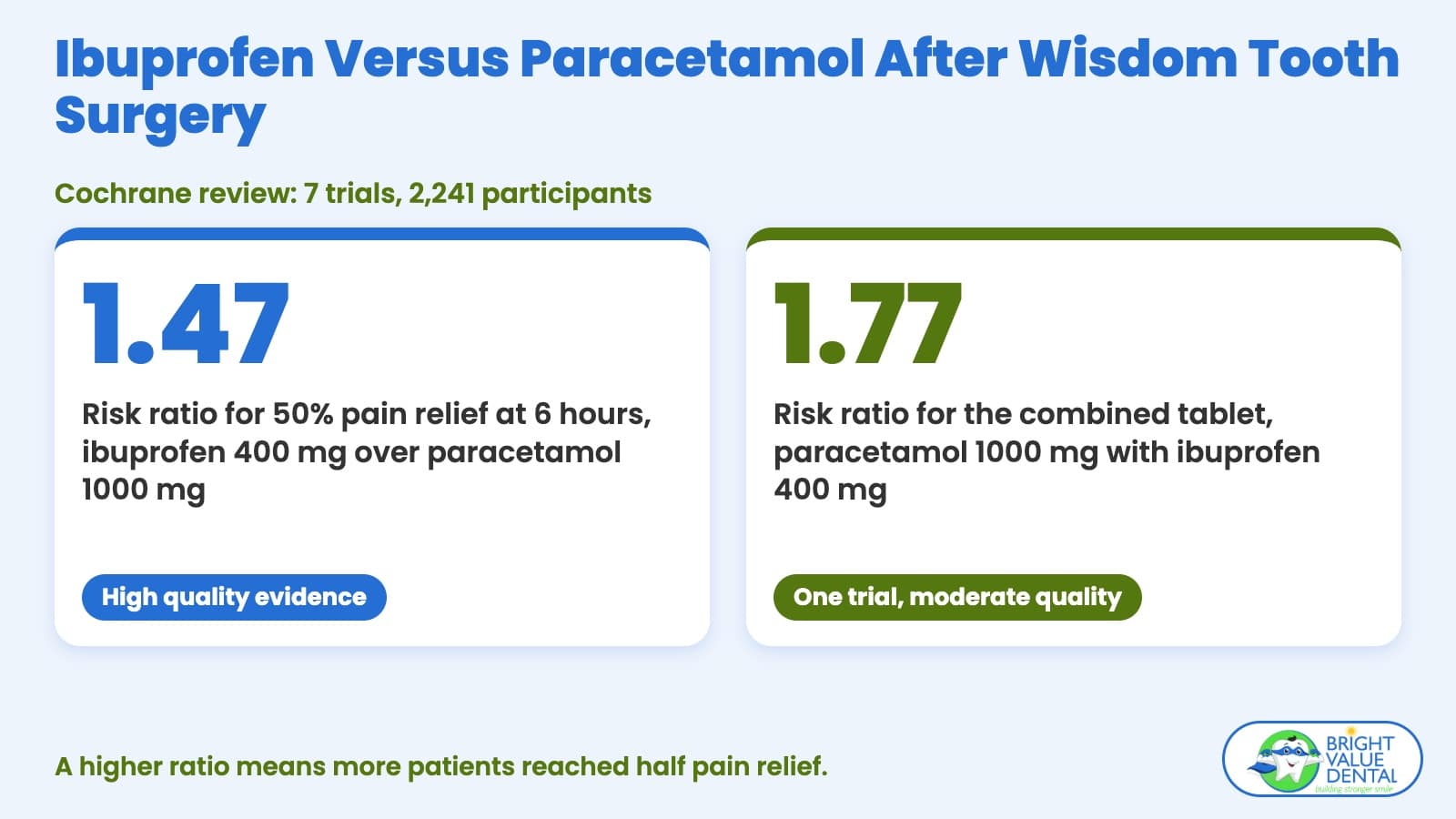
Ibuprofen and paracetamol (acetaminophen) are the painkillers the NHS and Cleveland Clinic name for wisdom teeth pain. A Cochrane review pooled seven trials with 2,241 participants after surgical removal of lower wisdom teeth. The review found high-quality evidence that ibuprofen 400 mg beats 1000 mg of paracetamol.
The risk ratio for at least 50% pain relief at six hours was 1.47. One trial of a combined tablet reached 1.77, rated moderate quality. The graphic below shows both ratios.
MedlinePlus says adults may take nonprescription ibuprofen every 4 to 6 hours with food or milk. The limit is 6 doses in 24 hours. Ibuprofen can cause ulcers and bleeding. MedlinePlus advises calling a doctor if pain lasts more than 10 days. The NHS says children under 16 should not take aspirin. A pharmacist can match any pain reliever to your health history.
What Is the 3-3-3 Rule for Toothache?
The 3-3-3 rule for toothache is an online shortcut, not a rule from MedlinePlus or the NHS. Label directions set the limits instead of a three-day rule. MedlinePlus caps adult nonprescription ibuprofen at 6 doses in 24 hours.
The NHS advises seeing a dentist when toothache lasts more than 2 days. That advice applies no matter which pain reliever you use.
How to Sleep With Wisdom Teeth Pain?
To sleep with wisdom teeth pain, raise your head on extra pillows. The Bedfordshire Hospitals NHS Trust advises this position after tooth removal. Pair it with a few steps before bed. Follow this order.
- Take a pain reliever as the label directs, with food or milk.
- Hold a cold pack wrapped in a towel on the cheek for 10 to 20 minutes.
- Rinse gently with warm salt water.
- Stack two or three pillows so your head sits above your chest.
- Sleep on the side away from the sore tooth.
The NHS advises a dental call when pain stays after painkillers. A swollen cheek or jaw is another reason to call.
What Causes Wisdom Teeth Pain?
Wisdom teeth pain comes from crowding, a wrong angle, gum infection or a cyst, says the American Dental Association (ADA). Each cause has its own signs. The list below names the four causes.
- Eruption trouble: a tooth that lacks room to surface or comes through at a wrong angle.
- Impaction: a tooth trapped in the jaw or under the gums.
- Pericoronitis: swelling of gum tissue around a partly erupted tooth, per Cleveland Clinic.
- Cysts: a pocket that can form on or near an impacted tooth, per the ADA.
The ADA adds that a cyst can damage nearby roots or the bone that supports teeth. The next questions look at each cause in turn. The graphic below shows the four causes.