
No, you should not sleep with dentures in unless your dentist tells you to. The NHS advises removing dentures every night, and MedlinePlus says to store them in water or a denture-cleansing liquid. A 2015 study of 453 older denture wearers linked overnight wear to a 2.38 times higher pneumonia risk. New immediate dentures are the main exception, for the first 24 hours.
Key Takeaways
- The NHS says not to wear dentures overnight unless your dentist recommends it.
- The ADA says to keep dentures in water or a denture cleanser when not worn, and never in hot or boiling water.
- A 2015 study tied overnight wear to a 2.38 times higher pneumonia risk in adults aged 85 and older.
- A Leeds Teaching Hospitals NHS Trust leaflet says immediate dentures stay in for the first 24 hours.
- ADA MouthHealthy says a partial denture comes out at bedtime once it fits well.
Can You Sleep with Dentures In?
Sleeping with dentures in is not advised unless your dentist recommends it, according to the NHS. Take dentures out every night so the gums rest and the dentures can soak. MedlinePlus, from the National Institute on Aging, gives the same instruction. The answer to can you sleep with dentures in is therefore no on routine nights.
We apply this rule to removable dentures of every type, and the dentist adjusts the plan for each patient. The exceptions are specific and short, and the sections below cover them one by one.
Do Dentures Need to Be Removed at Night?
Yes, dentures need to be removed at night, according to the NHS and MedlinePlus. The NHS lists trapped food, gum infection, tooth decay and a risk of choking as the reasons. The Leeds Teaching Hospitals NHS Trust adds that removal gives the gums a period of rest. Removable dentures come out every night unless a dentist says otherwise.
Implant-supported dentures are a separate case. The ADA says removing them gives access to the implant abutments for cleaning. Ask the dentist whether yours come out at night.
Is It Okay to Leave Your Dentures In All the Time?
No, leaving dentures in all the time is not recommended. The NHS says to remove them every night unless your dentist advises otherwise. A 2011 review in the Journal of Prosthodontics lists continual and nighttime wearing among the factors behind denture stomatitis. Constant wear keeps the tissue under the denture covered day and night.
How Many Hours a Day Should I Wear Dentures?
Daytime wear with nightly removal is the pattern the NHS and MedlinePlus describe, and neither agency sets a fixed hour count. ADA MouthHealthy says new dentures may feel awkward for a few weeks. The dentist checks the fit at follow-up visits and adjusts sore spots.
Wearers who want daily-routine tips can read about living with dentures on our blog. Practice makes taking dentures in and out easier, the NHS adds.
What Happens If You Sleep with Dentures In?
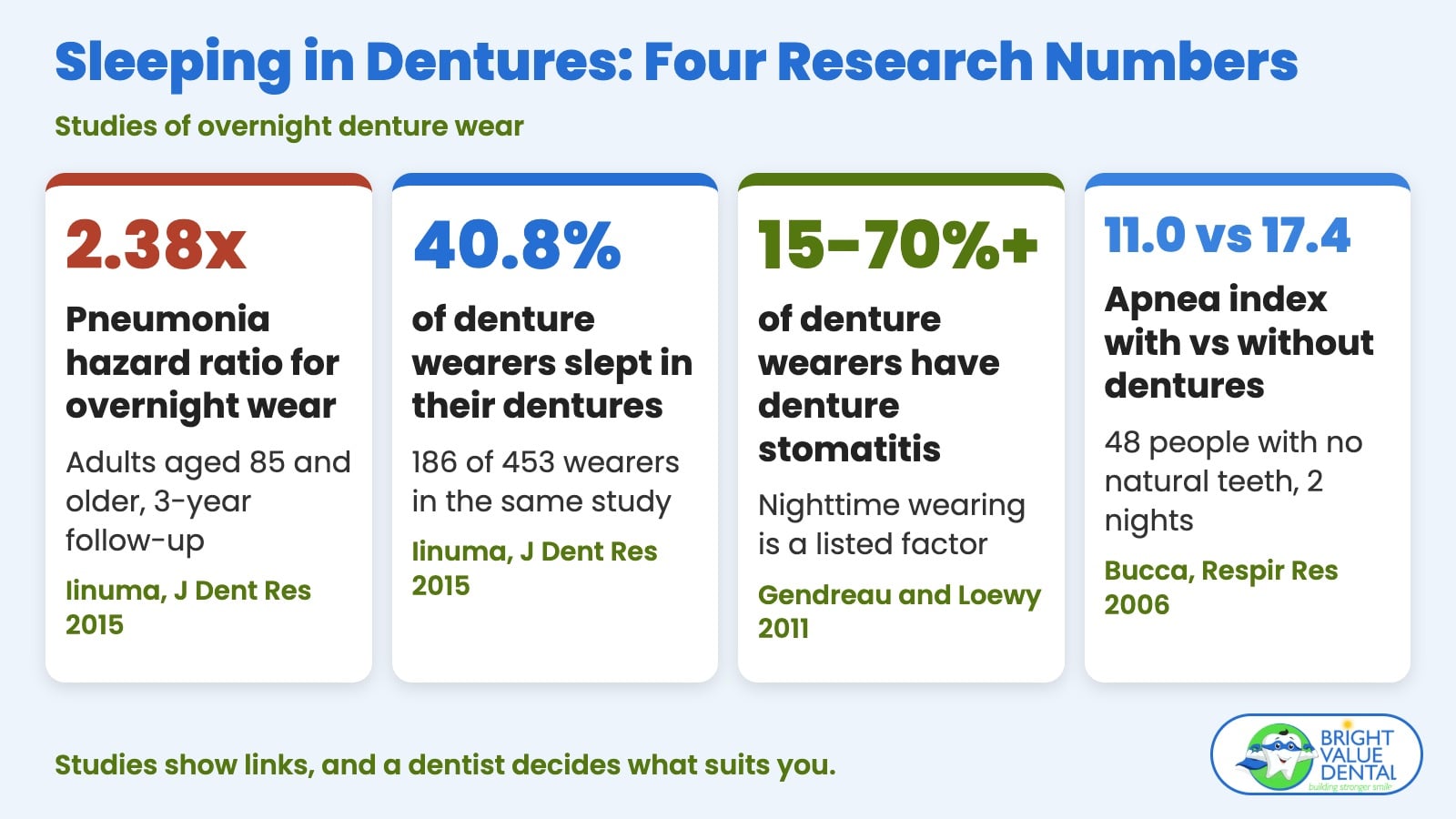
What happens if you sleep with dentures in is documented in three areas: yeast, gum inflammation and pneumonia risk. A 2015 study in the Journal of Dental Research followed 524 community-living adults aged 85 and older. Among 453 denture wearers, 186 (40.8%) wore dentures during sleep.
Those sleepers were more likely to have tongue and denture plaque, gum inflammation and a positive Candida albicans culture. The table below lists what each source reports about overnight wear.
Each row comes from a named source, and the next sections explain the two biggest findings.
Can Sleeping in Dentures Cause Infection?
Sleeping in dentures can contribute to infection, because the Gendreau and Loewy review lists nighttime wearing among the factors behind denture stomatitis. Denture stomatitis is inflammation and redness of the mouth tissue covered by the denture. Researchers report it in 15% to over 70% of denture wearers, depending on the group studied.
Candida albicans, a yeast, colonizes the denture and the mouth surfaces. The review adds that antifungal treatment relieves symptoms, yet stomatitis returns unless dentures are decontaminated and kept clean.
A study of 70 complete denture wearers found stomatitis tied to denture cleanliness and yeast presence. The study found no link to how often dentures were brushed. Your dentist checks the tissue under the denture during routine exams.
Can Sleeping with Dentures Cause Pneumonia?
Sleeping with dentures is linked to pneumonia in very elderly adults, according to the 2015 Journal of Dental Research study. Overnight denture wearing carried a hazard ratio of 2.38 for pneumonia over three years. The 95% confidence interval was 1.25 to 4.56.
The study counted 48 pneumonia events, 20 deaths and 28 hospitalizations. Swallowing difficulty carried a similar ratio of 2.31. The participants had a mean age of 87.8, and the authors describe an association, not proof of cause.
The graphic below shows four numbers from the studies in this section.
Why Do Gums Need a Break from Dentures at Night?
Gums need a rest from dentures at night, according to a Leeds Teaching Hospitals NHS Trust leaflet. Taking dentures out also gives time to soak them. Long night wear can lead to fungal infections beneath the dentures, the leaflet says.
Morning care helps too. ADA MouthHealthy says to brush the gums, tongue and roof of the mouth with a soft-bristle brush. Brushing before inserting dentures stimulates circulation in the tissues.
Can You Sleep with New Dentures In?
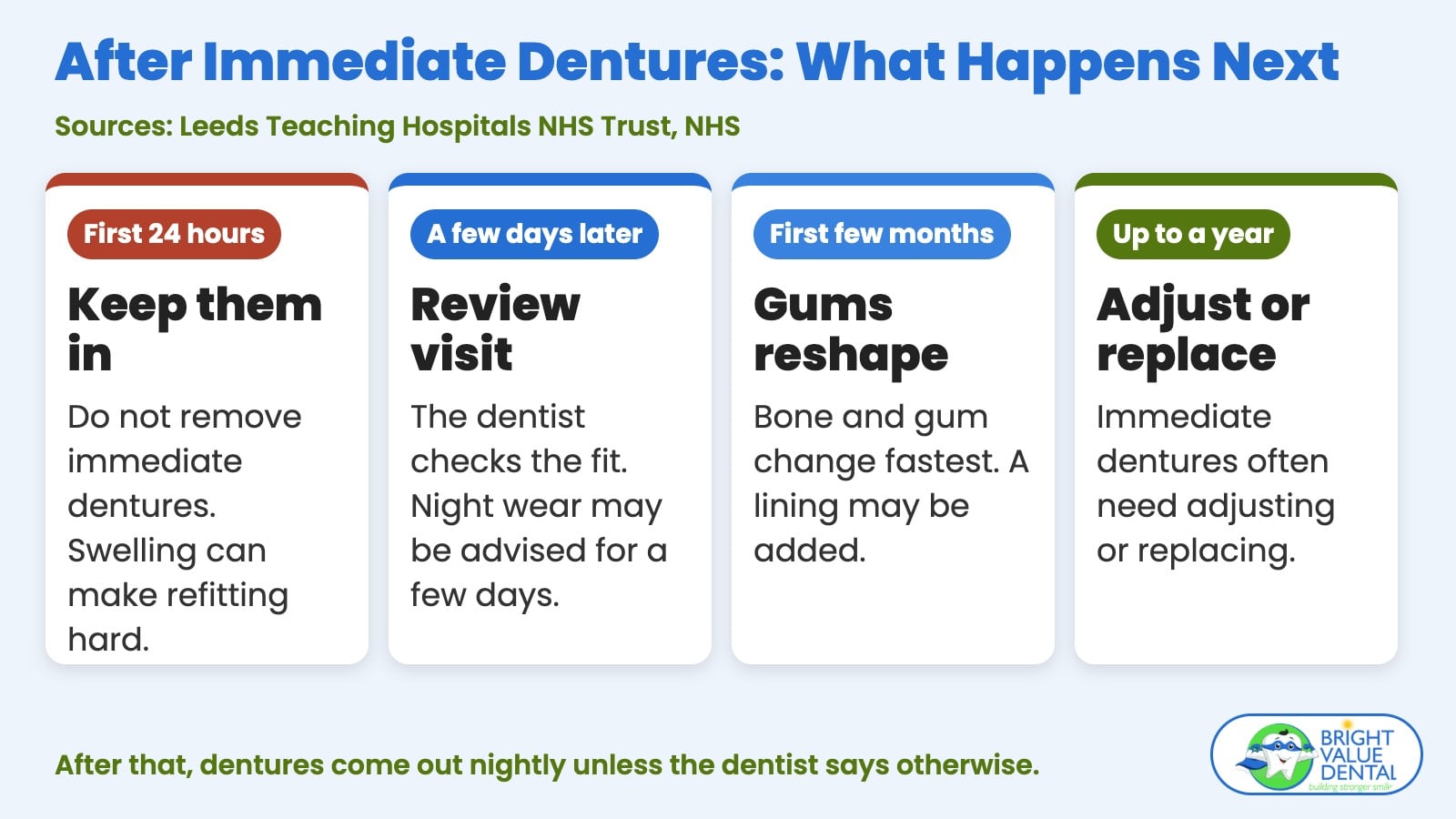
Sleeping with new dentures in is allowed only on your dentist’s instruction, and immediate dentures are the main case. A 2025 Leeds Teaching Hospitals NHS Trust leaflet says immediate dentures stay in for the first 24 hours. Removing them sooner can make refitting hard, because swelling develops where the teeth were taken out.
The same leaflet says the dentist may advise night wear for the first few days. The decision on should you sleep with dentures in belongs to the dentist during that period. After that, the usual nightly removal applies.
Can I Sleep with My Dentures In After Tooth Extraction?
Sleeping with immediate dentures in after tooth extraction is expected for the first 24 hours. The dentist sets the timing after that. A review appointment normally follows a few days after fitting. Bone and gum change shape fastest in the first few months, so the dentist may add a lining material.
The NHS adds that immediate dentures often need adjusting or replacing up to a year later. Patients who need tooth removal before dentures can ask about the immediate option at the consultation.
The timeline below shows the usual order after an extraction visit. Healing details are covered in a post on gum healing.
Can You Sleep with Partial Dentures in Your Mouth?
You should not sleep with partial dentures in your mouth once the fit is comfortable. ADA MouthHealthy says to remove a partial at bedtime. Sleeping with partial dentures carries the same concerns the NHS lists for dentures: trapped food, gum infection, decay and choking.
The ADA says wearing a new partial all the time at first is the quickest way to find spots that need adjustment. After the adjustments, the partial comes out at bedtime and stays moist in a soaking solution or water. The ADA also advises against toothpaste on a partial.
The table below summarizes the nightly rule by denture type.
The dentist confirms the rule for your specific device at each checkup.
Does Sleep Apnea Change the Advice on Dentures at Night?
Sleep apnea is the one situation where research complicates the advice on dentures at night. A 2006 study in Respiratory Research had 48 people with no natural teeth sleep two nights, one with dentures and one without. The apnea/hypopnea index averaged 11.0 with dentures and 17.4 without, with p = 0.002.
An index above 5 appeared in 23 people (48%) with dentures and 34 people (71%) without. Removing the dentures narrowed the retropharyngeal space from 1.522 cm to 1.27 cm. The study involved only 48 people. A dentist and a physician decide together whether a patient with sleep apnea wears dentures at night.
How Do You Care for Dentures Overnight?
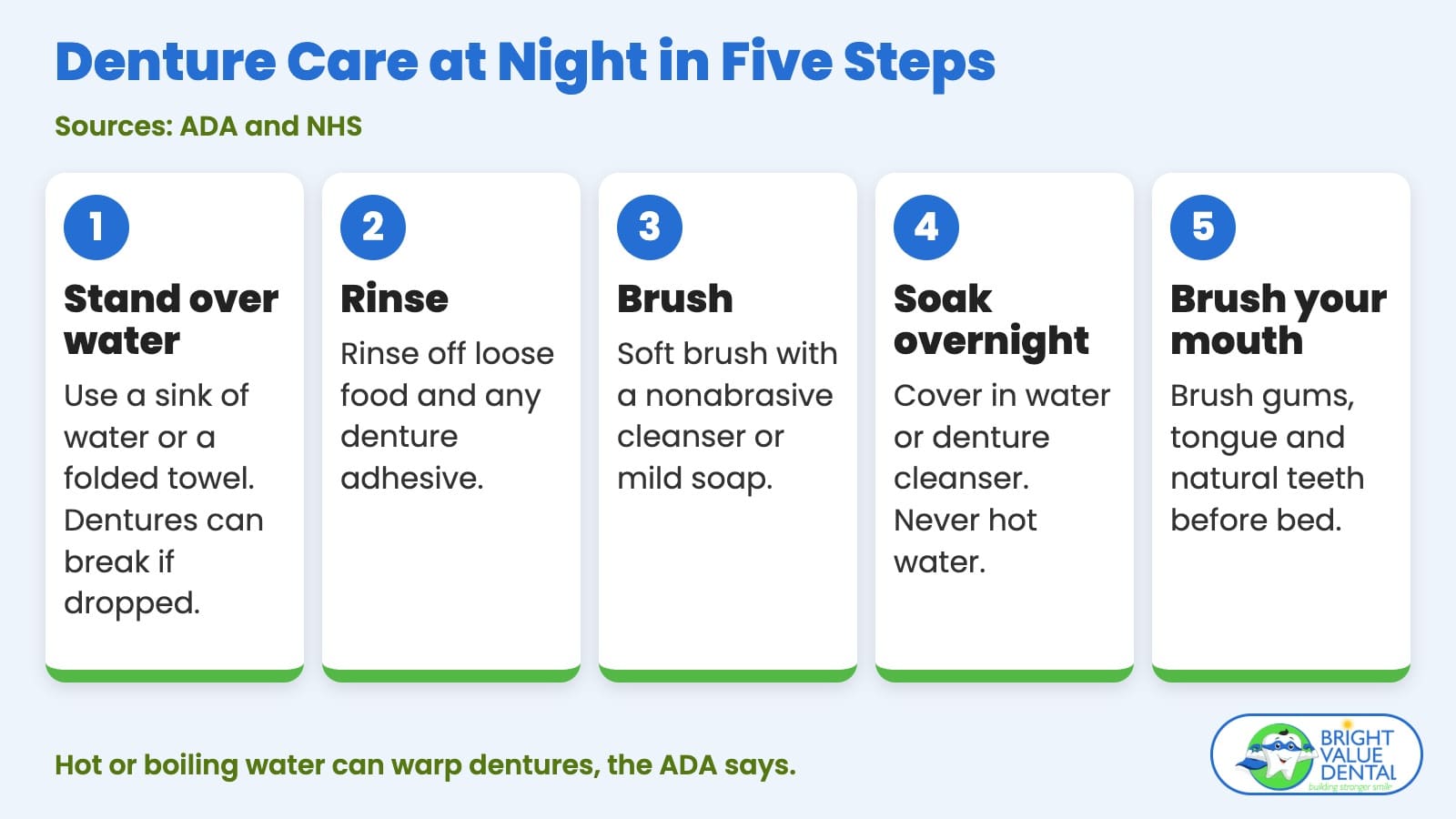
Caring for dentures overnight means cleaning them, covering them in water or cleanser and keeping them away from heat. Never use hot or boiling water, because the ADA says it can warp dentures. The five steps below follow ADA and NHS guidance.
- Stand over a sink filled with water or a folded towel, because the NHS says dentures can break if dropped.
- Rinse the dentures to remove loose food and any denture adhesive.
- Brush every surface with a soft-bristle brush and a nonabrasive cleanser or mild soap.
- Place the dentures in water or a denture-cleansing liquid for the night.
- Brush your gums, tongue and any natural teeth before bed.
Sources differ on toothpaste, so use mild soap or the cleanser your dentist recommends. The graphic below sums up the nightly routine.
Where Should I Store My Dentures If I Don’t Wear Them While Sleeping?
Store dentures you do not wear while sleeping in water or a denture-cleansing liquid, according to MedlinePlus and the ADA. The NHS names four containers when explaining how to store dentures overnight.
- A container of water
- A polythene bag with damp cotton wool
- An overnight denture-cleaning solution
- A denture bath
The ADA says water or cleanser keeps the denture pliable and keeps it from drying out.
What Is the Right Solution to Soak Dentures in Overnight?
Plain water or a denture-cleansing liquid both suit overnight soaking, according to the ADA and MedlinePlus. The American College of Prosthodontists says to clean dentures daily by soaking and brushing with a nonabrasive cleanser. Follow the manufacturer’s soak time for any cleanser tablet.
Cleanser tablets go into warm water. Creams, pastes and gels are brushed on and rinsed off. The ADA says cleansers are never used while dentures are in the mouth, and bleach and powdered household cleansers can damage dentures.
Do I Still Need to Brush My Gums If I Have Dentures?
Yes, you still need to brush your gums if you have dentures, according to ADA MouthHealthy. Brush the gums, tongue and roof of the mouth every morning before inserting dentures. The NHS adds fluoride toothpaste for the gums, tongue and any remaining teeth, morning and evening.
Natural teeth that remain need the same oral hygiene essentials as any other teeth.
What Else Should You Know About Sleeping with Dentures?
How Long Can You Wear Dentures Without Taking Them Out?
Dentures should not stay in around the clock, because the NHS says to remove them every night. Neither the NHS nor MedlinePlus gives a fixed number of hours for continuous wear. Immediate dentures stay in for the first 24 hours, and the dentist sets the timing afterward.
Can You Sleep with Upper Dentures In?
Upper dentures follow the same nightly rule as lower dentures. The NHS and MedlinePlus give the advice for dentures without exceptions by jaw. Remove upper dentures at night and store them in water or cleanser.
Should You Put Dentures in Your Mouth Wet or Dry?
Dentures go into the mouth moist, after any cleanser is rinsed off. The ADA says water or cleanser keeps dentures pliable and from drying out. Rinse the denture under water before inserting it. The ADA says denture cleansers are not used while dentures are in the mouth.
Will Eating with Dentures Ever Feel Normal?
Eating with dentures gets easier as the mouth adjusts, and ADA MouthHealthy says new dentures may feel awkward for a few weeks. The NHS suggests softer foods until you are comfortable with a regular diet. MedlinePlus warns that dentures can make hot foods harder to feel.
Well-fitting dentures may gain stability from denture adhesives, but the ADA says adhesives are not a remedy for ill-fitting dentures.
MedlinePlus also says wearers may not notice biting on a bone from their food, so chew slowly and check food for bones.
Sore spots, slipping and clicking during meals call for an adjustment from the dentist, not a home repair. Dentists treat these as fit problems, because the gums and jawbone change shape over time. The post on loose dentures explains the common causes.
Frequently Asked Questions
What Not to Do with Dentures?
Do not put dentures in hot or boiling water, because the ADA says it can warp them. Do not use bleach or powdered household cleansers, which the ADA says can damage dentures. The NHS adds not to wear dentures overnight unless the dentist recommends it, and not to clean them with toothpaste.
Can I Glue a Tooth Back on My Dentures?
No, do not glue a tooth back on your dentures. ADA MouthHealthy says never to use over-the-counter glues or do-it-yourself repair kits. Contact your dentist for repairs. The dentist can repair or remake a denture that is cracked or missing a tooth.
What’s the Average Lifespan of Dentures?
The average lifespan of dentures is not a fixed number. The American College of Prosthodontists says a dentist should evaluate a denture for replacement once it is more than 5 years old. Other red flags include needing adhesive to eat and chronic irritation under the denture.
Why Do My Bottom Dentures Move When I Eat?
Bottom dentures move when you eat once the fit no longer matches the gums. The NHS says dentures may loosen as the gums and jawbone shrink or change shape. The ADA says ill-fitting dentures may need to be relined or replaced to prevent oral sores.
How Does Bright Value Dental Help with Dentures and Nighttime Care?
Bright Value Dental helps patients with dentures by checking the fit, the tissue health and the nightly routine at each visit. We examine the tissue under the denture, adjust sore spots and confirm which overnight plan fits your device. Dr. Yu and our team see patients from Houston, Bellaire and Sharpstown.
New wearers and immediate denture patients start with our denture fittings, where we explain the first 24 hours and the nightly routine. The dentist also checks that the denture seats evenly and shows you how to take it in and out.
Regular follow-up matters for every wearer, because the gums and jawbone change shape over time, as the NHS notes. Current wearers can book denture checkups when dentures feel loose or sore, or when they are more than five years old.
Cracked dentures and sore spots that do not settle need attention without delay. A dentist can assess them through emergency appointments when pain or damage cannot wait.
The answer to can you sleep with dentures in depends on your device and healing stage. We confirm it at your fitting.
Booking takes a phone call or an online request, and the team confirms the visit type. You can schedule a checkup at a time that suits you.
Dr. Yu and the team welcome questions about soaking solutions, partial dentures and immediate dentures.
A second look at your nightly routine, storage container or cleanser takes only a few minutes. Patients can stop by the Bright Value practice.