
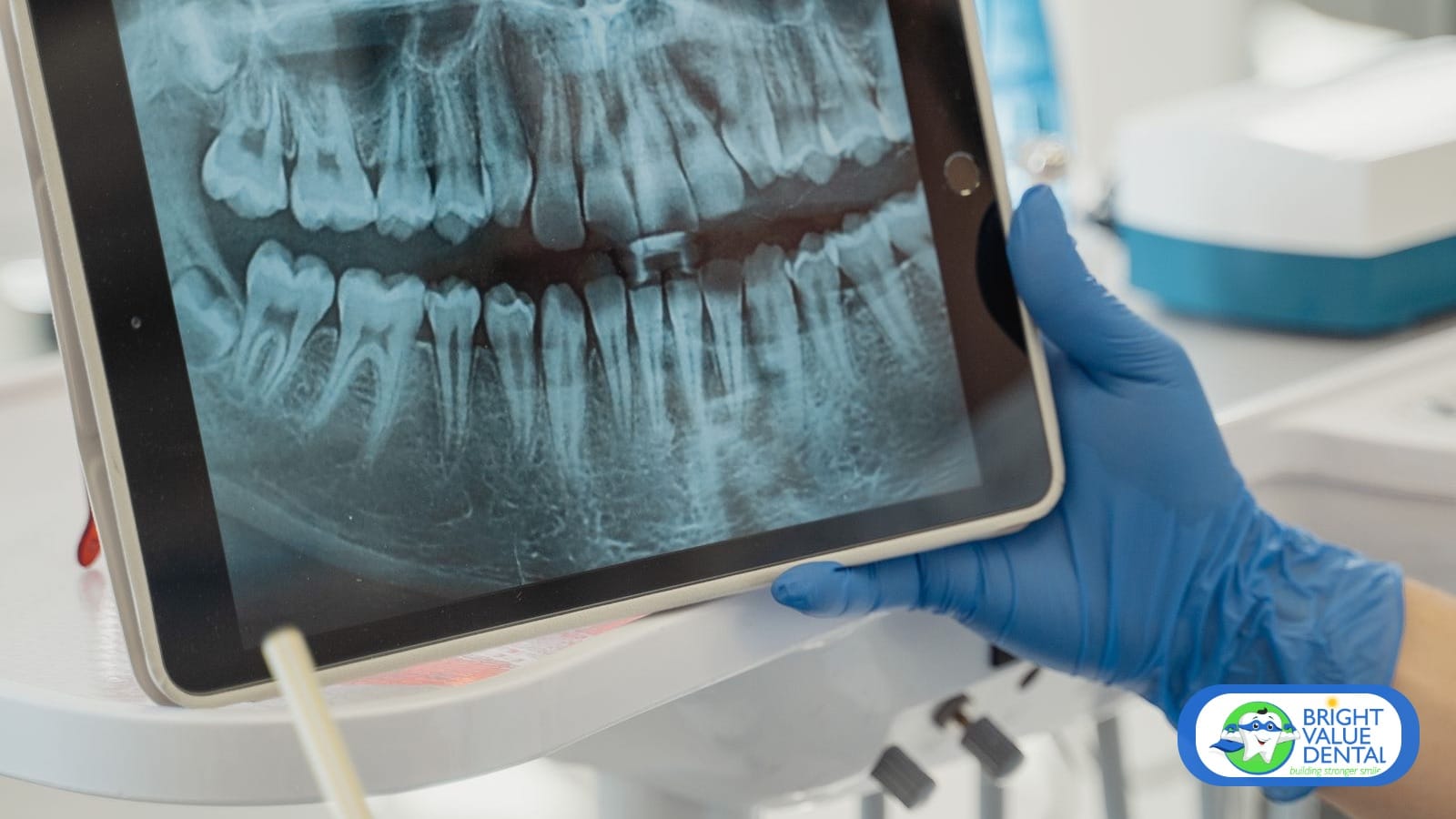
No, wisdom teeth cannot grow back after a dentist removes them completely. The American Dental Association (ADA) describes two sets of teeth, 20 baby teeth and 32 permanent teeth, with no third set. A hard spot in the back of the mouth after surgery usually comes from bone, a root fragment, or an extra tooth. A dentist confirms the cause with an exam and an X-ray.
Key Takeaways
- Wisdom teeth do not regrow once the tooth and its roots are fully removed.
- Bone spicules, retained root fragments, and extra teeth explain most “regrowth” reports.
- Supernumerary teeth occur in 1.5% to 3.5% of permanent dentitions, according to a 2014 review.
- Wisdom teeth usually appear between ages 17 and 21, and the socket heals in 1 to 2 weeks.
- Sharp edges, swelling, a bad taste, or fever need a dental exam.
Can Wisdom Teeth Grow Back After Extraction?
Wisdom teeth cannot grow back after extraction because the body forms only one set of permanent teeth. No new tooth forms in the socket once a dentist removes the whole tooth. The ADA lists 32 permanent teeth, and the third molars are the last four to arrive.
Patients often ask whether wisdom teeth grow back after extraction as a second set, and the answer stays no. Healing tissue and bone fill the empty socket instead. MedlinePlus explains that a blood clot fills the socket as the bone grows back in. Patients who want a clear answer about extraction care can review what the dentist removed and what stayed behind.
Can You Get Your Wisdom Teeth Twice?
No, you cannot get your wisdom teeth twice, because the same four third molars never form a second time. Patients who ask can your wisdom teeth grow back get the same answer. An extra fifth or sixth molar is a separate tooth that was present from birth. Such a tooth can appear after extraction and look like a returning tooth.
Has Anyone’s Wisdom Teeth Grown Back?
Dental sources report that a fully removed wisdom tooth does not regrow from the same socket. Reports of regrowth trace back to a different structure, such as a surviving root piece or a hidden extra tooth. A dental X-ray tells these cases apart, and do wisdom teeth grow back is answered by that image.
Why Does It Feel Like Wisdom Teeth Are Growing Back?
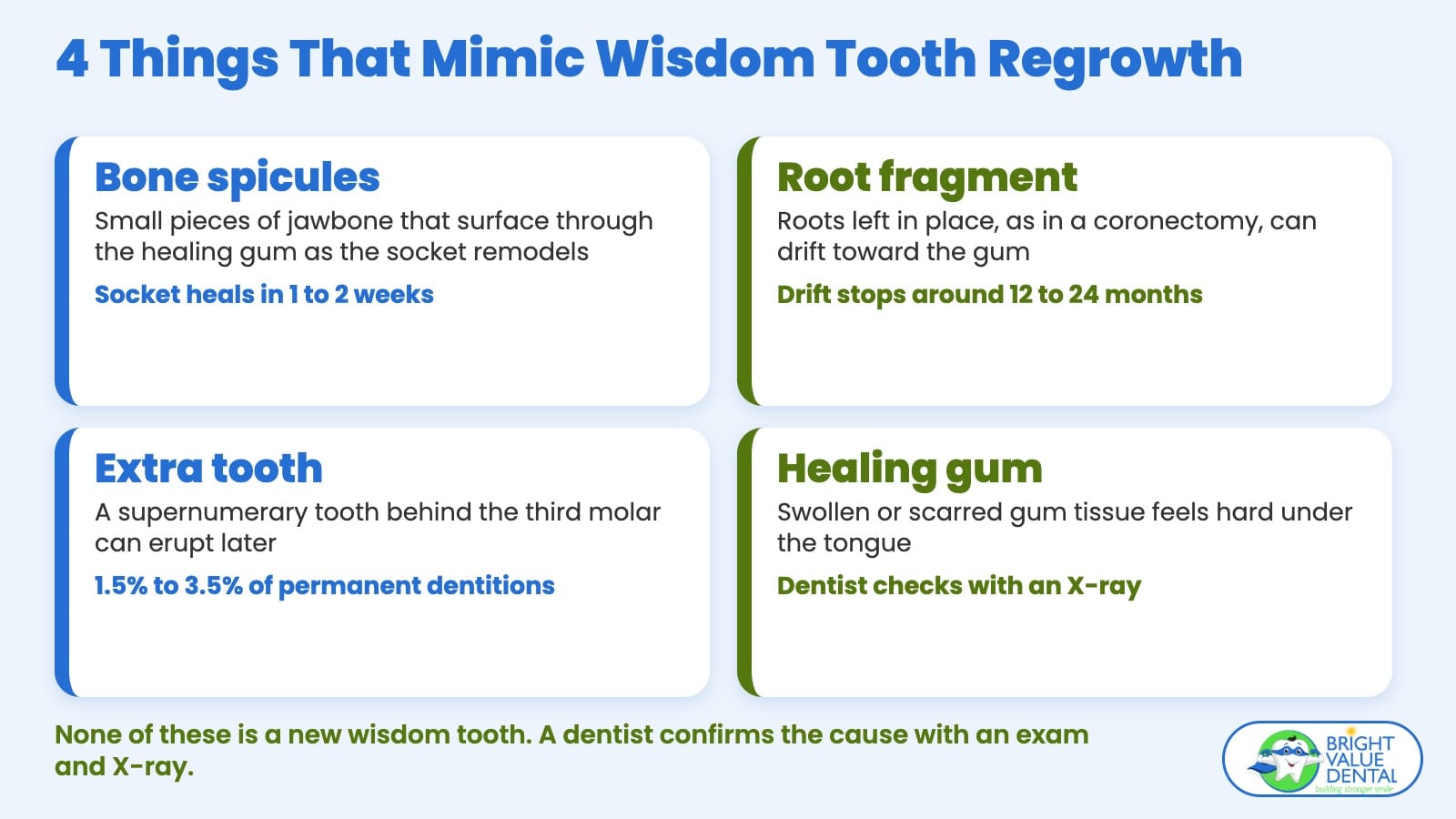
Wisdom teeth feel like they are growing back because healing bone, gum tissue, or a hidden tooth can create a hard bump. Four causes account for the sensation, and none of them is a new wisdom tooth. The table below compares them.
Each cause has a different timeline, and the sections below explain them in turn.
The graphic below shows these four causes next to the timing facts from named sources.
Why Do My Wisdom Teeth Keep Coming Back?
Wisdom teeth keep seeming to come back because the jaw keeps remodeling for months after surgery. Remodeling changes the gum surface as the socket closes. Araujo and colleagues describe three overlapping healing phases in the journal Periodontol 2000: inflammatory, proliferative, and modeling.
The question can wisdom teeth grow back often starts with this shifting surface. The same review reports up to 50% reduction of the original ridge width after extraction. The shifting ridge explains why a spot can feel different from week to week.
What Are Bone Spicules After Wisdom Tooth Removal?
Bone spicules after wisdom tooth removal are small, sharp pieces of jawbone that surface through the healing gum. The dentist smooths the bone during surgery, according to MedlinePlus, yet tiny edges can still work upward later. Most patients notice them during the first weeks of healing.
The socket usually closes in 1 to 2 weeks, per MedlinePlus, and the healing timeline shows when surface changes settle. Bone and tissue beneath the surface can need longer.
Can a Root Fragment Make a Wisdom Tooth Seem to Grow Back?
A root fragment can make a wisdom tooth seem to grow back because it can drift toward the gum. Roots moved most in the first 3 to 6 months in a 2021 systematic review. The review studied coronectomy, a procedure that leaves roots in place on purpose. Movement stopped around 12 to 24 months.
The review found mean movement of 1.9 to 2.97 mm at 3 months and no periapical infection in its seven included studies. A dentist confirms any fragment with an X-ray.
Can Healing Gum Tissue Feel Like a Tooth?
Healing gum tissue can feel like a tooth because swollen or scarred gum becomes firm over the socket. A firm but smooth area with no sharp edge usually points to tissue rather than bone. Ongoing redness or a bad taste calls for a dental check.
Patients with a soft, bumpy area can read about granulation tissue and how dentists treat it.
How Rare Is a Second Set of Wisdom Teeth?
A second set of wisdom teeth is rare because extra teeth occur in only 1.5% to 3.5% of permanent dentitions. Supernumerary teeth are teeth beyond the normal count. Ata-Ali and colleagues reported that range in the Journal of Clinical and Experimental Dentistry in 2014.
A distomolar is a supernumerary tooth that sits distal to the third molar. The same review notes the cause remains unclear and that men are affected about twice as often as women.
Distomolars usually appear on X-rays before they erupt. The next section covers the opposite situation, where a wisdom tooth never formed.
Does Everyone Grow Wisdom Teeth?
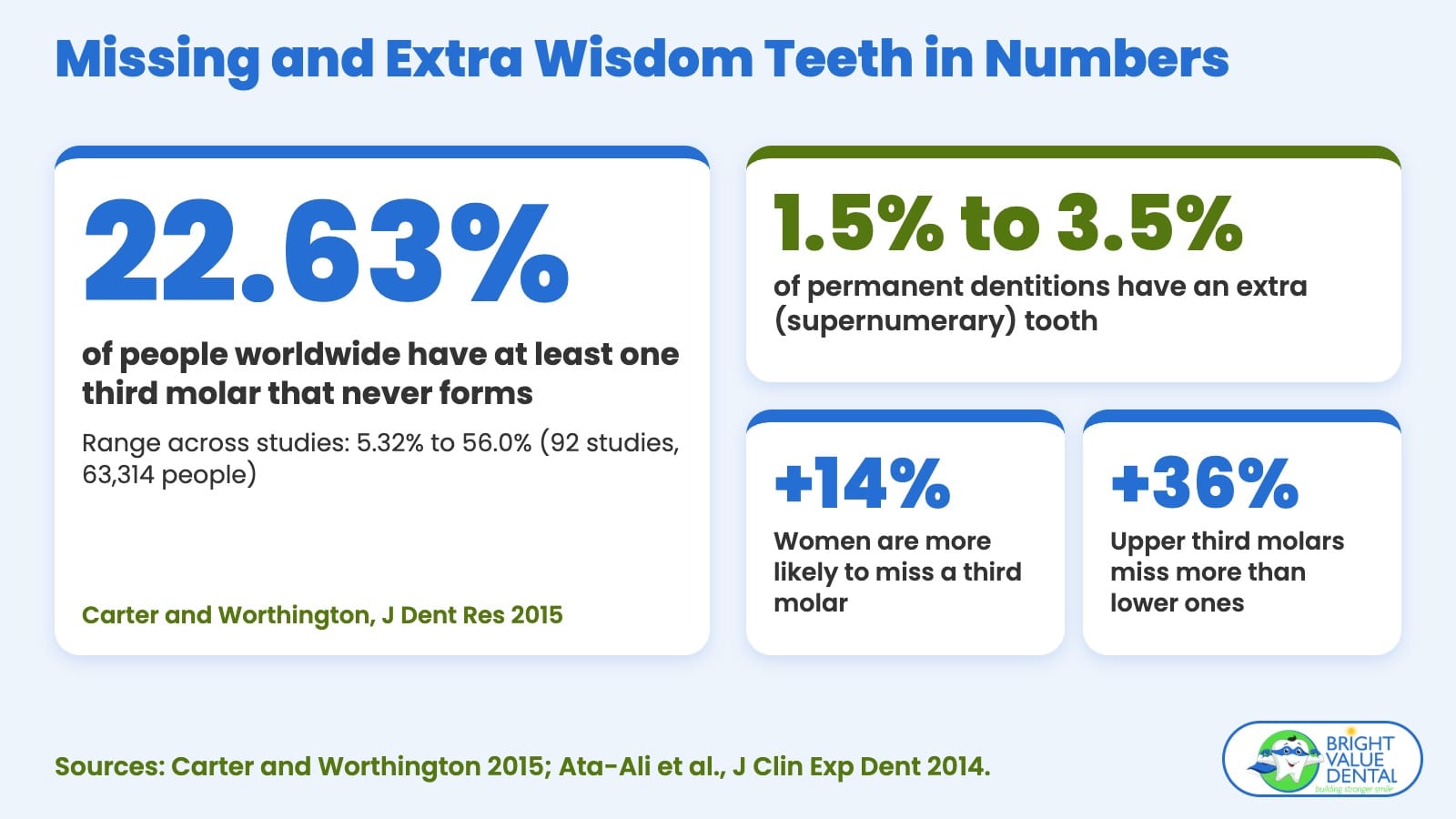
Everyone does not grow wisdom teeth, because 22.63% of people worldwide are missing at least one third molar. Carter and Worthington pooled 92 studies with 63,314 subjects in the Journal of Dental Research in 2015. Study results ranged from 5.32% to 56.0%.
The same meta-analysis found women 14% more likely than men to miss one or more third molars. Upper third molars were missing 36% more often than lower ones. A closer look at wisdom teeth count adds more detail.
How Rare Is 0 Wisdom Teeth?
Having 0 wisdom teeth is a less common pattern. Missing 3 or 4 third molars is less frequent than missing 1 or 2. Missing one or two is most common, according to Carter and Worthington. Cleveland Clinic adds that about 8 in 10 people have at least one wisdom tooth that does not erupt.
What Race Has Less Wisdom Teeth?
Wisdom tooth counts differ by region, and Carter and Worthington found large differences in agenesis rates across geographic regions. Ancestry alone does not predict whether one person has four wisdom teeth. An X-ray is the only reliable way to count them.
Where Do Wisdom Teeth Grow?
Wisdom teeth grow at the very back of the mouth, behind the second molars, with one in each quadrant. Cleveland Clinic describes four possible positions: upper left, upper right, lower left, and lower right. Wisdom teeth are also called third molars.
Do Wisdom Teeth Grow on Top and Bottom?
Wisdom teeth grow on top and bottom, because the upper jaw and lower jaw each hold up to two third molars. Upper and lower positions follow the same four-quadrant layout.
When Do Wisdom Teeth Grow In?
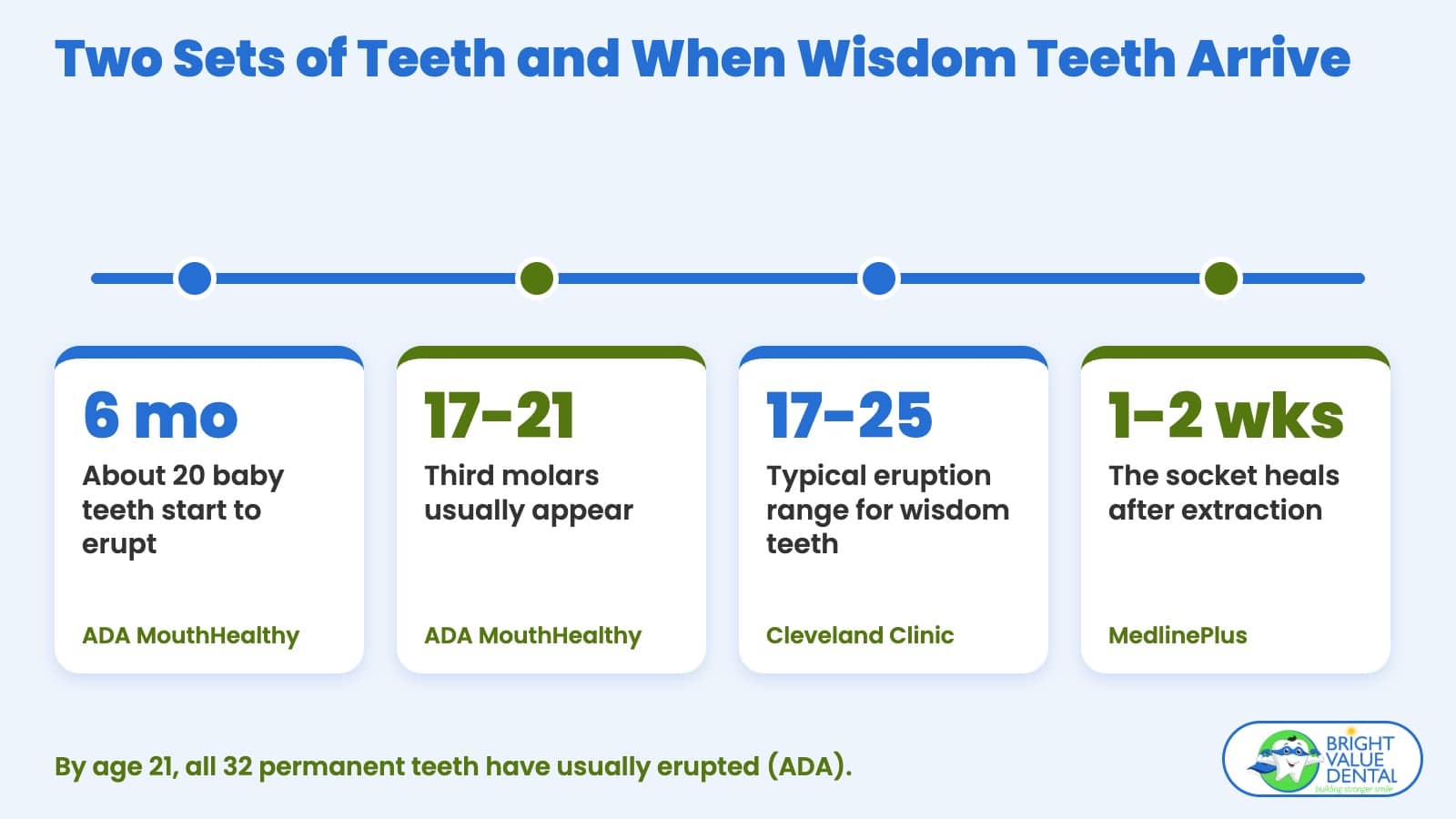
Wisdom teeth grow in between ages 17 and 21, according to the ADA. Cleveland Clinic gives a wider range of 17 to 25. The late teens and early twenties are the usual window. The ADA eruption chart notes that all 32 permanent teeth have usually erupted by age 21.
Each tooth moves at its own pace, so the wisdom tooth arrival age differs between people. Late arrivals after the mid-twenties are uncommon, and a dentist confirms them with an X-ray.
The timeline graphic below places wisdom teeth within the full sequence of tooth eruption and healing.
When Do Your Wisdom Teeth Grow In Compared With Other Teeth?
Your wisdom teeth grow in last. The ADA lists baby teeth starting at about 6 months and wisdom teeth in the late teens. Third molars are the final permanent teeth to erupt. That long gap explains the name wisdom teeth.
How Do Wisdom Teeth Grow In?
Wisdom teeth grow in by pushing up through the gum behind the second molar until the crown shows. Eruption happens slowly and can cause mild discomfort, according to the ADA. Pain that builds up needs a dentist visit.
Typical first signs include gum tenderness at the back of the jaw.
What Triggers Wisdom Teeth to Come In?
Wisdom teeth come in when the roots develop and push the crown toward the gum surface in the late teens. Root growth drives eruption, and the tooth moves only if the jaw has room. MedlinePlus lists crowding and a small jaw as causes of impaction.
Can Wisdom Teeth Grow Normally?
Wisdom teeth can grow normally when the jaw has enough room. Healthy, fully erupted wisdom teeth can help with chewing, according to the ADA. The ADA advises flossing around them and keeping regular dental visits.
Can Wisdom Teeth Grow in Normally Without Pain?
Wisdom teeth can grow in normally without pain, and the ADA calls mild discomfort expected during arrival. Impacted teeth are the exception. The ADA defines impacted as trapped in the jaw or under the gums. A Clinical Evidence review reported at least one impacted tooth in 72% of Swedes aged 20 to 30.
What Should You Do If Something Feels Like a Wisdom Tooth Growing Back?
A hard spot where a wisdom tooth was removed calls for a short, step-by-step check with your dentist. The steps below follow standard dental guidance.
- Note when the spot appeared and how long it has been there.
- Check for sharp edges, swelling, a bad taste, or pus.
- Rinse gently and avoid poking the area with a finger or tongue.
- Call the dental office if the spot lasts beyond the normal 1 to 2 week socket healing window.
- Expect an exam and an X-ray so the dentist can identify the cause.
The NHS says pain and swelling usually improve after 1 or 2 days following removal.
When Should You Call a Dentist About a Hard Spot?
You should call a dentist about a hard spot when it has sharp edges, pain, swelling, or signs of infection. Fever or a swollen cheek or jaw needs prompt care, according to the NHS toothache guidance. The NHS also lists toothache lasting more than 2 days.
- Sharp edges that cut the tongue or cheek
- New or worsening pain or swelling
- A bad taste, pus, or redness
- Fever
Patients with fever or spreading swelling can ask about dental emergency care right away.
What Else Should You Know About Wisdom Teeth Regrowth?
Can Wisdom Teeth Grow Back Years Later?
Wisdom teeth cannot grow back years later, but an extra tooth or retained root can surface after years. A late extra tooth was present from the start. Supernumerary teeth occur in 1.5% to 3.5% of permanent dentitions.
Can Wisdom Teeth Go Back Into the Gum?
Wisdom teeth can stay under the gum, because the ADA says impacted teeth are trapped in the jaw or under the gums. A tooth does not retreat once it has erupted. A partly erupted tooth can seem to sink as swelling changes.
Why Do Experts Now Say Not to Remove Wisdom Teeth Without Problems?
Experts say not to remove symptom-free wisdom teeth routinely because evidence is limited. Cochrane found low to very low certainty about removing disease-free impacted teeth in a 2020 review. NICE limits surgical removal to teeth with pathology.
Why Are Dentists So Eager to Remove Wisdom Teeth?
Dentists recommend removal when a tooth causes a problem. The ADA lists pain, infection, cysts, tumors, damage to neighboring teeth, gum disease, and decay as reasons. Removal can also be part of orthodontic care.
Patients can compare removal options with a dentist after an exam.
Frequently Asked Questions
What Is the Oldest Age for Wisdom Teeth?
No official oldest age exists, but Cleveland Clinic gives 25 as the top of the usual range. Late arrival after 25 is uncommon and needs an X-ray to confirm.
Is 25 Too Old for Wisdom Teeth?
No, 25 is not too old for wisdom teeth, because Cleveland Clinic lists 17 to 25 as the usual range. Age 25 sits at the edge of that window.
Can You Still Get Wisdom Teeth at 50?
Wisdom teeth at 50 are not expected, since eruption normally finishes by the mid-twenties. A tooth appearing at 50 is usually an old impacted tooth or a root piece, and a dentist should examine it.
Why Not Remove Wisdom Teeth?
Wisdom teeth do not need removal when they cause no problems and can be cleaned. The ADA advises monitoring kept wisdom teeth and flossing around them. Regular exams catch changes early.
What Heals Faster After Extraction?
Healing speed varies, and MedlinePlus says the socket takes 1 to 2 weeks to heal. Bone and tissue can need longer than the surface.
How Fast Do Wisdom Teeth Grow?
Wisdom teeth grow slowly across the late teens, and the ADA gives 17 to 21 as the usual arrival window. No fixed monthly rate applies to every tooth.
How Does Bright Value Dental Help With Wisdom Teeth Questions?
Bright Value Dental helps patients with wisdom teeth questions through exams, X-rays, and clear explanations. Dr. Yu reviews each X-ray to confirm what sits in the jaw. Our team serves Houston families who ask can wisdom teeth grow back and want plain answers.
We also offer general dentistry for regular checks of kept wisdom teeth. Dr. Yu explains each finding in plain language and answers questions about healing, X-rays, and next steps for the patient.
Patients can schedule a visit to have a hard spot examined. The office reviews the area, takes an X-ray when needed, and explains whether the finding is bone, tissue, or an extra tooth.
Both tooth extraction services and follow-up checks are available at our office. Follow-up visits track how the socket heals and whether a surface change needs any treatment at all. Patients leave with a clear explanation of what to watch for and when to call the office again.
Learn how Bright Value’s practice supports families across the area with affordable, friendly dental care.