
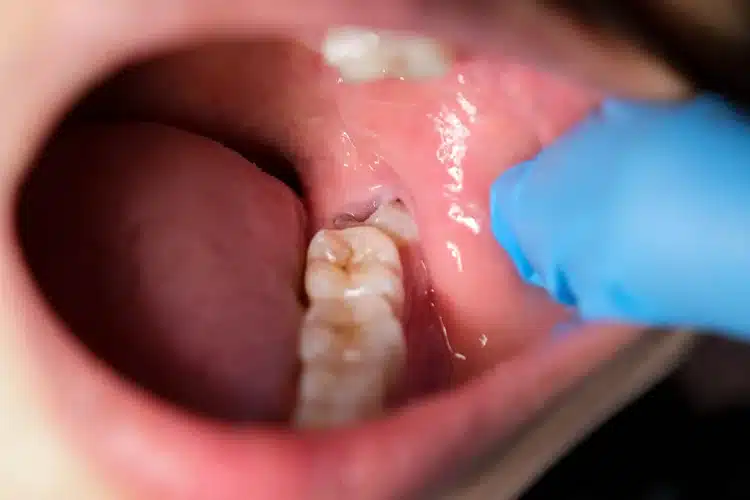
The first signs of wisdom teeth coming in are a dull ache or pressure behind your second molars, gum tissue at the back of the jaw that turns red and tender, stiffness when you open wide, small firm white points breaking through the gum, and sinus or ear pressure depending on which teeth are moving. Wisdom teeth are the third molars, the last permanent teeth to arrive, and they usually push through between the ages of 17 and 25. Here is what dentists want you to know about them: symptoms on their own cannot tell you whether a wisdom tooth is coming in straight or getting stuck, an X-ray can, and not every wisdom tooth needs to come out. The rest of this article covers what the early stage feels like, what it looks like in a mirror, how to tell wisdom tooth pain apart from other pain in the same area, and what to do the week you first notice it.
What Are the First Signs of Wisdom Teeth Coming In?
The first signs of wisdom teeth coming in show up at the very back of the mouth, behind the last molar you already have. Early pressure, tender gum tissue, and limited jaw opening are the three signs almost everyone notices first, and they usually arrive before anything is visible. The teeth responsible sit further back than most people realize, which is why the sensation often feels like it belongs to the jaw rather than to a tooth.
Here are the early signs worth paying attention to:
- A dull ache or pressure behind the second molars, sometimes spreading toward the ear, the neck, or the side of the head
- Red, swollen, tender gum tissue at the back of the jaw that feels sore to the touch and sore when you brush
- Jaw stiffness that makes opening wide or chewing tougher food uncomfortable
- Small white points poking through the gum behind your last molar, which are the tips of the tooth itself
- Sinus pressure or congestion with no cold to explain it, which comes from the upper wisdom teeth rather than the lower ones
- A bad taste or persistent bad breath that brushing does not fix
Those signs matter because of how common the underlying situation is. A 704-patient retrospective study found the highest prevalence of impacted teeth in the 17 to 25 age group, at 61 percent, which is the same window when wisdom teeth are trying to erupt. Most people in that age range are feeling something real.
What Does the Beginning of Wisdom Teeth Feel Like?
The beginning of wisdom teeth feels like a dull, deep pressure at the back of the jaw rather than a sharp pain in a single tooth. The ache comes and goes in waves, often disappearing for days or weeks before returning, because the tooth advances in small movements rather than continuously. Waves of pressure are the pattern that separates an erupting tooth from a cavity, which tends to hurt in response to something specific like cold water or sugar.
Pressure builds as the tooth pushes against the gum tissue and the bone around it, and it settles once that tissue adapts. Then the tooth advances again and the cycle repeats. Patients describe the feeling in almost identical terms year after year: a heaviness at the back corner of the jaw, worse at the end of the day, sometimes worse when lying down. Sharp, throbbing pain paired with swelling is a different signal and belongs in the next section rather than this one.
At What Age Do Wisdom Teeth Start Hurting?
Wisdom teeth start hurting between the ages of 17 and 25 for most people. That window is when the roots finish forming and begin driving the crown upward through the bone, which is the movement that produces the pressure. Some people feel it as early as 16 and others not until their late twenties, since eruption timing varies by several years from person to person.
Variation in timing does not mean the teeth are absent before then. Research on dental imaging shows wisdom tooth buds become visible on a panoramic X-ray around ages 10 to 12, more than half a decade before anyone feels anything. Dentists watching a teenager’s X-rays are already tracking those four teeth long before the first ache arrives.
At What Age Do Most People Get Wisdom Teeth?
Most people get their wisdom teeth between 17 and 25, with the heaviest concentration in the late teens and early twenties. Wisdom teeth are the third and final set of molars, arriving years after the second molars finish coming in around age 12. That gap of five or more years is why they so often find a jaw that has already run out of room.
Room runs out because the second molars and everything in front of them have long since settled into position. Published prevalence work on adults 25 and older shows about half of third molars are still retained in patients under 30, and retention drops steadily after that as teeth either finish erupting or get removed.
How Long Does Wisdom Tooth Pain Typically Last?
Wisdom tooth pain typically lasts a few days at a time, repeating over months or occasionally years as the tooth moves. Each episode of discomfort usually settles within three to seven days once the gum tissue adjusts to the tooth’s new position. Episodes that return in exactly the same spot over and over point to something more than ordinary eruption.
Repetition in one spot is the detail worth tracking. A tooth that is coming in normally produces discomfort that moves forward with it and eventually stops for good. A tooth that is stuck produces the same flare in the same place indefinitely, often with swelling that arrives each time. Writing down the dates of each flare gives a dentist far more to work with than a general description of recent soreness.
What Does a Wisdom Tooth Look Like When It Is Coming In?
A wisdom tooth coming in looks like one or more small, firm white points pushing through the gum directly behind your last molar. Those white points are the cusps, which are the raised corners on the chewing surface of the tooth, and they break through the gum before the rest of the crown does. Cusps appear first because they sit highest on the tooth.
Finding them takes a bright light and a mirror, since they sit further back than most people ever look. Run a clean fingertip along the gum behind your last molar and you may feel a hard point before you can see one. As more of the crown emerges, a flap of gum tissue often remains draped over part of it, which is normal during eruption and also the detail that sets up the most common wisdom tooth problem. Two things that look similar and are not: a canker sore appears as a soft white or yellow spot with a red border and is painful to touch, while an erupting cusp is hard and sits level with or slightly above the gum.
What Triggers a Wisdom Tooth to Erupt?
A wisdom tooth erupts when its roots begin forming and push the crown upward through the jawbone and gum tissue. Root development is the trigger, and it follows a biological schedule that has nothing to do with diet, brushing habits, or anything a person does. The schedule simply arrives, usually in the late teens.
Whether the tooth clears the gum depends on space rather than force. The modern human jaw is smaller than the jaw our ancestors had, and the third molars that were useful for grinding tough plant material now arrive last into a dental arch that is already full. Space available at the back of the jaw decides the outcome: enough room produces a normal tooth, and not enough room produces a tooth that stalls partway or turns sideways looking for a path.
How Long Does It Take for a Wisdom Tooth to Fully Erupt?
A wisdom tooth takes several months to a few years to fully erupt. Full eruption means the whole crown has cleared the gum and the tooth has settled into the bite, and that process runs far slower than the eruption of any other adult tooth. Slow progress is normal and is the reason symptoms stretch across years instead of weeks.
Some wisdom teeth never finish. Prevalence research on adults 25 and older found that partial impaction of lower third molars drops from 35.1 percent in the 25 to 29 age group to 19.2 percent in the 30 to 39 group, which reflects both late eruption and removal over that decade. A tooth that has made no visible progress in two years is one a dentist should be watching on film.
How Can You Tell If Pain Is Coming From Your Wisdom Teeth?
You can tell pain is coming from your wisdom teeth by its location, its pattern, and what comes with it. Wisdom tooth pain sits behind the last molar, builds as pressure rather than striking as a jolt, and often arrives alongside visible swelling in the gum tissue at that exact spot. Pain that fails those three tests usually belongs to something else in the same neighborhood.
The back corner of the mouth is crowded with structures that produce similar complaints, which is why self-diagnosis goes wrong so often. The jaw joint sits just in front of the ear. The maxillary sinuses sit directly above the upper back teeth. The second molar is the single hardest tooth to clean and a frequent site of decay. Research on impacted third molars found decay in the adjacent second molar in 42 percent of cases, which means a wisdom tooth problem and a second molar problem genuinely do travel together. The mapping below reflects the patterns dental and oral surgery literature associates with each source.
| Where It Hurts | What It Usually Points To | What Tends to Come With It |
|---|---|---|
| Dull pressure behind the last molar, in waves | A wisdom tooth erupting normally | Mild gum tenderness, white points visible over time |
| The same spot flaring repeatedly for months | An impacted wisdom tooth | Jaw stiffness, pain radiating to the ear, no visible progress |
| Throbbing gum tissue over a half-covered tooth | Pericoronitis, an infection under the gum flap | Swelling, foul taste, bad breath, pus, tender neck glands |
| Sharp pain in a specific tooth with cold or sweet | Decay in the second molar | Pain triggered by food and drink, no gum swelling |
| Ache in front of the ear, worse on waking | Jaw joint strain or clenching | Clicking, morning tightness, tender chewing muscles |
| Pressure across several upper back teeth at once | Sinus inflammation | Congestion, pressure that worsens when bending forward |
Pericoronitis is the row that needs the fastest response, because the swelling it produces can spread. Swelling that reaches the cheek or the floor of the mouth, fever, or trouble swallowing means the problem has moved past a local gum infection, and a spreading tooth infection needs same-day attention rather than a wait-and-see week.
Can Wisdom Teeth Cause Ear Pain, Headaches, or Sinus Pressure?
Wisdom teeth can cause ear pain, headaches, and sinus pressure, and which one you get depends on whether the upper or lower teeth are responsible. Lower wisdom teeth refer pain toward the ear, the neck, and the side of the head, while upper wisdom teeth press toward the maxillary sinuses and produce facial congestion. Separating the two makes the symptom far easier to interpret.
Lower wisdom teeth sit in the back of the mandible, close to the nerve that serves the whole lower jaw and near the muscles that open and close the mouth. Pressure there spreads along that nerve pathway and into those muscles, which is why an ear that feels full with no infection and a persistent one-sided headache both trace back to the lower jaw so often. Upper wisdom teeth sit directly beneath the maxillary sinuses, which are the air pockets behind the cheekbones. As their roots develop, they grow toward and occasionally into the sinus floor, producing cheek pressure and congestion that no decongestant resolves because the cause was never in the nose.
What Are the Signs of Impacted Wisdom Teeth?
The signs of impacted wisdom teeth are pain that returns to the same spot, swelling that comes back repeatedly, a tooth that never fully appears, jaw stiffness, and shifting or crowding in the teeth in front. Impaction means the tooth cannot fully erupt because bone, gum tissue, or the neighboring tooth is blocking its path. A blocked tooth does not resolve itself; it stays where it is or keeps pushing against whatever is in the way.
Blocked third molars are common enough to be considered ordinary. Institution-based research reports third molar impaction at 18 to 32 percent, cross-sectional studies covering wider populations put the range at 9.5 to 68 percent with more than half of patients carrying at least one impacted third molar, and panoramic radiograph research found that third molars account for 98 percent of all impacted teeth in the mouth. The lower jaw takes the brunt of it, with prevalence of lower third molar impaction reaching 77 percent in some published series.
Position determines the damage. A tooth angled forward presses into the roots of the second molar and can wear them down over years, a process that often goes unnoticed until it shows on an X-ray. A tooth angled backward pushes toward the jaw joint. A tooth that stays upright but trapped under bone can form a fluid-filled sac that slowly hollows out bone around it, which is uncommon but is one of the reasons dentists keep watching teeth that are not hurting. Patients who finished braces years earlier sometimes notice their front teeth drifting back out of line as pressure travels forward through the arch, and impacted wisdom teeth are one of the contributors worth ruling in or out.
How Common Is It for Wisdom Teeth to Not Erupt?
It is very common for wisdom teeth not to erupt, and more than half of adults have at least one third molar that never comes in properly. Teeth fail to erupt for two separate reasons: they get blocked on the way up, or they never formed in the first place. Both outcomes are normal and neither one is cause for concern on its own.
Never forming at all is more frequent than most people expect. Research across populations puts the rate of missing third molars at roughly 10 to 41 percent depending on ancestry, and one study of 5,923 panoramic radiographs published in PLOS ONE found 38.4 percent of patients missing at least one. Plenty of people have two wisdom teeth, or one, or none, and the ones they do have may sit quietly under the gum for decades without causing a problem. Research on adults over 60 found fully impacted third molars in only 3.6 percent of upper jaws and 2.7 percent of lower ones, which tells you most of these teeth are resolved one way or another long before that.
What Is Pericoronitis?
Pericoronitis is an infection of the gum tissue covering a partially erupted wisdom tooth. When a tooth breaks through only partway, the remaining flap of gum over it, called an operculum, traps food and bacteria in a pocket that a toothbrush cannot reach. Bacteria multiplying in that pocket produce the swelling, foul taste, and throbbing that bring most people in.
The operculum is what makes this condition specific to wisdom teeth. Published figures put pericoronitis in as much as 64 percent of patients with an impacted lower third molar, and a review in the British Journal of General Practice reported its occurrence at 43 percent. Signs to watch for are gum tissue that is red and swollen around a half-covered tooth, pus at the gumline, a persistent bad taste, tender glands under the jaw, and difficulty opening the mouth fully. Careful brushing and flossing around the area plus warm salt water rinses can calm a mild episode, though the pocket itself remains and tends to refill. Repeated episodes in the same spot are a strong argument for dealing with the tooth rather than the infection, and persistent inflammation back there can also set off gum disease in the surrounding tissue.
What Should You Do If You Feel Your Wisdom Teeth Coming In?
If you feel your wisdom teeth coming in, keep the area clean, manage the discomfort, and book a dental exam with an X-ray. Home measures make the next week comfortable, and an X-ray answers the question home measures cannot touch, which is whether the tooth has a clear path. Doing both is the practical sequence.
Here is the order we recommend to patients who call our Southwest Houston office about back-of-the-jaw pain:
- Note where the discomfort sits, when it started, and what makes it worse, so you arrive with specifics rather than a vague description.
- Rinse with warm salt water a few times a day, which flushes food out of the gum pocket and calms inflamed tissue.
- Hold a cold compress against the outside of your face for 15 minutes at a time for swelling, or a warm compress for muscle stiffness.
- Take an over-the-counter anti-inflammatory medication, following the directions on the label, unless your doctor has told you to avoid it.
- Brush the area gently with a soft toothbrush, even though it is sore, since skipping it feeds the bacteria causing the problem.
- Keep meals soft and chew on the other side while the area settles.
- Book an exam and a panoramic X-ray, and call sooner if you develop facial swelling, fever, or trouble swallowing.
That seventh step is the one that changes the outcome. We handle wisdom tooth extraction in our own office under local anesthesia when it turns out to be necessary, and we say so plainly when it is not.
How Do You Relieve Wisdom Tooth Pain at Home?
You relieve wisdom tooth pain at home with warm salt water rinses, cold compresses, over-the-counter anti-inflammatory medication, gentle cleaning, and soft foods. Salt water rinses do the most work of the group, because they clear debris from the gum pocket that is driving the inflammation. A rinse of about half a teaspoon of salt in a cup of warm water, swished for 30 seconds and spat out, is the standard version.
Cold compresses work differently and are worth using alongside rinses rather than instead of them. Cold constricts the small blood vessels in the area and reduces swelling, so it suits a jaw that looks puffy on the outside. Warmth relaxes the muscles instead, so it suits a jaw that is stiff rather than swollen. None of these measures moves the tooth, treats an infection, or buys more than a few days, which is the honest limit of home care here.
Why Symptoms Alone Cannot Tell You If Wisdom Teeth Need to Come Out
Symptoms alone cannot tell you if wisdom teeth need to come out because most of what matters happens below the gumline. A wisdom tooth can press into the root of the second molar, tilt sideways under bone, or sit directly against the nerve canal while producing no pain whatsoever. Silence from a tooth is not evidence that the tooth is fine.
What settles the question is a panoramic X-ray, which captures both jaws in a single image and shows the angle of each third molar, how deep it sits, how far its roots have developed, and how close it runs to the nerve canal below and the sinus floor above. Those four measurements are what a dentist actually uses to predict whether a tooth will erupt cleanly, stall quietly, or cause trouble in five years. A dental exam with that image attached turns a guess into a plan, and because wisdom tooth buds appear on film as early as ages 10 to 12, most patients have years of imaging history available to compare against.
Can You Just Let Your Wisdom Teeth Grow In?
You can let your wisdom teeth grow in when they have room, come in straight, and can be cleaned properly. Not every wisdom tooth needs to be removed, and a healthy third molar in a jaw with space is simply another molar to brush and floss. Plenty of patients keep all four for life without a single problem.
Keeping them is a decision that depends on being able to clean them. Third molars sit at the very back where a toothbrush reaches at an awkward angle, which is why decay rates climb in that part of the mouth, and a tooth you cannot keep clean eventually becomes a tooth you cannot keep. The practical arrangement for a wisdom tooth that is coming in well is monitoring: regular checkups, X-rays at reasonable intervals, and a clear plan for what would change the recommendation. A tooth that is only partly through the gum sits in a different category, since the gum flap over it keeps refilling with bacteria no matter how carefully you brush.
Will Wisdom Teeth Pain Go Away Without Removal?
Wisdom teeth pain goes away without removal when the tooth is simply erupting, and returns when the tooth is stuck. Eruption discomfort ends permanently once the crown clears the gum and the tissue settles, usually within a few days per episode. Pain from an impacted tooth or an infected gum flap follows a different pattern, quieting down and then coming back to the same spot.
The difference between those two patterns is the most useful thing you can track yourself. Three flares in the same place over six months is a tooth that is not going to resolve on its own, whatever the gaps between flares suggest. Pain that disappears for good after two or three episodes, with visible tooth appearing in between, is a tooth doing exactly what it should.
What Happens If You Ignore Wisdom Teeth Pain?
If you ignore wisdom teeth pain, a treatable situation usually turns into a more complicated one. Decay can develop in the second molar next door, a gum infection can spread beyond the local tissue, and a tilted tooth can keep pressing into the roots of its neighbor until that tooth is affected too. Each of those outcomes is far easier to prevent than to repair.
Repair is harder because it involves two teeth instead of one. Research on impacted third molars found decay in the adjacent second molar in 42 percent of cases, which means ignoring the back tooth frequently costs the one in front of it as well. Swelling that spreads into the cheek or under the jaw, a fever, or difficulty swallowing moves the situation out of the routine category entirely and belongs in emergency care the same day.
When a Wisdom Tooth Needs to Come Out
A wisdom tooth needs to come out when it is impacted, repeatedly infected, decayed, damaging the tooth next to it, or crowding the rest of the arch. Early detection of an impacted or infected wisdom tooth is what prevents those problems, which is why the exam matters more than the pain level. Removal timed well is a straightforward procedure.
Timing is the part worth planning for. A tooth taken out before its roots are fully formed and before infection has set in comes out more easily and heals faster than the same tooth removed at 35 after three rounds of pericoronitis. Dr. Yu has performed thousands of extractions over the past 20 years, and most of them happen right here in our office under local anesthesia. Patients who want to know what the appointment itself involves can read through a typical extraction visit before they come in.
Not every tooth makes this list, and we would rather tell you to keep yours. When one does qualify, a tooth extraction resolves the problem permanently rather than treating the same flare over and over. Budget is a fair question to raise at the consultation, and we break down what shapes the removal cost separately.
How Painful Is Wisdom Teeth Removal?
Wisdom teeth removal is not painful during the procedure, because the area is completely numbed before anything begins. What patients feel is pressure and movement rather than pain, and most describe the appointment as far easier than the weeks of flare-ups that led them to it. Soreness afterward is normal and manageable with the aftercare instructions we provide.
The numbers on complications are reassuring as well. A nationwide cohort study of 16,609 patients published in PLOS ONE found dry socket in 3.6 percent of impacted lower third molar removals and surgical site infection in 0.17 percent, meaning the overwhelming majority of these procedures heal without incident. Most patients are back to light activity the next day, with more complex cases taking one to two days of rest, and the full healing timeline runs its course over the following weeks.
Frequently Asked Questions
Does Everyone Have Four Wisdom Teeth?
Not everyone has four wisdom teeth. Some people have three, two, one, or none at all, and research across populations puts the rate of missing third molars at roughly 10 to 41 percent depending on ancestry. Having fewer than four is a normal variation and carries no health consequence whatsoever.
Do Wisdom Teeth Shift Your Other Teeth?
Wisdom teeth can contribute to shifting in the teeth in front of them, though they are rarely the only cause. A third molar angled forward presses against the second molar, and that pressure travels through the arch over time. People who finished orthodontic treatment as teenagers sometimes notice front teeth drifting in their twenties, and a retainer worn as directed does more to prevent that than anything else.
Will My Face Change After Wisdom Teeth Removal?
Your face will not change permanently after wisdom teeth removal. The third molars sit at the back of the jaw and contribute nothing to facial shape or jawline definition. Swelling in the cheeks during the first few days is temporary and resolves entirely as healing progresses.
How Can I Tell If My Pain Is Dry Socket?
You can tell pain is dry socket when it starts two to four days after an extraction, feels deep and throbbing, radiates toward the ear, and gets worse rather than better. Normal healing pain peaks early and fades steadily, so pain that reverses direction is the signal. Smoking and using straws raise the risk considerably, which is why the instructions for the days after extraction matter as much as the procedure.
What Are the Signs of Infection After Wisdom Teeth Removal?
The signs of infection after wisdom teeth removal are swelling that increases after day three, fever, pus or a foul taste coming from the site, and pain that intensifies instead of easing. Infection is uncommon, appearing in 0.17 percent of cases in a 16,609-patient cohort study, but any of those signs warrants a call to the office the same day. Normal recovery moves steadily in one direction, toward feeling better.
Can You Brush and Floss a Partially Erupted Wisdom Tooth?
You can brush and floss a partially erupted wisdom tooth, and you should, though the gum flap over it will still trap debris no matter how careful you are. Angle a soft toothbrush toward the back of the mouth and clean along the gumline slowly, then rinse with warm salt water to flush the pocket. Cleaning reduces the bacteria load without removing the pocket itself, which is why partially erupted teeth tend to flare repeatedly even in people with excellent habits.
The Bottom Line
The first signs of wisdom teeth coming in are pressure behind your back molars, tender swollen gum tissue, jaw stiffness, white points appearing through the gum, and ear or sinus pressure depending on which teeth are moving. Those signs tell you something is happening. They do not tell you whether the tooth has room, and that distinction is the whole question, because a wisdom tooth with a clear path simply becomes another molar while a tooth without one keeps causing the same problem until it is addressed.
What settles it is a panoramic X-ray and ten minutes with a dentist who will tell you honestly when a tooth can stay. If you are feeling pressure at the back of your jaw, rinse with warm salt water, keep the area clean, and get it looked at before the next flare arrives. We are happy to take a look and give you a straight answer here at Bright Value Dental. Give us a call at 713-668-1600 and we will find you a time.