
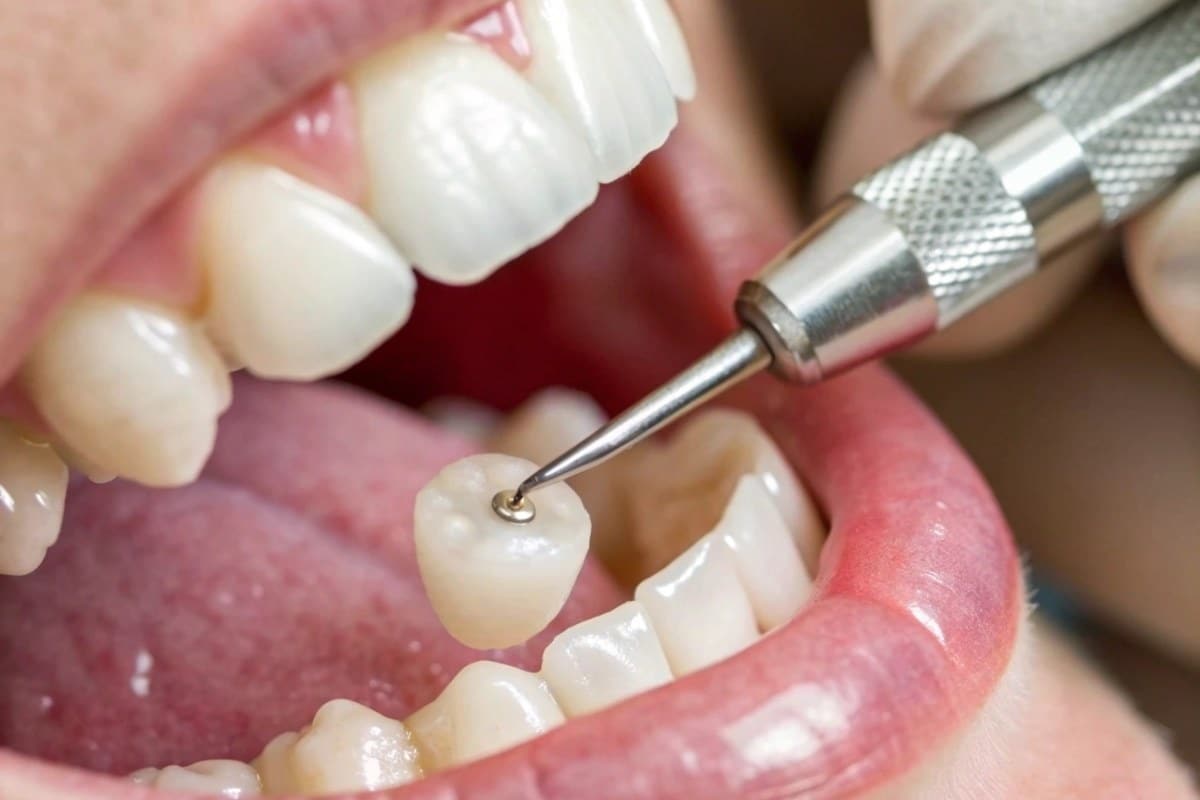
You may need a dental crown when a tooth is too cracked, decayed, or weak for a standard filling to fix. A crown is a custom-fitted cap that covers the entire visible part of a damaged tooth, restoring its strength, shape, and function while protecting it from further breakdown. Common signs include a visible crack or fracture, severe decay beyond what a filling can repair, large or failing old fillings, a tooth that recently had a root canal, enamel worn down by grinding or acid erosion, and sharp pain or pressure when you bite down. This article walks through each of these signs, explains what happens if you wait too long, and helps you understand when a crown is the right next step.
How Do You Tell if You Really Need a Dental Crown?
You tell if you really need a dental crown by looking at how much healthy tooth structure remains and whether a filling can still hold the tooth together safely. A filling works well when damage is small to moderate and plenty of strong tooth surrounds the restoration. A crown becomes necessary when the damage crosses a threshold that fillings cannot manage.
That threshold shows up in several ways. Watch for these warning signs that a filling is no longer enough:
- A visible crack or fracture line on the tooth surface
- A cavity so large that more than half the biting surface is damaged
- An old filling that keeps breaking, loosening, or developing dark edges
- A tooth that has become brittle after root canal treatment
- Enamel worn flat or thin from grinding, clenching, or acid erosion
- Sharp pain or pressure every time you bite down on a particular tooth
In each of these situations, the tooth needs full coverage from the outside, not a patch from the inside. A dental crown wraps around the entire tooth and holds it together the way a filling simply cannot.
According to data from the CDC’s 2024 Oral Health Surveillance Report, nearly 21% of adults aged 20 to 64 in the United States have at least one permanent tooth with untreated decay. Many of those teeth sit right at the line between needing a filling and needing a crown. The difference between a straightforward crown and a more complex procedure often comes down to timing.
How Do Dentists Decide Between a Crown and a Filling?
Dentists decide between a crown and a filling by evaluating the size of the damage, the location of the tooth, and the structural integrity of what remains. A filling is appropriate when the cavity is small, the tooth walls are thick, and the biting forces on that tooth are manageable. A crown is recommended when more than roughly 50% of the tooth’s biting surface is compromised, when the remaining walls are too thin to withstand chewing pressure, or when the tooth has already been filled and refilled multiple times. Research published in Clinical and Experimental Dental Research confirms that larger cavities shorten filling lifespan significantly, meaning a large filling placed today often leads to a crown within a few years anyway. Placing the crown sooner preserves more natural tooth and avoids the cycle of repeated repairs.
Signs You May Need a Dental Crown: A Cracked or Fractured Tooth
A cracked or fractured tooth is one of the most common reasons dentists recommend a crown. Cracks can develop from biting into hard foods, grinding your teeth at night, trauma to the mouth, or simply from years of daily chewing pressure on enamel that has weakened over time. According to a study published in the journal Scientific Reports (PMC), cracked tooth syndrome affects roughly 5% of all adults each year. Research from PubMed shows that cracks occur most frequently in people over 40 years of age, with the highest prevalence in the 45 to 59 age range.
The danger of a cracked tooth is that the crack rarely stays the same size. Every time you chew, the two sides of the crack flex apart and press back together. That repeated flexing drives the crack deeper into the tooth over weeks and months. A small crack that a crown could stabilize today can become a deep fracture that reaches the root, and a root fracture often means the tooth cannot be saved at all.
Common signs of a cracked tooth include sharp pain when you bite down or release pressure, sensitivity to hot or cold that lingers for several seconds after the source is gone, and discomfort that comes and goes without a clear pattern. Some cracks are visible as a thin line on the tooth surface, but many are too small to see without magnification. Your dentist can detect cracks using a bite test, a dental explorer, transillumination with a focused light, or dental X-rays. A crown placed over a cracked tooth holds the pieces together, stops the crack from spreading, and seals out bacteria that could infect the inner pulp. Molars carry the highest risk because they absorb the greatest chewing forces. The same PubMed analysis found that 33.8% of cracked teeth were maxillary first molars and 23.4% were maxillary second molars.
Severe Tooth Decay That a Filling Cannot Fix
Severe tooth decay that a filling cannot fix is another clear sign you may need a dental crown. Fillings are designed to repair small to moderate cavities where enough healthy tooth structure remains to support the restoration. When decay destroys a large portion of the tooth, a filling loses its foundation. Placing a large filling in a heavily decayed tooth is like patching a wall that is already too weak to stand on its own.
Data from the CDC and the National Center for Health Statistics shows that approximately 91% of U.S. adults aged 20 to 64 have experienced dental caries in their permanent teeth. Decay is extremely common, and not every cavity stays small. Left untreated, a cavity grows. Bacteria consume the enamel, then the dentin beneath it, and eventually reach the pulp chamber where the tooth’s nerve and blood supply live. Once bacteria reach the pulp, the tooth develops an infection that requires root canal treatment before any crown can be placed. Catching severe decay early and placing a crown prevents that progression. A crown covers the entire tooth, seals out bacteria, and restores the tooth’s ability to handle preventive care routines like normal brushing and flossing. Patients who also have gum inflammation benefit from scaling and root planing to address the gum tissue before or alongside crown placement.
Do I Need a Crown or a Filling?
You need a crown instead of a filling when the damage to the tooth extends beyond what a filling can structurally support. Specific indicators include a cavity that covers more than half the biting surface, tooth walls that are too thin to hold a filling without cracking, a tooth that has already had multiple fillings replaced in the same area, or decay that wraps around the sides of the tooth rather than staying contained in one spot. Your dentist evaluates these factors during an exam and recommends the option that gives the tooth the best chance of lasting long-term.
A Large or Failing Old Filling
A large or failing old filling is a sign that your tooth may need a crown. Fillings do not last forever. Composite resin fillings typically last 5 to 15 years, and amalgam fillings average 10 to 15 years, according to research published in Clinical and Experimental Dental Research. Over time, the materials break down from chewing forces, temperature changes, and the natural acids in your mouth.
When a filling starts to fail, tiny gaps form between the filling material and the surrounding tooth. These gaps allow bacteria to slip underneath and cause new decay, a process called secondary caries. A study published in PMC found that secondary caries accounts for 93% to 95% of all filling replacements. That means the vast majority of fillings that fail do so because bacteria found a way back in through a weakened margin.
Signs of a failing filling include sensitivity in a tooth that had no sensitivity before, a rough or uneven texture when you run your tongue over the filling, visible dark areas or discoloration around the edges of an old restoration, and discomfort or pressure when chewing near the filling. If the filling is large and the tooth around it has been weakened by repeated drilling over the years, replacing the filling with another filling only continues the cycle. A crown breaks that cycle by covering the entire tooth and providing protection that a filling in the same spot cannot match. We see this pattern frequently at our Southwest Houston practice, where patients come in with old fillings that have been patched two or three times before reaching the point where a crown makes the most sense.
A Tooth That Recently Had a Root Canal
A tooth that recently had a root canal almost always needs a dental crown, especially if it is a back tooth used for heavy chewing. Root canal treatment saves the tooth by removing infected or damaged pulp tissue from inside the tooth chamber and root canals. The dentist cleans the interior, disinfects it, and fills the empty space with a rubber-like material called gutta-percha. This process eliminates the infection, but it also removes the tooth’s internal blood supply and a significant amount of structural material.
Without a crown, a root-canal-treated tooth is at high risk of fracturing under normal biting forces. Research reviewed by the Canadian Agency for Drugs and Technologies in Health (CADTH) found that root-canal-treated teeth restored with crowns had a 94% cumulative survival rate at five years, while teeth restored with fillings alone dropped to just 63% over the same period. A separate study published in the Journal of Prosthetic Dentistry found that root-canal-treated molars without crowns had only a 36% survival rate at five years. Clinical data cited in the British Dental Journal confirms that teeth with crowns after crown restoration following root canal treatment are six times more likely to survive long-term than those left unprotected.
The National Dental Practice-Based Research Network surveyed 1,777 dentists and found that 94% recommended crowns for posterior teeth that had undergone root canal treatment. That near-unanimous recommendation reflects how critical the crown is to the tooth’s long-term survival. Skipping the crown after a root canal is one of the most common reasons patients lose teeth that were initially saved by the procedure.
Teeth Worn Down by Grinding or Erosion
Teeth worn down by grinding, clenching, or acid erosion may need dental crowns to restore their shape, height, and function. Enamel is the hardest substance in the human body, but it is not indestructible. Chronic grinding, clinically known as bruxism, wears through enamel over months and years until the softer dentin underneath becomes exposed. Acid erosion from frequent consumption of acidic foods and beverages, acid reflux (gastroesophageal reflux disease, or GERD), or eating disorders accelerates this process.
According to the Sleep Foundation, 8% to 31% of adults experience some form of bruxism. The Merck Manual reports that sleep bruxism can generate up to 250 pounds of clenching force, far more pressure than conscious chewing produces. That force flattens tooth cusps, shortens tooth height, and thins enamel to the point where the tooth can no longer function properly. Worn teeth become more sensitive, more prone to chipping, and less effective at chewing food thoroughly.
A dental crown restores the original shape and height of a worn tooth, rebuilding the biting surface and protecting the remaining structure from further damage. Crowns fall under cosmetic dentistry when improving appearance and under restorative dentistry when rebuilding function, and in most cases they accomplish both at the same time. For patients who grind their teeth, we also recommend a custom night guard to shield both natural teeth and crowns from teeth grinding forces during sleep. Treating the wear with a crown and preventing future wear with a night guard addresses both the damage and its cause.
Sharp Pain or Pressure When Biting Down
Sharp pain or pressure when biting down is a sign that a tooth may have structural damage requiring a dental crown. Pain during chewing often points to a crack, a fracture, a failing filling, or decay that has reached the inner layers of the tooth. The specific pattern of pain can help narrow down what is happening inside the tooth.
Sharp, sudden pain that occurs when you bite down and releases when you let go typically indicates a crack. The two sides of the crack separate under biting pressure and pinch the inner pulp tissue, creating a jolt of pain that disappears once the pressure is removed. Lingering pain after eating or drinking something hot or cold, pain that continues for 10 seconds or more after the temperature source is gone, suggests that the pulp inside the tooth is inflamed. Constant throbbing pain that does not go away with pressure changes may indicate an infection or abscess forming at the root of the tooth.
None of these pain patterns should be ignored. Pain is the tooth’s signal that something has gone wrong structurally. A crown placed over a cracked or weakened tooth redistributes chewing forces evenly, eliminates the flexing that causes pain, and protects the nerve from further irritation. If pain has progressed to constant throbbing, the tooth may need root canal treatment before the crown can be placed. This is why acting early, when pain is intermittent rather than constant, leads to simpler and less extensive treatment. If you experience sudden or recurring tooth pain, scheduling an emergency dental visit helps catch the problem before it escalates.
What Happens if You Don’t Get a Crown When You Need One?
Delaying a crown when your tooth needs one almost always leads to a worse outcome. Teeth do not heal themselves the way bones or skin do. A crack does not close, decay does not reverse, and a weakened tooth does not regain strength on its own. The damage progresses, and each stage of progression narrows your treatment options and increases the complexity and cost of repair.
The typical progression follows a predictable path:
- The crack spreads or decay deepens: A small crack that a crown could have stabilized grows deeper into the tooth. A moderate cavity expands toward the pulp chamber. The window for a simple crown-only treatment begins to close.
- Bacteria reach the pulp: Once the crack or decay reaches the pulp, the tooth’s nerve becomes infected. An abscess, a pocket of pus at the root tip, forms. At this stage, root canal treatment becomes necessary before any crown can be placed. The treatment becomes longer, requires more visits, and involves more cost.
- The tooth fractures beyond repair: If a vertical crack reaches the root, or if decay destroys so much structure that there is nothing left to support a crown, the tooth must be extracted. Tooth extraction leaves a gap that can cause neighboring teeth to shift, the opposing tooth to over-erupt, and the jawbone to lose density over time.
- Replacement becomes necessary: Replacing a missing tooth with a dental implant or bridge is significantly more involved than placing a crown on a damaged tooth that is still intact. The entire situation, from a simple crown to extraction and replacement, could have been avoided with earlier treatment.
When Is It Too Late to Put a Crown on a Tooth?
It is too late to put a crown on a tooth when there is not enough healthy tooth structure remaining above the gum line to support the restoration, when the root is fractured vertically, or when infection and bone loss have progressed to a point where the tooth cannot be saved. A crown needs a solid foundation to grip. If decay, fracture, or gum disease has destroyed that foundation, extraction may become the only remaining option. This is the strongest reason not to delay treatment when your dentist recommends a crown. The earlier you act, the more tooth structure is preserved, and the more likely the crown will succeed long-term.
Is Getting a Crown on a Tooth Worth It?
Yes, getting a crown on a tooth is worth it because a crown preserves the natural tooth, restores full chewing function, and prevents far more expensive problems down the road. A literature review published in the Journal of Prosthetic Dentistry by Pjetursson (2007) found that 95% of dental crowns survive at least five years and 90% survive at least 10 years. Many crowns last 15 to 20 years or longer with proper care. Gold crowns show a 96% survival rate at 10 years, and zirconia crowns show 92% survival at 10 years, according to recent clinical data.
The value of a crown becomes even clearer when you compare it to the alternative. A tooth that loses its crown candidacy because damage was allowed to progress may need extraction followed by an implant or bridge, treatments that require more visits, longer healing periods, and substantially higher cost. Preserving a natural tooth with a crown is almost always the simpler, faster, and more affordable path compared to replacing that tooth after it is lost. Patients who invest in crowns early often find they can focus future dental visits on maintenance like cleanings and teeth whitening instead of emergency repairs.
| Scenario | Treatment Path | Visits Required | Recovery | Long-Term Outcome |
|---|---|---|---|---|
| Crown placed early | Crown only | 2 visits | Same-day return to normal | 90% survival at 10 years |
| Delayed until infection | Root canal + crown | 3-4 visits | 1-2 weeks sensitivity | 85-94% survival at 10 years |
| Delayed until fracture | Extraction + implant | 4-6+ visits over months | 3-6 month healing | Good, but natural tooth lost |
| Delayed until fracture | Extraction + bridge | 3-4 visits | 2-3 weeks adjustment | Requires modifying adjacent teeth |
The comparison makes the case clearly. A crown placed when the tooth first needs one keeps the treatment simple, the recovery fast, and the long-term prognosis strong. Every stage of delay adds complexity. We help patients at our practice understand exactly where their tooth stands and what the best next step is, so there are no surprises.
Frequently Asked Questions
Can a Tooth Still Rot Under a Crown?
Yes, a tooth can still rot under a crown. The crown itself cannot decay because it is made of porcelain, zirconia, or metal. However, the natural tooth underneath remains vulnerable to bacteria at the margin where the crown edge meets the tooth surface near the gum line. Poor oral hygiene, gum recession, and cement breakdown can create gaps that allow bacteria to enter. Brushing twice daily, flossing around the crown, and keeping up with regular dental checkups are the best ways to prevent decay under an existing crown.
What Destroys Teeth the Most?
What destroys teeth the most is the combination of bacterial acid from plaque buildup and mechanical force from grinding or clenching. Bacteria in plaque feed on sugars and produce acids that dissolve tooth enamel, creating cavities. Grinding and clenching generate excessive force that cracks, chips, and wears down enamel over time. Together, acid erosion and mechanical stress account for the vast majority of tooth damage that leads to crowns, root canals, and extractions.
Is It Ever Too Late to Start Taking Care of Your Teeth?
No, it is never too late to start taking care of your teeth. Even teeth that have already been damaged, filled, or crowned benefit from improved oral hygiene, regular dental visits, and protective habits like wearing a night guard. Teeth that still have healthy structure can be preserved with proper care. Teeth that already have restorations last longer when you maintain them well. Starting today is always better than waiting.
How Long Does a Dental Crown Last?
A dental crown lasts 10 to 15 years on average, and many crowns last 20 years or longer with good care. Gold and zirconia crowns tend to last the longest due to their superior strength and wear resistance. Porcelain and porcelain-fused-to-metal crowns typically fall in the 10-to-15-year range. Regular checkups, proper brushing and flossing, and avoiding hard or sticky foods all help extend a crown’s lifespan.
Does Getting a Crown Hurt?
Getting a crown does not hurt during the procedure because your dentist uses local anesthesia to numb the tooth and surrounding tissue completely. You may feel mild soreness or sensitivity for a few days after the appointment, especially to temperature changes. Over-the-counter pain relievers like acetaminophen or ibuprofen manage this discomfort effectively. Most patients return to their normal routine the same day.
How Many Visits Does a Crown Take?
A dental crown typically takes two visits. The first visit involves tooth preparation, removing any decay or damage, reshaping the tooth, taking impressions, and placing a temporary crown. The second visit, usually two to three weeks later, involves removing the temporary crown and bonding the permanent crown in place. Each visit lasts roughly 45 minutes to one hour.
At What Age Do People Normally Get Crowns?
People most commonly get dental crowns between the ages of 40 and 70, though crowns can be needed at any age depending on the condition of the teeth. Research shows that cracked teeth peak in prevalence among adults aged 45 to 59, and large fillings placed in younger years often need crown replacement by middle age. Children and young adults may also need crowns after trauma, severe decay, or developmental conditions that weaken tooth structure. A dentures alternative for older patients, crowns help preserve natural teeth longer when placed at the right time.
The Takeaway
The signs that you may need a dental crown are not hard to spot once you know what to look for. A cracked tooth, severe decay, a large or failing filling, a recent root canal, worn-down enamel from grinding, and pain when you bite down are all signals that a tooth needs more protection than a filling alone can provide. The data consistently shows that acting early, placing the crown when the tooth first needs it, produces the best outcomes and avoids the cascade of more complex, more expensive treatments that delay creates.
If any of these signs sound familiar, the best next step is a simple dental evaluation. At Bright Value Dental, we take the time to explain exactly what is happening with your tooth and walk you through every option so you can make the decision that is right for you. Call us at (713) 668-1600 to schedule a visit.