
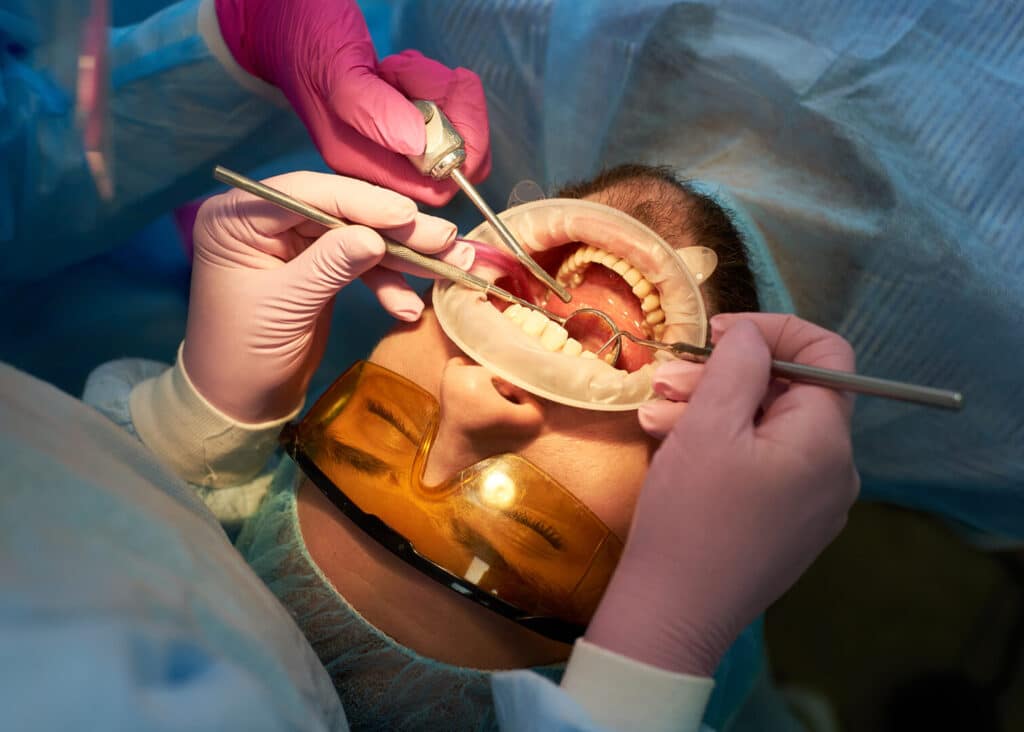
Wisdom teeth surgery takes 30 to 60 minutes for all four teeth, with deeply impacted or complex cases running up to 90 minutes, and a single erupted tooth coming out in 15 to 25 minutes. The number most people actually need is the other one: plan on roughly 1.5 to 2 hours at the office once paperwork, numbing, the procedure itself, and a few minutes of recovery are all counted. Here is what patients should know beyond the clock: the anesthesia choice shapes both the appointment length and whether you can drive home, the first night matters more than any other part of recovery, swelling peaks on day two or three rather than day one, and protecting the blood clot in each socket is the single thing that keeps the week on track. The rest of this article walks through the timing, the appointment, the first night, and the days that follow.
How Long Is Wisdom Teeth Surgery?
Wisdom teeth surgery is 30 to 60 minutes of actual chair time for a full four-tooth case. Each individual tooth takes about 5 to 10 minutes to remove once the area is numb, and the rest of the time goes to access, positioning, and closing. Access is where the variation lives, because reaching a tooth sitting under bone takes longer than lifting one that is already above the gumline.
The distinction that drives every figure here is simple versus surgical. A simple extraction removes a tooth that has fully erupted and sits in a reasonably normal position, so it can be loosened and lifted with standard instruments. A surgical extraction removes a tooth that is partly or completely covered by gum tissue and bone, which means a small incision, sometimes removal of a little bone, and sometimes sectioning the tooth into pieces so it comes out safely. Published procedure guidance from major dental groups puts simple extractions at 15 to 25 minutes and surgical extractions at 45 to 60 minutes or more, with oral surgery practices reporting 40 to 90 minutes for a full four-tooth case. The breakdown below reflects those ranges.
| Case Type | Chair Time | What Is Involved | Total Office Time |
|---|---|---|---|
| One erupted wisdom tooth | 15 to 25 minutes | Numbing, loosening, lifting the tooth, gauze | About 45 minutes to 1 hour |
| One impacted wisdom tooth | 20 to 40 minutes | Small incision, possible bone removal, sometimes sectioning, stitches | About 1 to 1.5 hours |
| All four, simple | 30 to 45 minutes | One side at a time, 5 to 10 minutes per tooth | About 1.5 hours |
| All four, impacted or surgical | 45 to 90 minutes | Incisions, bone removal, sectioning, stitches at each site | About 1.5 to 2 hours |
Total office time is the column worth planning around, because it is the one that decides how much of your day disappears. We will give you a realistic figure for your own case at the consultation, once we have looked at your X-ray and talked through a wisdom tooth extraction plan.
How Long Does It Take to Remove All Four Wisdom Teeth?
Removing all four wisdom teeth takes 30 to 60 minutes in most cases, and up to 90 minutes when the teeth are deeply impacted. Four teeth do not take four times as long as one, because the numbing, setup, and closing happen once rather than four times over. Setup time is fixed, so the marginal cost of each additional tooth is only the 5 to 10 minutes of removal itself.
Doing all four in one appointment is what most patients choose, and the reason is the recovery rather than the surgery. One appointment means one set of aftercare instructions, one swelling curve, and one week of soft foods instead of two. The teeth are usually handled one side at a time, upper and lower together, which keeps swelling and bleeding easier to manage and leaves the other side available for the first careful bites.
How Long Does a Single Wisdom Tooth Extraction Take?
A single wisdom tooth extraction takes 15 to 25 minutes when the tooth has erupted and 20 to 40 minutes when it is impacted. An erupted tooth is the fastest case in the entire category, because the whole crown is already accessible and nothing has to be cut or uncovered. Accessibility is the whole variable.
Impacted single teeth run longer for a reason that shows on the X-ray before anyone sits down. The lower jaw carries the majority of impacted third molars, with published prevalence for the lower wisdom tooth reaching 77 percent in some series, and a lower tooth lying sideways against its neighbor takes more careful work than an upper tooth sitting upright under a thin layer of tissue.
What Makes Wisdom Teeth Surgery Take Longer?
Wisdom teeth surgery takes longer when the tooth is angled, buried in bone, or shaped in a way that resists a clean lift. Four factors account for nearly all of the variation: the angle of the tooth, how deeply it is impacted, the shape of its roots, and the anesthesia being used. The first three are visible on film weeks before the appointment.
Angle comes first. A tooth growing straight up comes out along the path it was already traveling, while a tooth lying horizontally against the second molar has to be freed, often in pieces, without disturbing the tooth next to it. Impaction depth comes second, since a tooth fully encased in bone needs that bone opened before the tooth can move at all. Root shape comes third and is the one patients never think about: straight, fully formed roots release cleanly, while curved roots or roots that hook around the nerve canal demand slower work. Anesthesia comes fourth and adds time at the front of the appointment rather than during the procedure.
Nothing on that list is a surprise on the day. A panoramic X-ray taken at a routine dental exam shows the angle, the depth, the root development, and the distance to the nerve canal and sinus floor, which is why we can tell you ahead of time whether your case sits at the 30-minute end of the range or the 90-minute end.
How Long Will You Be at the Office?
You will be at the office about 1.5 to 2 hours for a wisdom teeth appointment. The surgery itself occupies well under half that window, with the rest going to paperwork, numbing, instructions, and a short period of sitting up before you leave. Numbing alone accounts for about 5 minutes with local anesthesia, and sedation adds another 5 to 10 minutes on top of that plus monitored time afterward.
Here is how the appointment runs at our Southwest Houston office, start to finish:
- Check-in and final questions, 10 to 15 minutes. Paperwork is completed, your medical history is confirmed, and we review the X-ray and the plan with you one more time.
- Numbing, about 5 minutes. Local anesthetic is placed and given time to take full effect before anything else begins.
- Confirming you are numb, 2 to 3 minutes. We test the area and wait longer if any sensation remains.
- The extraction, 15 to 60 minutes. The range depends on how many teeth and whether any of them are impacted. You will feel pressure and movement rather than pain.
- Gauze and initial bleeding control, 5 to 10 minutes. Folded gauze is placed over each site and you bite down with steady pressure.
- Aftercare instructions, 5 to 10 minutes. We go through the first 24 hours in detail and send the instructions home with you in writing.
- Sitting up and leaving, 5 to 15 minutes. Longer if you chose sedation, since you stay until you are fully alert and your ride is with you.
That total holds for the great majority of cases. Appointments at the longer end of the range are usually four impacted teeth with sedation, where the monitored recovery period adds the extra time rather than the surgery.
How Long Does Anesthesia Last for Wisdom Teeth?
Local anesthesia for wisdom teeth lasts about two to four hours, with the lower jaw usually staying numb longer than the upper. Numbness in the lower lip, chin, and tongue is normal during that window because the anesthetic blocks the nerve serving the whole lower jaw rather than just the tooth. That block is also why lower extractions feel so completely painless at the time.
Dentistry offers several anesthesia approaches, and they behave differently. Local anesthesia numbs the area while you stay fully awake and aware, and it is what the majority of wisdom tooth extractions are done with. Sedation options keep patients relaxed or asleep through the procedure and are used more often for complex surgical cases, and they carry a longer, groggier recovery along with a requirement that someone drive you home. Most procedures at our practice are handled in-office under local anesthesia, and we talk through what suits your case at the consultation. While numbness lingers, chew nothing and sip carefully, since a numb lip or cheek is very easy to bite without noticing.
Can You Drive Yourself Home After Wisdom Teeth Removal?
You can usually drive yourself home after wisdom teeth removal with local anesthesia only, and you cannot drive yourself home if you chose sedation. Sedation requires an escort who stays through the appointment and drives you home afterward, with no exceptions. No exception exists because sedative medication keeps affecting judgment and reaction time well after you feel alert.
Arranging the ride is worth doing even for a local-anesthetic appointment. Plenty of patients feel fine and drive themselves, and plenty of others would rather not manage a numb jaw, fresh gauze, and traffic at the same time. If you are even slightly unsure, bring someone.
What Should You Know Before Wisdom Teeth Removal Surgery?
Before wisdom teeth removal surgery, you should know your anesthesia plan, your ride situation, what you can eat beforehand, and what you need waiting at home. Preparation is almost entirely logistics, and the patients who have the easiest week are the ones who sorted the logistics before the appointment rather than afterward. Logistics also happen to be the part nobody tells you about.
Here is what to have settled before the day:
- Your anesthesia plan and whether you need a driver, confirmed at the consultation rather than assumed
- Eating instructions, since local anesthetic appointments usually allow a normal light meal beforehand while sedation appointments come with fasting instructions
- Loose, comfortable clothing with short sleeves or sleeves that roll up easily, and shoes you can slip on
- Soft food in the house, bought ahead, because nobody wants to shop on the way home
- Ice packs or a bag of frozen vegetables, plus an extra pillow for sleeping propped up
- Two to three days with nothing demanding on the calendar, ideally running into a weekend
- Your questions written down, since it is easier to ask them before you are numb
Coverage is worth sorting out in the same conversation. We accept a wide range of plans, and you can review what we take on our insurance options page. Patients who want the full picture on what shapes the removal cost can read that breakdown separately, and anyone who has never had a tooth extraction before may want to see how the appointment runs step by step.
What Happens During Wisdom Teeth Surgery?
During wisdom teeth surgery, the area is numbed, the tooth is loosened and lifted out, and the site is closed and packed with gauze. For an impacted tooth, two extra steps sit in the middle: a small incision in the gum tissue, and sometimes sectioning the tooth into pieces so it can leave the socket without forcing the bone around it. Sectioning sounds dramatic and is actually the gentler option, since removing a tooth in two or three pieces takes less force than removing it whole.
Patients are often surprised by how little they feel. Pressure and movement come through clearly because anesthetic blocks pain rather than sensation, so you will know something is happening at the back of your jaw without it hurting. Dissolvable stitches are commonly placed to close the gum tissue, and those disappear on their own over the following week or two. The extraction visit is usually shorter and less eventful than the weeks of worrying that preceded it.
What Should You Do the First Night After Surgery?
The first night after surgery, your only real job is protecting the blood clot forming in each socket. Bite firmly on gauze, keep your head elevated, skip rinsing and spitting entirely, and avoid anything that creates suction in your mouth. Suction is the specific enemy here, because negative pressure is what pulls a forming clot out of the socket.
Clot protection explains every instruction on the list. The clot seals the socket, shields the exposed bone underneath, and provides the scaffold that new tissue grows into, so disturbing it in the first 24 hours sets recovery back days rather than hours. Keeping your head propped on an extra pillow reduces blood flow to the area and slows both bleeding and swelling overnight. Published guidance puts bleeding slowing within 3 to 4 hours of surgery, so steady oozing during the evening is expected rather than alarming.
How Long Do You Keep Gauze In After Wisdom Teeth Removal?
You keep gauze in for 30 to 45 minutes at a time, biting with firm steady pressure, and replace it only when it becomes saturated. Changing gauze constantly works against you, because every swap disturbs the clot that is trying to form underneath. Steady pressure is what stops bleeding, not fresh material.
Most patients are done with gauze within three or four hours. If oozing is still happening after that, fold a fresh piece, dampen it slightly, place it directly over the socket rather than between your teeth, and bite for a full 30 minutes without checking. A moistened tea bag works as a substitute when gauze runs out, since the tannins in tea help small vessels constrict. Bleeding that soaks through gauze repeatedly and will not slow after several hours is worth a phone call.
How Long Do Wisdom Teeth Bleed After Surgery?
Wisdom teeth sites bleed actively for the first three to four hours and ooze lightly for up to 24 hours. Pink-tinged saliva on the first day is normal and does not mean the bleeding has restarted, because a very small amount of blood colors a large amount of saliva. Colored saliva is the thing patients most often mistake for a problem.
Real bleeding looks different: bright red, steady, and soaking gauze within minutes rather than over an hour. That pattern on day one usually responds to a fresh fold of gauze and 30 uninterrupted minutes of firm pressure. The same pattern appearing on day three or four, after bleeding had already stopped, is a different situation and belongs in a call to the office.
How Should You Sleep After Wisdom Teeth Removal?
You should sleep on your back with your head elevated on two or three pillows for the first two or three nights. Elevation keeps blood from pooling in the surgical area, which means less overnight bleeding and noticeably less swelling to wake up to. Less overnight swelling makes day two considerably more bearable.
Side sleeping is the habit worth breaking for a few nights, since pressing the swollen side of your face into a pillow increases both swelling and soreness on that side. Place a towel over your pillowcase for the first night in case of light oozing. Setting an alarm for a middle-of-the-night dose of whatever pain medication you were advised to take also helps, because staying ahead of discomfort works far better than catching up to it in the morning.
How Long Does Swelling Last After Wisdom Teeth Removal?
Swelling after wisdom teeth removal peaks 48 to 72 hours after surgery and recedes visibly from day four onward. Most swelling is gone within a week, with mild residual puffiness or tenderness sometimes lingering up to two weeks. Peak timing is the detail that catches people off guard, since it means you look worse two days after surgery than you did on the day itself.
Cold is the tool for the first stretch. The American Association of Oral and Maxillofacial Surgeons recommends intermittent cold for the first 48 to 72 hours, applied in roughly 20-minute intervals with breaks in between rather than one long session. Intervals matter because continuous cold on the skin is both uncomfortable and less effective than cycling. Once swelling has peaked and begun to recede, switch to gentle warmth, which does nothing for swelling but loosens the jaw stiffness that shows up alongside it. Bruising along the jaw or neck sometimes appears around the same time, which looks alarming and resolves on its own.
What Is the Worst Day After Wisdom Tooth Removal?
The worst day after wisdom tooth removal is day two or day three for most patients. Swelling and jaw stiffness peak together in that 48 to 72 hour window, which is why the second morning often feels like a step backward. Day one feels deceptively manageable because anesthetic and the first doses of medication are still working.
Direction is what tells you whether that peak is normal or not. Discomfort that holds steady through day two and three and then begins easing on day four is following the expected curve. Discomfort that starts increasing on day four or five, after it had already begun improving, is the classic signal of a dislodged clot and deserves a call rather than another day of waiting.
What Are You Not Allowed to Do After Wisdom Teeth Removal?
After wisdom teeth removal you are not allowed to use straws, smoke or vape, spit forcefully, rinse vigorously, or exercise hard for the first several days. Every item on that list does the same thing, which is create suction or raise blood pressure in a way that can pull the clot out of the socket. Suction and pressure are the two mechanisms behind the whole list.
Knowing the mechanism makes the rules easier to follow than memorizing them. Straws and smoking create negative pressure directly. Forceful spitting and vigorous rinsing do the same thing with your own cheek muscles. Strenuous exercise, heavy lifting, and heat all raise blood pressure at the surgical site, which can restart bleeding even days later. Gentle warm salt water rinses are fine starting 24 hours after surgery, letting the water fall out of your mouth rather than spitting it. The specifics for the days after extraction are worth reading through before the appointment rather than afterward.
How Long After Wisdom Teeth Can You Use a Straw?
You should wait at least one week after wisdom teeth removal before using a straw. Drawing liquid through a straw creates exactly the kind of negative pressure inside your mouth that lifts a clot out of its socket. Negative pressure does not care whether the drink is cold, thin, or healthy.
Smoothies are the trap here, since they are the food most people reach for and the one most likely to arrive with a straw. Spoon them instead, which works perfectly well and removes the risk entirely. Drink everything else directly from the glass for the full week.
How Long After Wisdom Teeth Can You Smoke?
You should wait at least one week after wisdom teeth removal before smoking, and longer is better. Smoking combines the suction that dislodges clots with chemicals that slow tissue healing and reduce blood flow to the site, which is why smokers run far higher complication rates. The numbers are not subtle: one dental teaching hospi