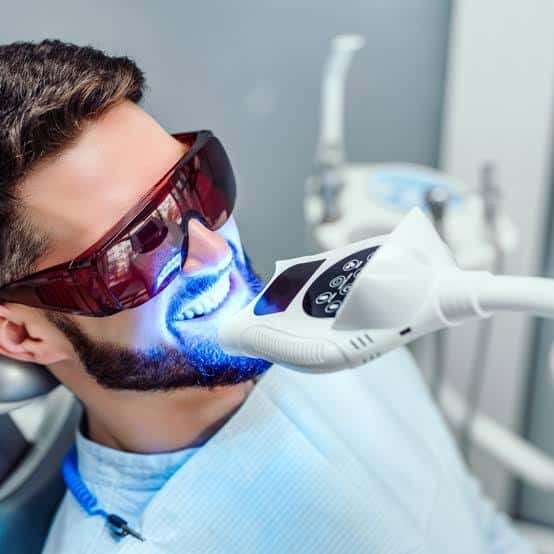
Teeth whitening treatment options fall into three main categories: over-the-counter products you can buy at any drugstore, dentist-supervised at-home kits with custom trays, and in-office professional bleaching performed at your dentist’s office. Each method uses a form of peroxide to break apart stain molecules on and inside the tooth, but the concentration, application time, and results vary widely between them. According to Grand View Research, 67% of American adults have tried some form of teeth whitening, making it one of the most popular cosmetic dental procedures in the country. This guide walks through how whitening works, what each method involves, who qualifies, and how to keep your results looking bright for as long as possible.
What Causes Teeth to Turn Yellow
Teeth turn yellow because of two types of staining: extrinsic stains on the outer enamel surface and intrinsic stains inside the tooth structure. Extrinsic stains develop over time from daily habits. Coffee, tea, red wine, dark berries, and tobacco leave colored compounds on the enamel that build up gradually. These surface-level stains are the easiest to treat with whitening products because the bleaching agent only needs to reach the outer layer of the tooth.
Intrinsic stains form deeper inside the enamel or in the dentin layer beneath it. Dentin is the bony tissue under the enamel that has a naturally yellow tone. Certain antibiotics taken during childhood, such as tetracycline, can cause gray or brown intrinsic discoloration. Dental trauma, excessive fluoride exposure during tooth development, and genetic factors also contribute to intrinsic staining. These deeper stains are harder to treat with standard whitening products because the bleaching agent must penetrate further to reach them.
Age plays a significant role as well. The enamel layer wears thinner over the years, and the dentin underneath regenerates with a darker shade. Thinner enamel allows more of that yellow dentin to show through, which is why teeth naturally darken with age even in people who avoid staining foods and drinks. Good oral hygiene slows this process but cannot stop it entirely.
Can Yellow Teeth Really Be Whitened
Yes, yellow teeth can really be whitened in most cases, and the results depend on the type and depth of the stain. Surface stains from coffee, tea, wine, and tobacco respond best to whitening treatments. These extrinsic stains sit on or near the enamel surface, where peroxide-based agents can break them apart effectively. Most patients with yellow extrinsic staining see a noticeable improvement within days or weeks of starting treatment.
Brown stains from fluorosis or long-term tobacco use respond moderately. A patient with brown staining may see a 2 to 3 shade improvement, but reaching a bright white shade typically requires professional-strength treatment rather than store-bought products. Gray or blue discoloration from tetracycline or dental trauma is the hardest to treat. According to research cited by the American Dental Association (ADA), tetracycline stains may require three to four months of nightly treatment to see meaningful lightening.
One important distinction: whitening treatments only work on natural tooth structure. Crowns, veneers, fillings, and dental bonding do not respond to bleaching agents. Patients with visible restorations on their front teeth should talk to a dentist before whitening to avoid an uneven appearance between natural and restored teeth.
How Does Teeth Whitening Work
Teeth whitening works by using a peroxide-based bleaching agent that penetrates the enamel and breaks apart the colored compounds causing discoloration. The two active ingredients used in nearly all whitening products are hydrogen peroxide and carbamide peroxide. Both produce the same bleaching effect, but they differ in concentration and release speed.
Hydrogen peroxide is the direct bleaching agent. When applied to the tooth surface, hydrogen peroxide molecules pass through the tiny spaces between enamel crystals and reach the dentin layer underneath. According to research published in the journal Materials (Llena et al., 2018), hydrogen peroxide can diffuse from enamel through dentin to the pulp within 15 minutes of exposure. The oxygen molecules released during this process react with the organic chromophores (colored compounds) embedded in the enamel and dentin, breaking the chemical bonds that create visible staining.
Carbamide peroxide is a compound that contains hydrogen peroxide combined with urea. A 10% carbamide peroxide solution breaks down into approximately 3.5% hydrogen peroxide, according to Colgate’s clinical resources. Carbamide peroxide releases its bleaching power more slowly; about 50% activates in the first two hours, and the remaining portion stays active for up to six additional hours. Hydrogen peroxide, by comparison, releases most of its bleaching power within 30 to 60 minutes. This difference in release speed is why dentists choose carbamide peroxide for overnight tray-based treatments and hydrogen peroxide for shorter in-office sessions.
What Are the Three Treatment Options for Whitening Teeth
The three treatment options for whitening teeth are over-the-counter (OTC) products, dentist-supervised at-home whitening with custom trays, and in-office professional bleaching. Each option uses peroxide at different concentrations and delivers different levels of results. A 2005 study by Auschill et al., cited by the ADA, found that an OTC bleaching technique took 16 days to match the whitening level achieved by a 7-day at-home tray system and a single in-office visit.
Over-the-Counter Whitening Products
Over-the-counter whitening products include whitening strips, whitening toothpaste, whitening rinses, paint-on gels, and LED whitening kits. These products use lower concentrations of peroxide than professional options, typically 3% to 10% hydrogen peroxide or its carbamide peroxide equivalent. According to Mordor Intelligence, the at-home whitening segment accounted for 68.67% of the global teeth whitening market in 2024, driven largely by the convenience and affordability of OTC products.
Whitening strips are among the most effective OTC options. They use flexible plastic coated with a peroxide gel that adheres to the front of the teeth. Most strip treatments require daily application for 10 to 14 days and can lighten teeth a few shades. Results from whitening strips typically last up to six months. Whitening toothpaste works differently. Most whitening toothpastes rely on mild abrasives to polish away surface stains rather than chemical bleaching. Some contain low levels of peroxide, but the contact time during brushing is too short for significant bleaching to occur. A 2020 systematic review found that whitening toothpastes had less efficacy than whitening strips, with comparable side effects.
LED whitening kits pair a peroxide gel with a blue light device intended to accelerate the bleaching process. Research suggests that the peroxide concentration and contact time matter more for results than the light itself. For patients considering any OTC product, the ADA recommends looking for the ADA Seal of Acceptance, which confirms the product has been tested for safety and effectiveness.
Dentist-Supervised At-Home Whitening With Custom Trays
Dentist-supervised at-home whitening uses custom whitening trays made from impressions of the patient’s teeth. These trays fit precisely over the teeth, holding the whitening gel evenly against every surface and keeping it away from the gums. The gel used in these kits contains a higher concentration of peroxide than OTC products, typically 10% to 22% carbamide peroxide, which falls within the range the ADA describes for at-home professional systems.
Patients wear the trays for a period of time each day, usually 30 minutes to several hours depending on the concentration, for one to four weeks. Custom trays produce more even and more dramatic results than one-size-fits-all OTC strips because the tray conforms to the exact shape of each tooth. This eliminates the uneven whitening that strips sometimes cause on curved tooth surfaces and between teeth. Results from custom tray whitening typically last six months to two years with proper maintenance.
We offer custom take-home whitening kits right here at our Southwest Houston practice. Dr. Yu creates trays molded to fit each patient’s teeth so the whitening gel reaches every area evenly. Patients can whiten on their own schedule at home, which makes this option especially convenient for busy families.
In-Office Professional Bleaching
In-office professional bleaching is the fastest and most dramatic whitening option. A dentist applies a high-concentration bleaching agent, typically 25% to 40% hydrogen peroxide, directly to the teeth. A protective barrier shields the gums from the strong solution. Some systems use a light or laser to activate or accelerate the bleaching process. The entire procedure takes one to two hours in a single visit.
In-office whitening can lighten teeth by 5 to 8 shades in one session, according to data from multiple dental sources. The results last one to three years with proper aftercare. A systematic review on PubMed Central found no significant difference in final shade improvement between in-office and at-home dentist-supervised treatments, though in-office whitening achieves results faster. The trade-off is cost; in-office whitening carries a higher price point than at-home methods.
What Is the Most Effective Teeth Whitening Process
The most effective teeth whitening process is in-office professional bleaching for speed and immediate results, and dentist-supervised custom trays for a balance of effectiveness, convenience, and gradual whitening. Both professional methods outperform OTC products in clinical comparisons. The choice between them depends on the patient’s timeline, budget, and sensitivity tolerance.
| Factor | OTC Products (Strips, Toothpaste) | Custom Trays (Dentist-Supervised) | In-Office Bleaching |
|---|---|---|---|
| Active Ingredient Concentration | 3%-10% hydrogen peroxide | 10%-22% carbamide peroxide | 25%-40% hydrogen peroxide |
| Time to See Results | 2-6 weeks | 1-4 weeks | 1 visit (1-2 hours) |
| Shade Improvement | 1-3 shades | 3-6 shades | 5-8 shades |
| How Long Results Last | A few months | 6 months-2 years | 1-3 years |
| Supervision | None | Dentist-guided | Dentist-performed |
| Best For | Mild surface stains, maintenance | Moderate staining, convenience | Deep stains, fast results |
Sources: American Dental Association, Auschill et al. (2005), Healthline, Aspen Dental, NewMouth, Blyss Dental
According to NewMouth, approximately 90% of people who whiten their teeth choose at-home methods, while only about 10% undergo in-office procedures. The popularity of at-home whitening reflects its lower cost and convenience, but patients who want faster or more noticeable improvement tend to get better results from professional options. More than 90% of patients who receive professional in-office whitening report satisfaction with their results.
What Is the Difference Between Hydrogen Peroxide and Carbamide Peroxide
The difference between hydrogen peroxide and carbamide peroxide is that hydrogen peroxide acts as a direct bleaching agent, while carbamide peroxide is a compound that breaks down into hydrogen peroxide and urea when applied to the teeth. Carbamide peroxide contains approximately one-third the concentration of active hydrogen peroxide. A 30% carbamide peroxide solution is roughly equivalent to 10% hydrogen peroxide in bleaching strength.
The release speed differs as well. Hydrogen peroxide activates quickly and delivers most of its bleaching power within 30 to 60 minutes. Carbamide peroxide releases about 50% of its whitening agent in the first two hours and remains active for up to six additional hours. A study published in the Journal of the American Dental Association found that both ingredients produce the same final whitening results, though carbamide peroxide shows slightly more dramatic initial results due to its extended release period. Neither ingredient causes significantly more sensitivity than the other when used as directed.
Dentists choose between the two based on the treatment type. In-office bleaching typically uses hydrogen peroxide because the shorter activation time suits a 60 to 90 minute appointment. At-home tray systems typically use carbamide peroxide because the slower release allows patients to wear the trays for longer periods, including overnight, without increased risk of irritation.
Is Teeth Whitening Safe
Yes, teeth whitening is safe when performed under professional guidance or when using products that carry the ADA Seal of Acceptance. The American Dental Association confirms that temporary tooth sensitivity and gingival inflammation are the most common side effects of vital tooth whitening. A 2018 Cochrane review of home-based whitening products found that sensitivity and oral irritation were more common at higher peroxide concentrations but were considered mild and transient in most cases.
According to preventive care guidelines, a dental exam before whitening helps identify issues like untreated cavities or inflamed gums that could cause complications during bleaching. Peroxide can seep into a cavity or cracked tooth and cause significant pain, which is why a professional assessment matters before starting any whitening treatment.
Patients with active gum disease face higher risk of irritation from bleaching agents because the gum tissue is already inflamed. Treating periodontal issues first creates a healthier foundation for whitening and reduces the chance of discomfort during the process.
A 2022 systematic review provided additional reassurance: hydrogen peroxide-containing products used for tooth whitening do not appear to have carcinogenic effects on the oral mucosa. The ADA also cautions against do-it-yourself (DIY) methods promoted online, such as charcoal brushing, lemon juice, or strawberry paste. Research by Kwon et al. found no measurable whitening from a strawberry and baking soda mixture, and a study by Yaacob et al. documented enamel damage from charcoal-based scrubbing.
Does Teeth Whitening Damage Enamel
Teeth whitening does not damage enamel when used as directed and at recommended concentrations. The ADA notes that transient sensitivity during treatment reflects a temporary reaction in the tooth pulp, not permanent structural damage. Research shows that sensitivity typically develops within two to three days of starting treatment and resolves by the fourth day after stopping, according to findings cited by Kielbassa et al.
Overuse is the real risk. Using whitening products too frequently or leaving them on longer than directed can increase enamel porosity and lead to surface roughness. A clinical study found that using lower concentrations for extended durations actually caused more negative enamel changes and higher sensitivity than using higher concentrations for shorter periods. This is one reason why dentist-supervised treatments, which control both concentration and timing, produce safer outcomes than unsupervised overuse of OTC products.
Who Should Not Get Teeth Whitening
People with certain dental conditions should not get teeth whitening until those conditions are treated or resolved. The ADA and the American Academy of Pediatric Dentistry provide guidelines on who should avoid whitening treatments:
- Patients with untreated tooth decay, because peroxide can penetrate a cavity and irritate the nerve
- Patients with active periodontal disease or inflamed gums, because the bleaching agent can worsen irritation
- Patients with severely worn or thin enamel, because the peroxide may reach sensitive dentin too quickly
- Children and adolescents under age 14 to 16, because their permanent teeth may not be fully erupted and their enamel is thinner
- Pregnant or nursing women, as a precaution due to limited research on peroxide exposure during pregnancy
- Patients with overly sensitive teeth, until the cause of the sensitivity is identified and addressed
Patients with dental crowns, veneers, or large visible fillings should understand that these restorations will not change color during whitening. If the surrounding natural teeth lighten significantly, the restorations may appear darker by contrast. A dentist can help plan the whitening approach to minimize this mismatch.
How Long Does Teeth Whitening Last
Teeth whitening lasts anywhere from a few months to three years, depending on the method used and the patient’s habits. In-office professional bleaching produces the longest-lasting results, typically one to three years with proper aftercare. Dentist-supervised custom tray whitening lasts six months to two years. Over-the-counter strips and gels last a few months before the color begins to fade, and whitening toothpaste requires ongoing daily use to maintain even subtle improvements.
Diet is the biggest factor affecting longevity. Coffee, tea, red wine, dark berries, tomato sauce, and soy sauce all deposit pigments on the enamel that gradually re-stain whitened teeth. Tobacco use accelerates the return of discoloration faster than any food or drink. According to Delta Dental’s 2024 survey, 52% of adults rate tooth brightness as a top oral priority, which explains why touch-up treatments are a routine part of maintaining whitening results for many patients.
The natural aging process also affects longevity. Enamel continues to thin over time, allowing more dentin color to show through. Patients who combine whitening with consistent general dentistry visits every six months tend to maintain brighter results longer because professional cleanings remove surface stains before they set deeply into the enamel.
What Should You Avoid After Teeth Whitening
You should avoid staining foods, drinks, and tobacco products for at least 48 hours after teeth whitening, because the enamel is more porous and absorbent during this period. The first two days after any whitening treatment are the most critical window for stain prevention. During this time, the enamel’s surface is temporarily more open after peroxide exposure, making it easier for pigments to penetrate and undo the results.
To extend whitening results as long as possible, follow these aftercare steps:
- Avoid coffee, tea, red wine, cola, dark juices, and deeply pigmented sauces for 48 hours after treatment
- Stop using tobacco products entirely during the recovery period, and ideally long-term
- Brush twice daily with a fluoride toothpaste and floss once daily to remove surface stain particles before they set
- Rinse with water immediately after consuming any staining food or beverage
- Drink dark beverages through a straw to limit direct contact with the front teeth
- Schedule professional dental cleanings every six months to remove stain buildup before it becomes permanent
- Use custom whitening trays for periodic at-home touch-ups every 6 to 12 months, as recommended by your dentist
Eating foods high in calcium, such as dairy products, helps strengthen enamel and reduce transparency. Stronger enamel masks more of the yellow dentin underneath, which contributes to a whiter overall appearance between whitening sessions.
Can I Whiten Teeth During Invisalign
Yes, you can whiten teeth during Invisalign treatment, but the timing and method require careful coordination with your dentist or orthodontist. Because Invisalign aligners are removable, they create an opportunity for whitening that traditional braces do not allow. Some dentists prescribe low-concentration whitening gels that patients apply directly inside their aligners, effectively using the aligner trays as whitening trays.
Most dental professionals recommend whitening toward the end of Invisalign treatment, typically in the last four to six weeks. At that stage, the teeth are close to their final positions, and any surfaces that were previously hidden by overlapping teeth are now exposed. Whitening at this point produces more even results across all visible tooth surfaces. Patients with Invisalign attachments (small tooth-colored bumps bonded to certain teeth) should know that the areas under the attachments may not receive the same gel contact, which can cause slight unevenness until the attachments are removed.
Whitening toothpaste and rinses are safe to use at any point during Invisalign treatment for mild stain maintenance. For deeper whitening, a consultation with your dentist helps determine the right product, concentration, and timing for your specific treatment stage.
Does Insurance Cover Teeth Whitening
No, dental insurance does not typically cover teeth whitening because it is classified as a cosmetic procedure rather than a medically necessary treatment. Insurance plans cover procedures that treat disease or restore function, such as fillings, crowns, or cosmetic dentistry procedures that also serve a restorative purpose. Whitening is considered elective, which means the patient pays out of pocket regardless of whether the treatment is performed in-office or at home with a dentist-supervised kit.
Flexible financing options can help manage the cost. Many dental practices accept payment plans or third-party financing that allows patients to spread the cost of professional teeth whitening over several months. The investment is often worth it for patients who want results that are faster, more even, and longer lasting than what OTC products deliver.
Frequently Asked Questions
What Is the Best Option to Whiten Teeth
The best option to whiten teeth depends on the type of staining, the patient’s sensitivity level, and the desired timeline. For fast, dramatic results, in-office professional bleaching produces the greatest shade improvement in a single visit. For a balance of effectiveness and convenience, dentist-supervised custom trays allow patients to whiten at home with professional-strength gel. OTC whitening strips work well for mild surface stains and ongoing maintenance between professional treatments.
How White Can Teeth Get With Professional Whitening
Teeth can get 5 to 8 shades lighter with professional in-office whitening in a single session. Custom tray whitening can lighten teeth 3 to 6 shades over one to four weeks of daily use. The final shade depends on the starting color, the type of stain, and the patient’s enamel thickness. Patients with yellow extrinsic stains see the most dramatic improvement, while those with gray or brown intrinsic stains may see moderate lightening.
What Types of Stains Can Whitening Remove
Whitening can remove both extrinsic and some intrinsic stains. Extrinsic stains from coffee, tea, wine, berries, and tobacco respond best because they sit on the enamel surface. Intrinsic stains from aging, fluorosis, or medication use respond more slowly and may require higher concentrations or longer treatment periods. According to the ADA, brown stains from fluorosis may respond to bleaching, while white spot lesions may become less noticeable as the surrounding tooth lightens.
What Is the Difference Between Whitening and Bleaching
The difference between whitening and bleaching is that whitening refers to any process that makes teeth appear whiter, including mechanical stain removal, while bleaching specifically refers to using a chemical agent like hydrogen peroxide or carbamide peroxide to change the natural color of the tooth. The ADA defines “whitening” as the broader category and “bleaching” as the chemical subset. In everyday conversation, most people use the two terms interchangeably.
Can Whitening Work on Crowns or Fillings
No, whitening cannot work on crowns, fillings, veneers, or other dental restorations. Bleaching agents only affect natural tooth enamel and dentin. If a patient whitens their natural teeth, existing restorations may appear darker by comparison. The ADA recommends discussing visible restorations with a dentist before starting whitening to plan for a consistent appearance across all teeth.
Is Teeth Whitening Safe for Teenagers
Teeth whitening is generally not recommended for teenagers under 14 to 16 years of age. The American Academy of Pediatric Dentistry discourages full-arch cosmetic bleaching for children and adolescents in the mixed dentition and primary dentition stages. Younger patients have thinner enamel and more reactive gum tissue, which increases the risk of sensitivity and irritation. A dentist can evaluate whether a teenager’s permanent teeth are fully erupted and healthy enough for whitening.
Putting It All Together
Teeth whitening offers a simple way to brighten your smile, and the right treatment option depends on where your stains come from, how quickly you want results, and how you prefer to whiten. OTC products handle mild surface stains well. Custom trays from your dentist deliver stronger, more even whitening at home. In-office bleaching produces the fastest and most dramatic improvement for patients who want results in a single visit. According to the ADA, all three approaches are safe when used correctly, and the most common side effects, sensitivity and gum irritation, are temporary and resolve within days.
The global teeth whitening market reached $7.72 billion in 2025, according to Mordor Intelligence, and continues to grow as more people recognize that a brighter smile supports confidence in social and professional settings. Whether you are dealing with years of coffee stains or natural age-related darkening, a whitening plan matched to your specific needs produces the best long-term results. We would love to help you find the right approach for your smile. Give Bright Value Dental a call at 713-668-1600 to schedule a consultation with Dr. Yu and our cosmetic dentistry team.