Signs of Tooth Decay in Children

2026-07-03T11:25:20-05:00 July 4th, 2026|Kids Dentistry|0 Comments

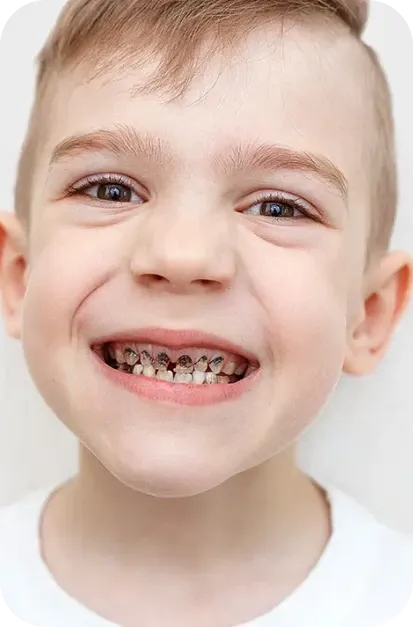
Signs of tooth decay in children include white or chalky spots on the tooth surface, light brown or yellow discoloration near the gumline, sensitivity to sweet or cold foods, visible holes or pits in the enamel, and pain when chewing. Tooth decay, also called dental caries, is the most common chronic disease in children, according to the National Institute of Dental and Craniofacial Research (NIDCR). The good news is that catching these signs early gives parents the best chance to protect their child’s smile before real damage sets in. This article walks through every sign parents need to watch for, what causes decay in baby teeth, what happens when it goes untreated, and exactly how to prevent it.

What Are the Signs of Tooth Decay in Children?

The signs of tooth decay in children are white spots on the enamel, brown or black discoloration, tooth sensitivity, visible holes or pitting, swollen or bleeding gums near a tooth, and persistent pain. These signs do not always show up at the same time. Tooth decay develops gradually, and the earliest warning signs are easy to miss if parents do not know what to look for.

White or chalky patches near the gumline are the first visible clue that enamel is losing minerals. Enamel loss at this stage has not yet formed a hole in the tooth. The tooth surface still looks smooth, but the color change signals that acid from bacteria has started to weaken the outer layer. A 2024 Oral Health Surveillance Report from the Centers for Disease Control and Prevention (CDC) found that approximately 11% of children aged 2 to 5 had at least one primary tooth with untreated decay. Many of those cases likely began with white spots that went unnoticed.

As decay moves past the white-spot stage, the tooth develops light brown or yellow bands closest to the gumline. Children may start to complain that certain foods hurt their teeth, or they may avoid chewing on one side of their mouth. These behavioral changes are just as important as the visual signs. A child who suddenly refuses hard or crunchy snacks may be reacting to dental problems that are not yet visible to the eye.

Visible holes, pitting, or dark brown to black spots on a tooth indicate that decay has broken through the enamel surface. At this point, the cavity cannot heal on its own. Pain, swelling, or a bad taste in the mouth may follow. According to data from the NIDCR, about 42% of children ages 2 to 11 develop at least one cavity in their primary teeth. The key for every parent is learning to spot decay before it reaches the stage where a filling or more involved treatment becomes necessary.

What Is the First Stage of Tooth Decay in Children?

The first stage of tooth decay in children is demineralization, which appears as white or chalky spots just below the surface of the enamel. Demineralization happens when acids produced by oral bacteria dissolve the calcium and phosphate minerals that give enamel its strength. The tooth has not formed a cavity at this stage. The surface is still intact, and the damage is still reversible with proper care.

Demineralization occurs every time a child eats or drinks something containing sugar or starch. Bacteria in the mouth, particularly Streptococcus mutans, feed on those sugars and release acid as a byproduct. That acid pulls minerals out of the enamel in a process dental professionals call an “acid attack.” Saliva works as the body’s natural repair system by washing away food particles and delivering calcium and phosphate back to the tooth surface. This mineral replacement process is called remineralization.

Remineralization and demineralization happen in a constant cycle throughout the day. The problem begins when the acid attacks happen more often than the saliva can repair. Frequent snacking, sipping on juice throughout the day, or going to bed without brushing gives bacteria a steady supply of sugar and tips the balance toward mineral loss. Over time, those repeated acid attacks create the white spots that mark the first stage of decay. Fluoride accelerates the remineralization process. According to a Cochrane Review of 22 trials involving over 12,400 children, fluoride treatments reduced decay on baby teeth by 37% and on permanent teeth by 43%.

What Are the Three Early Signs of Tooth Decay?

The three early signs of tooth decay are white or chalky spots on the tooth near the gumline, light brown or yellow discoloration on the tooth surface, and sensitivity to sweet, hot, or cold foods and drinks.

White spots are the earliest visual marker. They appear because the enamel has lost minerals but has not yet developed a hole. These spots are especially common on the upper front teeth in toddlers and on the chewing surfaces of molars in school-age children. Parents can check for white spots by lifting the child’s upper lip and looking at the front teeth near the gum. The spots may look dull or matte compared to the shiny enamel around them.

Brown or yellow bands replace white spots when decay progresses. The discoloration deepens as more enamel breaks down. According to Johns Hopkins Medicine, tooth decay first appears as white spots, then turns light brown, and progressively becomes darker as the cavity grows. This color progression from white to brown to dark brown or black serves as a reliable visual timeline for parents to gauge severity.

Sensitivity often accompanies the visual changes. When enamel thins, the dentin layer underneath becomes more exposed. Dentin contains tiny tubes that connect to the nerve inside the tooth, called the pulp. Sweet foods, cold drinks, and even cold air can trigger discomfort through those tubes. A child who winces while eating ice cream or pulls away from cold water is showing a sign that enamel protection has been compromised. We see this frequently in children who eat sticky or sugary snacks between meals without brushing afterward.

What Does Tooth Decay Look Like as It Gets Worse?

Tooth decay looks progressively darker and deeper as it moves through five distinct stages. Each stage produces different visual markers, different levels of discomfort, and different treatment requirements. The table below breaks down each stage so parents can identify where their child’s tooth may fall on the spectrum.

StageWhat It Looks LikeReversible?Treatment Needed
1. DemineralizationWhite or chalky spots near the gumlineYesFluoride application, improved brushing, diet changes
2. Enamel decayLight brown or yellow discoloration, surface roughnessNoDental filling (direct restoration)
3. Dentin decayDark brown spots, sensitivity to temperatureNoDental filling or dental crown
4. Pulp involvementDeep dark cavity, persistent throbbing painNoPulp treatment or extraction
5. AbscessBrownish-black stump, swelling in the gum, pus, feverNoEmergency care, extraction

Sources: Johns Hopkins Medicine, Better Health Channel (Victoria, Australia), WebMD Stages of Tooth Decay, Oral-B Stages of Tooth Decay

The critical takeaway from this progression is that only Stage 1 is reversible. Once a cavity breaks through the enamel surface in Stage 2, the tooth cannot repair itself. Every stage after that requires professional dental treatment. This is why recognizing the white-spot stage gives parents the greatest opportunity to stop decay before it becomes a permanent problem.

Is It Normal for a 7 Year Old To Have Cavities?

Yes, it is common for a 7 year old to have cavities, but cavities are not inevitable. The CDC reports that by age 9, half of all children in the United States have experienced at least one cavity in their primary or permanent teeth. Among children aged 6 to 8, over 52% have had a cavity in their baby teeth, according to data from the NIDCR. These numbers show that tooth decay is widespread, but they also show that nearly half of children in that age range have no cavities at all.

Children around age 6 to 7 face a unique risk window. Their first permanent molars, often called “six-year molars,” erupt around this time. These molars have deep grooves and pits on their chewing surfaces that trap food particles and bacteria. A child’s brushing skills at age 7 are still developing, and those deep grooves are difficult to clean even with good technique. The CDC found that nearly 18% of children aged 6 to 8 had at least one untreated decayed primary tooth. Children from lower-income households faced even higher rates, with 24.6% having untreated decay compared to 10.9% in higher-income households.

Having a cavity does not mean a child has poor parents or bad genetics. Many factors contribute to decay risk, including diet, brushing habits, saliva composition, and access to pediatric dentistry services. What matters most is how quickly the cavity is identified and treated.

What Causes Tooth Decay in Baby Teeth?

Tooth decay in baby teeth is caused by bacteria that produce acid when they feed on sugars left on the tooth surface. The primary bacterium responsible for cavities is Streptococcus mutans. This bacterium converts sugars and starches from food into lactic acid. Lactic acid dissolves the mineral structure of tooth enamel, creating the conditions for a cavity to form.

Several factors increase the risk of decay in baby teeth:

  • Poor oral hygiene that allows plaque, a sticky film of bacteria and food particles, to build up on the tooth surface and harden into tarite (calculus)
  • A diet high in sugary snacks, fruit juices, flavored milk, and sticky foods like gummy candies that provides constant fuel for acid-producing bacteria
  • Frequent snacking or sipping on sugary drinks throughout the day, which gives saliva less time to neutralize acids and repair enamel between eating sessions
  • Low fluoride exposure from water, toothpaste, or professional treatments, which limits the enamel’s ability to remineralize after acid attacks
  • Reduced saliva flow, which can result from mouth breathing, certain medications, or dehydration, lowering the mouth’s natural defense against acid

Baby bottle tooth decay, also known as early childhood caries (ECC), is a particularly aggressive form of decay that affects infants and toddlers. ECC develops when a baby falls asleep with a bottle of milk, formula, or juice. As the child sleeps, the liquid pools around the upper front teeth. Saliva flow drops during sleep, so the natural repair process slows down. The sugars in the liquid feed bacteria for hours. According to the World Health Organization (WHO), more than 530 million children worldwide have untreated caries in their primary teeth, and ECC is a major contributor to that number.

How Does Sugar Cause Tooth Decay in Children?

Sugar causes tooth decay in children by feeding the bacteria in dental plaque, which then produce acid that dissolves tooth enamel. The process works like a chain reaction. A child eats a cookie or drinks a glass of juice. Sugar from that food lands on the tooth surface. Bacteria in the plaque consume the sugar within minutes. Those bacteria release acid as a metabolic waste product. The acid lowers the pH in the mouth and begins pulling calcium and phosphate out of the enamel.

Each acid attack lasts roughly 20 to 30 minutes after eating. Saliva gradually brings the mouth’s pH back to a neutral level and delivers minerals back to the enamel. This recovery period is why frequency of sugar exposure matters more than total amount. A child who sips on juice for an hour creates a continuous acid bath on their teeth. A child who drinks the same amount of juice in five minutes with a meal gives their saliva a chance to recover. The National Institute of Dental and Craniofacial Research (NIDCR) emphasizes that limiting between-meal snacks reduces the number of acid attacks on teeth and gives enamel time to repair itself.

Why Do Children’s Teeth Decay Faster Than Adults?

Children’s teeth decay faster than adult teeth because the enamel on baby teeth is thinner, softer, and less mineralized than the enamel on permanent teeth. Baby tooth enamel measures roughly half the thickness of permanent tooth enamel. Thinner enamel means acid can break through to the softer dentin layer underneath more quickly. Once acid reaches the dentin, decay spreads faster because dentin is less resistant to acid than enamel.

Children’s brushing skills also play a role. Most children cannot brush their teeth effectively by themselves until around age 7 or 8. Younger children tend to miss the back molars, the gumline, and the spaces between teeth. These are the exact areas where plaque accumulates most heavily and where cavities are most likely to form. The American Academy of Pediatric Dentistry recommends that parents brush their child’s teeth or supervise brushing until the child can reliably do it alone.

Diet habits add another layer of risk. Children consume sugary snacks and drinks more frequently than adults. Sticky snacks like fruit gummies, raisins, and crackers cling to tooth surfaces longer than foods that dissolve quickly. That prolonged contact gives bacteria more time to produce acid. Our Southwest Houston families often ask why their child got a cavity despite brushing every day. The answer is usually that snacking frequency, not just brushing, tipped the balance toward decay.

Can Tooth Decay in Baby Teeth Spread to Permanent Teeth?

Yes, tooth decay in baby teeth can spread to the permanent teeth developing underneath. Baby teeth serve as placeholders for the adult teeth that will eventually replace them. The roots of baby teeth sit directly above the developing permanent tooth buds inside the jawbone. When decay in a baby tooth advances deep enough to cause infection, that infection can reach the surrounding bone and damage the permanent tooth forming below it.

Severe infection in a baby tooth can cause discoloration, pitting, or enamel defects on the permanent tooth before it even erupts. Dentists call this condition Turner’s tooth, or Turner hypoplasia. Beyond direct infection, losing a baby tooth prematurely due to advanced decay creates spacing problems. Baby teeth hold the correct amount of space for permanent teeth to grow into. When a baby tooth is lost too early, the surrounding teeth shift into the gap. The permanent tooth then has less room to come in straight, which often leads to crowding and the need for orthodontic treatment later.

According to Indiana University School of Medicine, tooth decay in children is five times more common than asthma and seven times more common than hay fever. Treating decay in baby teeth early protects the permanent teeth that a child will use for the rest of their life. A small dental crown or filling on a baby tooth today can prevent far more complex treatment on a permanent tooth in the future.

What Happens If Tooth Decay Is Left Untreated in Children?

Untreated tooth decay in children leads to pain, infection, difficulty eating and speaking, missed school days, and potential damage to permanent teeth. A cavity that starts as a small hole in the enamel grows deeper over time. Once it reaches the dentin, the child may experience sharp pain when eating. Once it reaches the pulp, where the nerves and blood vessels live, the pain becomes constant and intense.

Infection from a decayed tooth can form an abscess, a pocket of pus at the root tip. An abscess causes swelling in the gum, face, or jaw. In rare but serious cases, the infection can spread to the bloodstream. The CDC reports that 34 million school hours are lost each year due to unplanned dental care, and the total cost of dental-related issues exceeds $45 billion annually in the United States. Research published in the American Journal of Public Health found that children with poor oral hygiene miss an average of 2.1 school days per year because of dental pain or emergencies.

Untreated decay also affects a child’s ability to eat nutritious food. A child with a painful tooth avoids chewing on that side, which limits their diet and can affect nutrition during critical growth years. Decay in the front teeth can impact speech development and self-confidence, especially in school-age children. When decay reaches the point where tooth extraction becomes the only option, the consequences extend to permanent tooth alignment, jaw development, and long-term dental costs.

Can Early Tooth Decay Be Reversed in Children?

Yes, early tooth decay can be reversed in children when it is caught at the white-spot stage before a cavity has formed. At the demineralization stage, the enamel has lost minerals but has not developed a physical hole. Fluoride treatments, improved brushing with fluoride toothpaste, reduced sugar intake, and professional dental care can restore lost minerals and harden the weakened enamel. This process, called remineralization, essentially heals the tooth from the inside out.

Fluoride works by binding to the enamel surface and attracting calcium and phosphate ions from saliva. The resulting mineral layer is actually more resistant to future acid attacks than the original enamel. A Cochrane Review of 22 clinical trials confirmed that fluoride varnish application reduces decay on primary teeth by 37% and on permanent teeth by 43%. For children under 3, a rice-grain-sized amount of fluoride toothpaste is recommended. Children aged 3 to 6 should use a pea-sized amount.

Once a cavity has formed and broken through the enamel surface, reversal is no longer possible. The tooth requires professional treatment, typically a filling or a dental bonding restoration, to remove the decayed material and seal the tooth. This distinction between reversible and irreversible decay is why regular dental checkups matter so much. A dentist can spot white-spot lesions that parents might miss and recommend fluoride treatment before a cavity develops.

How To Stop a Cavity From Spreading

The best way to stop a cavity from spreading is to see a dentist as soon as possible for a filling or other restoration. Once a cavity has broken through the enamel, it will continue to grow deeper into the dentin and eventually reach the pulp. No home remedy, toothpaste, or dietary change can close a hole that has already formed. Only a dental professional can remove the decayed tissue and seal the tooth with a filling material that prevents bacteria from re-entering.

While waiting for a dental appointment, parents can slow the progression of a cavity by keeping the child’s teeth as clean as possible. Brush twice a day with fluoride toothpaste, floss daily to remove food trapped between teeth, and limit sugary snacks and drinks. Rinsing with water after meals helps wash away food particles and dilute the acid in the mouth. Avoid giving the child sticky foods that cling to the tooth surface near the cavity.

According to the CDC, children aged 6 to 11 without dental sealants are three times more likely to develop cavities than children who have sealants. If a child has a cavity on one molar, sealing the remaining molars can prevent new cavities from forming on those teeth. We strongly encourage parents to bring their child in for a checkup at the first sign of discoloration, sensitivity, or pain rather than waiting for the problem to worsen. Early treatment for a small cavity takes less time, causes less discomfort, and protects the tooth from more serious damage.

How To Prevent Tooth Decay in Children

Preventing tooth decay in children requires a combination of proper brushing, a low-sugar diet, fluoride exposure, dental sealants, and regular children’s dental care visits. No single strategy works alone. Each layer of protection reinforces the others. The American Dental Association (ADA) and the CDC both recommend that prevention start as soon as the first tooth appears.

The following age-by-age prevention steps give parents a practical roadmap for protecting their child’s teeth from infancy through adolescence:

  1. Birth to 6 months: Wipe the baby’s gums with a clean, damp cloth after each feeding. This removes milk residue and bacteria before teeth even appear.
  2. 6 to 12 months (first tooth appears): Begin brushing with a soft infant toothbrush and a rice-grain-sized smear of fluoride toothpaste. Schedule the child’s first dental visit by their first birthday or within six months of the first tooth.
  3. Ages 1 to 3: Continue brushing twice daily. Never put a child to bed with a bottle of milk, formula, or juice. Transition from bottle to cup by age 12 months. Limit juice intake.
  4. Ages 3 to 6: Increase toothpaste to a pea-sized amount of fluoride toothpaste. Begin flossing when two teeth touch. Supervise brushing to make sure all surfaces are reached, especially back molars.
  5. Ages 6 to 8: Ask the dentist about dental sealants for the first permanent molars (six-year molars). Continue supervising brushing until the child demonstrates effective technique independently.
  6. Ages 8 to 14: Maintain twice-daily brushing and daily flossing. Apply sealants to second permanent molars when they erupt around age 12. Limit sugary sports drinks and sodas.

Diet management is equally important. The NIDCR recommends limiting between-meal snacks to reduce the number of acid attacks on teeth throughout the day. Water is the best beverage for teeth. Cheese, yogurt, nuts, and crunchy vegetables like carrots and celery are tooth-friendly snacks because they stimulate saliva production and do not cling to enamel surfaces. In our Houston practice, we see the biggest difference in decay rates among children whose parents manage snacking frequency, not just sugar quantity.

Do Dental Sealants Prevent Cavities in Children?

Yes, dental sealants prevent cavities in children by creating a protective barrier over the grooves and pits on the chewing surfaces of back teeth. Sealants are thin, plastic coatings that a dentist paints onto the molars. The sealant flows into the deep fissures on the tooth surface and hardens to form a smooth, sealed surface that food and bacteria cannot penetrate.

The CDC found that sealants prevent up to 80% of cavities in molars for two years after application and continue to protect against 50% of cavities for up to four years. The ADA reported that children who received both fluoride treatments and dental sealants were 73% less likely to develop cavities compared to children who received fluoride alone. Despite this strong evidence, only about 43% of children aged 6 to 11 in the United States have at least one dental sealant, according to CDC data.

Sealant application is quick, painless, and requires no drilling or anesthesia. The dentist cleans the tooth, applies an etching gel to roughen the surface slightly, rinses and dries the tooth, paints on the sealant liquid, and hardens it with a curing light. The entire process takes a few minutes per tooth. Sealants work best when applied shortly after the permanent molars erupt, around age 6 for first molars and around age 12 for second molars. We recommend sealants for every child as part of a complete cavity prevention plan.

Frequently Asked Questions

When Should a Child First See a Dentist?

A child should first see a dentist by their first birthday or within six months of the first tooth appearing, whichever comes first. The American Academy of Pediatric Dentistry (AAPD) recommends this early timeline because decay can begin as soon as teeth erupt. Early kids’ dental visits establish a baseline for the child’s oral health, catch potential problems before they develop, and help the child become comfortable with dental appointments at a young age.

How Often Should Children Visit the Dentist?

Children should visit the dentist every six months for a checkup and professional cleaning. Twice-yearly visits allow the dentist to catch early signs of decay, monitor tooth development, apply fluoride varnish, and assess whether sealants are needed. Children at higher risk for cavities may benefit from more frequent visits, which the dentist can recommend based on the child’s individual needs.

Can Cavities Be Passed From Parent to Child?

Yes, the bacteria that cause cavities, particularly Streptococcus mutans, can be passed from parent to child through saliva. Sharing utensils, tasting a child’s food before feeding, blowing on food to cool it, and cleaning a pacifier in a parent’s mouth are all common ways bacteria transfer. Babies are born without cavity-causing bacteria in their mouths. Transmission from caregivers introduces these bacteria, which then colonize the child’s teeth once they erupt.

Are Baby Teeth Cavities Worth Fixing?

Yes, baby teeth cavities are worth fixing. Baby teeth hold space for permanent teeth to grow into the correct position. Losing a baby tooth too early from untreated decay causes surrounding teeth to shift, leading to crowding and misalignment of permanent teeth. Untreated cavities can also cause pain, infection, difficulty eating, and speech problems. Fixing a small cavity in a baby tooth prevents more serious and more expensive problems later.

What Foods Cause the Most Tooth Decay in Children?

The foods that cause the most tooth decay in children are sticky candies, gummy snacks, fruit juice, soda, flavored milk, cookies, cakes, and starchy snacks like crackers and chips. Sticky foods cling to tooth surfaces for extended periods, giving bacteria more time to produce acid. Sugary drinks that are sipped over long periods create continuous acid exposure. The NIDCR recommends saving sugary foods for mealtimes and choosing water between meals.

How Much Fluoride Toothpaste Should a Child Use?

Children under 3 years old should use a smear of fluoride toothpaste about the size of a grain of rice. Children aged 3 to 6 should use a pea-sized amount. These amounts provide enough fluoride to strengthen enamel while minimizing the risk of dental fluorosis, a cosmetic condition that can occur if young children swallow excessive fluoride during the tooth-forming years. Parents should supervise brushing and encourage spitting rather than swallowing.

What Is Early Childhood Caries?

Early childhood caries (ECC) is a severe form of tooth decay that affects infants and children under 6 years old. ECC typically begins on the upper front teeth and progresses rapidly. It is strongly associated with prolonged bottle feeding, especially at bedtime, and frequent exposure to sugary liquids. The WHO identifies ECC as a major global public health concern, with over 530 million children worldwide affected by untreated caries in primary teeth.

Putting It All Together

Tooth decay in children is common, but it does not have to be inevitable. The signs start small, with white spots that most parents would never notice without knowing what to look for. From there, decay follows a predictable path, from discoloration to sensitivity to visible cavities to pain. Every step along that path is a chance to intervene. Catching decay at the white-spot stage means it can still be reversed. Catching it after a cavity forms means a quick filling can stop the damage. Waiting until a child is in pain means the treatment becomes more involved, more costly, and harder on the child.

Regular dental visits, daily brushing with fluoride toothpaste, sealants on permanent molars, and smart snacking habits form the strongest defense against childhood tooth decay. If you notice any changes in your child’s teeth or your child complains about sensitivity or pain, we are here to help. Bright Value Dental welcomes children of all ages, and Dr. Yu and our team make every visit comfortable and stress-free.

Call us at 713-668-1600 to schedule your child’s next checkup.

Appointments